
Every B2B tech executive now has a LinkedIn presence, a set of recurring talking points about AI and disruption, and a content team that helps them publish regularly. That collective effort has produced an unintended side effect: thought leadership saturation. LinkedIn feeds, company blogs, podcasts, and owned media channels are flooded with executive content that largely covers the same ground, which means the sheer volume of executive thought leadership no longer correlates with actual influence.
This creates a real strategic problem for B2B communications teams. Publishing more executive content used to be a reasonably safe way to build visibility. In a saturated market, more content without greater specificity just adds to the noise everyone else is already contributing.
The discomfort this creates inside communications teams is real and worth naming directly. The instinct when content stops performing is usually to produce more of it, faster. In a saturated market, that instinct makes the underlying problem worse, not better, because it adds volume to a category that already has more content than genuine differentiation.
Quick Takeaway
- Thought leadership saturation means executive content volume has outpaced executive content distinctiveness. Most leaders now publish regularly, but most of it covers the same ground in similar language. What still cuts through, according to recent communications research, is original thinking, specific lived experience, data-backed insight, and an authentic voice that includes real lessons learned, not just polished opinions. The fix isn’t publishing less or more. It’s auditing for which of those four traits is actually present.
What Thought Leadership Saturation Actually Looks Like
Saturation shows up as a specific, recognizable pattern: executives summarizing industry trends rather than making a specific claim, repeating widely accepted opinions instead of contributing an original one, and discussing innovation in language broad enough to apply to almost any company in almost any sector. None of that content is necessarily badly written. It’s simply interchangeable, which, at scale, is functionally the same as invisible.
A useful way to spot it in your own feed: scroll past ten executive posts from ten different companies in the same category, and count how many you could confidently reattribute to the wrong author without anyone noticing the swap. In a saturated market, that number is usually higher than most communications teams would like to admit.
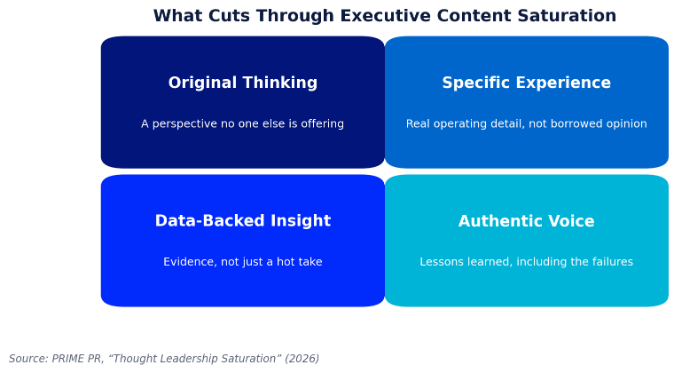
Figure 1: The four traits that cut through executive content saturation.
Why More Executive Content Hasn’t Meant More Influence
The logic that drove most companies into this saturated market made sense at the time: thought leadership builds trust, more content builds more trust, so more executive content should build more trust faster. That logic breaks down once every competitor reaches the same conclusion simultaneously. When the entire category publishes at high volume with similar talking points, individual pieces stop differentiating anyone, and the market collectively produces more content with less aggregate influence than a smaller number of genuinely distinctive pieces would have generated.
This matters especially in technical, complex markets like AI, cybersecurity, and infrastructure, where executive authority directly shapes enterprise buyer trust. In those categories, visibility without real differentiation creates very little strategic value, because a buyer comparing five similar-sounding executive opinions has no real basis to prefer one company’s leadership over another’s.
There’s a useful parallel to advertising clutter here. Just as a buyer eventually stops noticing any individual ad in a sufficiently crowded feed, a buyer eventually stops attributing any individual executive post to a specific company once enough of those posts say roughly the same thing in roughly the same voice.
The teams that recognize this earliest tend to be the ones already getting direct, unfiltered feedback from sales about which executive content actually comes up in real buyer conversations, which is usually a much smaller, more specific list than the full publishing calendar would suggest.
What Cuts Through the Noise, According to the Data
Recent communications research identifies a consistent pattern in the executive content that still earns real attention amid the saturation: original thinking that offers a perspective genuinely not already available elsewhere; specific, lived operational experience rather than borrowed industry opinion; data-backed insight instead of a general hot take with no evidence behind it; and an authentic voice willing to discuss real lessons learned, including outright failures, not just a curated highlight reel of success.
A Framework for Auditing Your Own Executive Content
Most communications teams can run this audit on their own existing content library without outside help. The table below shows what to check for.
| Trait | Audit Question | Red Flag |
| Original thinking | Could a competitor publish this exact piece under their own name? | Yes, with no changes needed |
| Specific experience | Does this reference a real situation, or only general industry observations? | No named example or operational detail anywhere |
| Data-backed insight | Is there evidence behind the claim, or just an asserted opinion? | Zero data points, studies, or named sources |
| Authentic voice | Does this admit any real complexity, tension, or failure? | Reads as entirely polished with no genuine vulnerability |
Mistakes That Add to the Saturation Instead of Escaping It
Most executive content doesn’t fail because of poor writing, it fails because of a few avoidable habits:
These habits are seductive precisely because each one feels like a reasonable, low-risk editorial choice in the moment. Stacked together across a year of publishing, they’re what quietly turns a leadership team’s content into something indistinguishable from everyone else’s.
- Starting every piece from the latest industry trend report instead of the executive’s own specific experience
- Editing out anything that sounds uncertain or imperfect, which removes the authenticity that builds real trust
- Publishing on a fixed schedule regardless of whether there’s a genuinely new point to make that week
- Avoiding any claim specific enough that someone could disagree with it
- Measuring success in post frequency or impressions instead of inbound interest, analyst attention, or sales team usage of the content
THP’s Take: Specificity Is the Scarce Resource Now
THP Studio Perspective
- Volume used to be the scarce resource in B2B thought leadership. Not everyone could produce content consistently. That’s no longer true; production is cheap and abundant. What’s scarce now is a genuinely specific point of view backed by real experience and evidence, because that requires an actual person to have a real opinion worth defending, which can’t be manufactured at scale the way content volume can.
- If a leadership team can only commit to one change this year, we’d suggest this: before publishing the next piece, ask whether it would survive being read aloud in a room of the company’s sharpest competitors. If the honest answer is that no one in that room would learn anything or disagree with anything, it’s not ready yet.
Frequently Asked Questions
Key Takeaways
- Thought leadership saturation means executive content volume has outpaced its distinctiveness across most of the B2B tech market.
- More executive content hasn’t translated into more influence, because most of it covers similar ground in similar language.
- What cuts through, per recent research: original thinking, specific lived experience, data-backed insight, and an authentic voice that includes real failures.
- Audit existing executive content against those four traits rather than assuming more volume will eventually break through.
- Specificity, not production volume, is now the scarce resource that actually differentiates executive thought leadership.
Work With THP’s PR & Media Profiling Studio
- THP’s PR & Media Profiling Studio audits existing executive content for real distinctiveness, then builds the interview process and editorial discipline needed to keep publishing something worth reading. If your last quarter of executive posts could have come from any competitor, that’s the starting point for this work.
Author