Four-stage frameworks are easy to remember and easy to misapply. Teams learn the stage names, map their existing work onto them, and conclude they were doing Loop Marketing all along. Usually they were not, because the difference is in what actually crosses between the stages.
This article walks through each stage as HubSpot defines it, what the work looks like in a B2B context, where each stage typically breaks, and how the output of one becomes the input of the next. For the wider picture, including the evidence behind the framework, start with our guide to HubSpot Loop Marketing.
Quick Takeaway
- The stages are not the framework. The handoffs are. Express produces the guides that Tailor personalizes from, Tailor produces the variants Amplify distributes, Amplify produces the signals Evolve reads, and Evolve rewrites what Express does next. Break one handoff and you have four disconnected activities.
The Framework Is a Cycle Built on Three Foundations
The HubSpot Loop Marketing framework is a four-stage cycle, Express, Tailor, Amplify and Evolve, run against a single objective, in which humans and AI work together and each cycle’s learning improves the next.
On its Loop Marketing playbook page, HubSpot names three foundations to have in place first: a customer guide, a style guide and a data layer. The company frames these as what gives AI the context to sound like you rather than everyone else, and says that once the foundations exist, the Loop applies to any objective, from awareness to email open rates to a product launch.
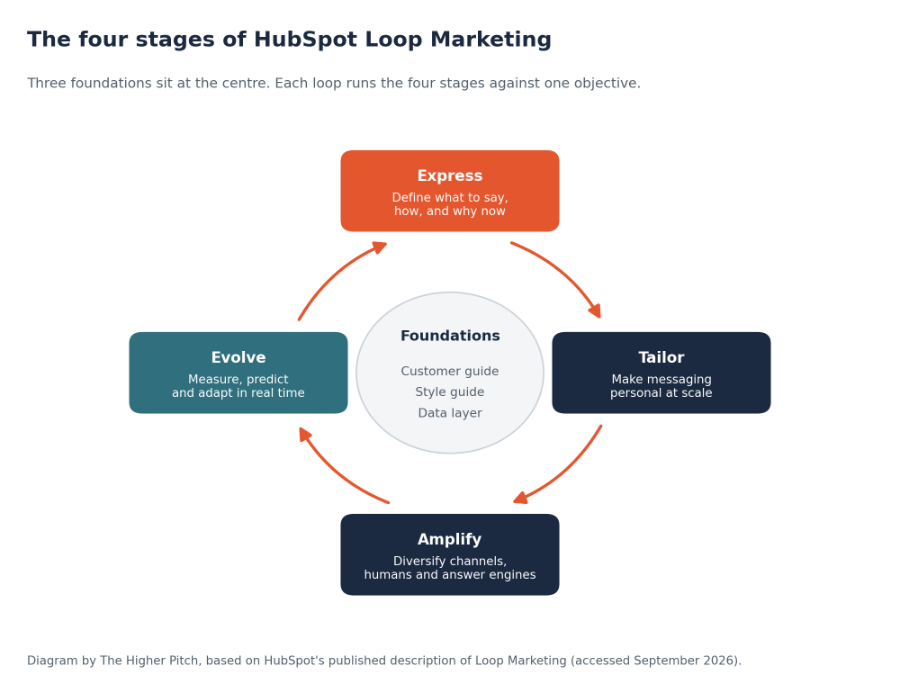
Figure 1: The four stages and three foundations. Diagram based on HubSpot’s published description.
The worked example (hypothetical). Throughout this article we follow an illustrative company selling predictive maintenance software to manufacturing operations teams. It is not a client. Its objective for a first loop is to generate qualified conversations with plant operations leaders in food and beverage manufacturing.
Stage 1: Express, Where You Decide What Only You Can Say
HubSpot describes Express as defining your taste, tone and point of view before bringing in AI, and says brand identity and deep customer understanding are what separate great content from generic content. The playbook breaks the stage into generating the campaign story, creating the core asset the campaign drives traffic to, and planning how the story appears across formats and channels.
Defining Brand Voice, ICP and Point of View
Three documents come out of this stage, and they should be written to be used rather than admired.
| Document | What it must contain | The test of a good one |
| Customer guide | Target company characteristics, personas, buying committee roles, pain points and goals | Someone outside marketing could use it to judge whether a lead fits |
| Style guide | Voice, positioning, messaging pillars, values and the things you will not claim | An AI tool briefed with it produces copy your team recognizes |
| Point of view | What you believe about the problem that a competitor would argue with | A reasonable competitor could not sign it |
Table 1: The three Express outputs.
The third is the one teams skip, and it is the one that matters most once AI is producing volume. A point of view that everyone in the category could state is not a point of view. We covered this problem in B2B thought leadership’s sameness problem, and giving leaders a distinctive voice is the subject of our executive ghostwriting playbook.
Where Express breaks: producing a style guide that describes tone (“professional yet approachable”) without positioning. Tone guidance makes AI output smoother; positioning makes it different.
Worked example: the company’s point of view is that most predictive maintenance programs fail because plants instrument the wrong assets first, not because their models are weak. The core asset is a guide to choosing which lines to instrument, written for operations leaders rather than data teams.
HubSpot tools mapped here: Brand Identity (beta), Breeze Assistant and Marketing Studio (beta).
Stage 2: Tailor, Where Messaging Becomes Personal Rather Than Personalized
HubSpot sets the bar for this stage explicitly: experiences that feel more “how did they know?” and less “Dear {First Name}”, built from unified data including CRM records, call transcripts and website behaviour. The playbook describes building audience segments from enriched data and intent signals, generating content that adjusts by industry, role, stage and time of day, and keeping human quality checks so AI maintains accuracy while your judgment is applied.
Using CRM Data and AI for Personalization
The practical sequence is:
- Define segments that change the message, not just the salutation. Industry, role in the buying committee, stage and trigger event usually earn their place; job title alone rarely does.
- Decide what actually varies between segments: the problem framed, the proof used, the objection answered.
- Generate variants from the style guide, so every version sounds like the same company.
- Review before publishing. HubSpot names human quality checks as part of the stage, which is a useful thing to hold teams to.
Where Tailor breaks: CRM data. Duplicates, overwritten original sources and inconsistent lifecycle stages make segments unreliable, and AI will act on them confidently. If segments cannot be trusted, start with broader ones you can defend and tighten as data improves. Our piece on the signs your CRM data is holding back growth is the practical starting point.
Worked example: three segments, each with a different opening problem: plant operations leaders (unplanned downtime), maintenance managers (technician time), and finance (capital versus operating spend on a line nearing end of life).
HubSpot tools mapped here: AI-Powered Segmentation (beta), Personalization (beta) and AI-Powered Email (beta).
Stage 3: Amplify, Where the Work Is Discovery, Not Publication
HubSpot’s description of Amplify is that publishing great content is not enough, because customers are asking ChatGPT, watching YouTube, trusting creators, skimming G2 and Reddit, turning to communities and texting friends. The stage covers optimizing for answer engines, remixing content into the formats each channel expects, and combining targeted ads with partnerships with subject matter experts your audience already trusts.
Reaching Buyers Across Search, AI, Social and Emerging Channels
Three distinct activities live here, and they need different owners:
- Format remixing: one core asset becomes a webpage, a short video, a carousel, an email series and a briefing for sales. This is where AI saves the most time.
- Answer engine visibility: making sure your material is the kind AI systems draw on, and tracking whether they do. Our Loop Marketing and AEO guide covers this properly.
- Third-party presence: review sites, communities, creators and analysts. This is the slowest to build and the hardest for competitors to copy.
Where Amplify breaks: treating it as distribution. Posting the same asset to more channels is republishing, not amplification. The stage only works if each channel gets a format its audience actually consumes.
Worked example: the guide becomes a technical webinar for maintenance managers, a short line-walk video for LinkedIn, an FAQ page structured around the questions operations leaders ask, and a briefing note the sales team uses in discovery.
HubSpot tools mapped here: HubSpot AEO (beta), Marketing Studio (beta) and Video Marketing.
Stage 4: Evolve, Where Learning Turns Into the Next Loop
HubSpot describes Evolve as a live feedback loop: predicting which customers and campaigns are likely to convert before publishing, monitoring engagement and conversion signals as they happen, running rapid experiments on headlines, offers and audiences, and applying each learning to creative, targeting and spend.
Using Data and AI to Optimize in Real Time
What makes this stage real rather than rhetorical is a decision rhythm. Three things need naming before the loop starts:
- What gets reviewed, and when. A weekly slot with named attendees beats a dashboard nobody opens.
- What counts as a result worth acting on, so the team is not chasing noise in small samples.
- Who can change what without approval. If every change needs sign-off, the cadence will be quarterly regardless of the tooling.
Where Evolve breaks: optimizing the loop’s inputs. Faster content and more experiments are easy to improve and easy to mistake for progress. Our Loop Marketing metrics guide covers how to keep the scorecard honest.
HubSpot tools mapped here: the ChatGPT Deep Research Connector, Email Engagement Optimization (beta) and Marketing Analytics.
How Each Stage Feeds the Next
| Handoff | What crosses over | What it looks like when it fails |
| Express to Tailor | The style guide, customer guide and core asset | Personalization applied to content with no point of view |
| Tailor to Amplify | Segment definitions and message variants | One generic asset pushed to every channel |
| Amplify to Evolve | Channel performance, AI visibility and citation data | Reporting on reach with nothing that changes behaviour |
| Evolve to Express | What resonated, what to stop, what to say next | A new campaign started from a blank page |
Table 2: The four handoffs, which are where the framework actually lives.
The last row is the one that turns a campaign into a loop. If the next Express stage starts from a blank page rather than from what the previous loop learned, you have run a campaign with new stage names.
A B2B Loop Marketing Example, End to End
Following the worked example through one full cycle:
Express. The team writes the point of view about instrumenting the wrong assets first, and publishes the selection guide as the core asset.
Tailor. Three segments get three framings of the same argument, drawn from the same style guide, with sales-call language informing the wording for each role.
Amplify. The guide is remixed into a webinar, a short video, an FAQ page and a sales briefing. AEO tracking begins on a small set of prompts that operations leaders plausibly ask.
Evolve. Two findings emerge. First, the finance framing outperforms the others in email, which nobody expected. Second, AI answers about predictive maintenance selection cite two analyst sites and a community forum, none of which mention the company.
The next loop’s Express stage starts from those findings: the capital-versus-operating-cost argument becomes the core asset, and third-party presence moves onto the plan. That is a loop rather than a campaign.
The full build sequence is in how to build a HubSpot Loop Marketing strategy, and the comparison with funnel-based planning is in Loop Marketing vs the marketing funnel.
THP Studio Perspective
- The stage most B2B teams will get wrong is Express, and not for lack of effort. Teams produce a style guide describing tone and call it done, because tone is comfortable to agree on and positioning is not. The result is AI output that sounds polished and says nothing a competitor could not say. Our advice is blunt: before running a single loop, write one sentence stating what you believe about your customers’ problem that a competitor would dispute. Without that sentence, the framework is machinery with no direction.
Frequently Asked Questions
Key Takeaways
- Judge your implementation by the handoffs between stages, not by whether the stage names appear in your plan.
- Write a point of view a competitor would dispute, because tone guidance alone will not differentiate AI-assisted output.
- Expect the Tailor stage to expose CRM data problems; start with broader segments you can defend.
- Treat Amplify as format and discovery work, not as posting the same asset in more places.
- Give Evolve a decision rhythm with named attendees and clear authority, or the cadence stays quarterly whatever the tooling.
Work With THP’s Content & Communications Studio
- THP’s Content & Communications Studio builds B2B content strategy, positioning and thought leadership, which is the work the Express stage depends on. If your team is ready to run loops but the point of view is not settled, that is the place to start.
Author