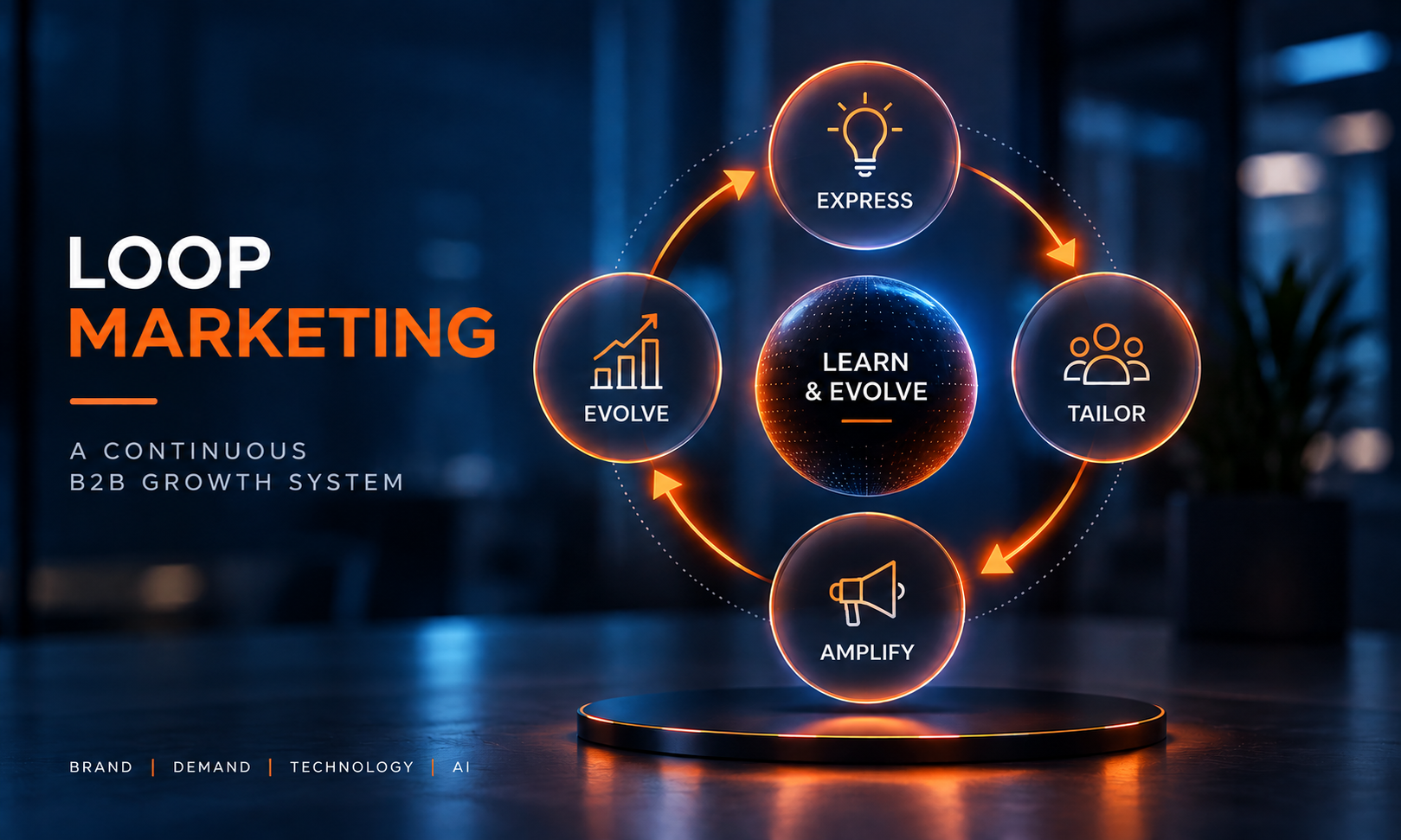

What Is Loop Marketing?
B2B marketing has become harder to manage.
Buyers now move across search, AI tools, social media, websites, communities, email, events and sales conversations before they ever speak with a company. Marketing teams are also expected to create more content, personalize more experiences and prove revenue impact.
A traditional funnel can still help explain the buying journey. But the funnel alone does not capture how modern B2B buyers behave.
This is where Loop Marketing comes in.
Loop Marketing is a continuous marketing approach built around four connected movements:
Express → Tailor → Amplify → Evolve
Instead of treating marketing as a series of campaigns that start, run and end, Loop Marketing creates a system that learns from customer behavior and uses those insights to improve the next marketing action.
In simple terms:
Traditional marketing asks, “What campaign should we run?” Loop Marketing asks, “What did we learn, and what should we do next?”
For B2B companies with complex products, long sales cycles and multiple decision-makers, that shift can be especially valuable.
Why B2B Companies Need a Different Marketing Model
B2B buying journeys are rarely linear.
A potential buyer might:
- Discover your company through an AI search result.
- Read an article or LinkedIn post.
- Compare you with competitors.
- Visit your website several times.
- Download a resource.
- Speak with a salesperson.
- Return to your website months later.
- Ask colleagues for recommendations.
- Re-enter through a completely different channel.
Yet many marketing organizations still operate in disconnected cycles:
Campaign → Leads → Report → End
Then the next quarter begins from scratch.
The problem is not necessarily a lack of marketing activity. It is often a lack of connection between activity, customer signals and the next decision.
Loop Marketing addresses that gap by making learning part of the operating model.
The Four Stages of Loop Marketing
1. Express: Make Your Story Clear
The first stage is Express.
Before you personalize or distribute anything, your company needs a clear point of view.
Express is about defining:
- Who you are
- Who you serve
- What problem you solve
- Why your approach is different
- What your brand should stand for
- How your brand should sound and look
- What core campaign or content asset communicates the story
For B2B companies, this matters because complex offerings often produce complicated messaging.
An IT services company may offer cloud, cybersecurity, data, AI and digital transformation services. A SaaS company may have dozens of features and use cases.
The buyer, however, does not want to decode your organization chart.
They want to understand:
“Is this relevant to my problem, and why should I trust you?”
A strong Express stage turns complex capabilities into a clear, memorable story.
Example
Instead of:
“We provide end-to-end digital transformation services across cloud, data, AI and enterprise technology.”
A stronger expression might focus on the business outcome:
“We help technology companies turn complex capabilities into growth.”
The exact message will vary by company, but the principle is consistent: clarity comes before scale.
2. Tailor: Make the Experience More Relevant
Once the story is clear, the next question is:
Does every buyer experience the same message?
The answer should not always be yes.
Tailor is about using available customer, CRM and behavioral signals to make marketing more relevant.
Signals can include:
- Industry
- Company size
- Role
- Previous interactions
- Content consumed
- Website behavior
- Buying stage
- Campaign engagement
- Sales activity
- Intent signals
For example, a cybersecurity company could create different experiences for:
- A CISO researching security strategy
- A CTO evaluating technical architecture
- A CFO evaluating investment and risk
- A security operations leader looking for implementation support
The underlying brand story stays consistent.
The experience changes according to the buyer.
Tailoring does not mean creating hundreds of pages. The goal is not personalization for its own sake. The goal is to use meaningful signals to answer:
“What does this buyer need to see next?”
That can influence website content, email, offers, ads, CTAs, nurture journeys and sales enablement.
3. Amplify: Take the Message Where Buyers Are
Great marketing does not create demand simply by publishing content.
The message has to reach the places where buyers actually discover and evaluate companies.
That is the role of Amplify.
This can include:
- Organic search
- AI search and answer engines
- Paid media
- Communities
- Events and webinars
- Industry publications
- Partnerships
- Subject-matter experts
- Sales outreach
For B2B companies, this is increasingly important because discovery is fragmented.
One buyer might search Google. Another might ask an AI tool. Another might see a LinkedIn post. Another might hear about you from a peer.
Your marketing system needs to be visible across the discovery points that matter to your ICP.
The key is not “be everywhere.”
It is:
Be present where your ideal buyers are looking for answers.
Amplification should therefore be driven by ICP, buyer behavior and performance data—not by a checklist of channels.
4. Evolve: Turn Marketing Into a Learning System
This is where Loop Marketing becomes fundamentally different from a campaign-only approach.
Evolve means using performance and customer feedback to improve what happens next.
Instead of asking only:
“Did the campaign generate leads?”
you start asking:
- Which message attracted the right audience?
- Which content influenced engagement?
- Which pages helped conversion?
- Which audience segments responded?
- Which channels produced qualified opportunities?
- Where did buyers drop out?
- What questions are prospects repeatedly asking?
- What did sales learn from conversations?
- What should we change in the next cycle?
Then those insights feed back into the system.
The loop becomes:
Express → Tailor → Amplify → Evolve → Express again
The next campaign does not begin from zero.
It begins with what the previous cycle taught you.
Loop Marketing vs. Traditional Funnel Marketing
The funnel is still useful. It helps marketers understand movement from awareness to consideration, conversion and revenue.
But a funnel tends to describe a one-way progression.
A loop introduces another dimension:
Learning.
| Traditional Campaign Model | Loop Marketing |
|---|---|
| Campaign-led | Customer-signal-led |
| Starts with a plan | Starts with a clear story and buyer understanding |
| Pushes messages through channels | Adapts experiences and distribution |
| Measures campaign performance | Continuously learns from performance |
| Campaign ends | Insights feed the next cycle |
| Optimization often happens periodically | Optimization is built into the process |
This does not mean replacing every existing marketing process.
It means connecting those processes into a system that can learn.
A Simple B2B Loop Marketing Example
Imagine an IT services company wants to generate more demand for its cloud modernization services.
Express
The company develops a clear position around helping enterprises modernize legacy environments without disrupting business operations.
It creates:
- Core positioning
- Messaging
- A flagship guide
- Supporting thought leadership
- Website messaging
Tailor
The company identifies different audiences:
- CIOs
- CTOs
- IT Directors
- Digital Transformation leaders
The website, content offers and nurture journeys are adjusted according to audience needs and engagement.
Amplify
The company distributes the message through:
- Google Search
- AI-search-friendly content
- Industry communities
- Webinars
- Sales outreach
Evolve
The team reviews:
- Which topics attract qualified visitors
- Which audiences engage
- Which pages convert
- Which leads become opportunities
- What sales hears in conversations
The insights then influence the next content, messaging and campaign cycle.
That is the loop.
What Makes Loop Marketing Especially Relevant for B2B?
1. B2B Buyers Need More Than One Touchpoint
High-value B2B purchases rarely happen after one ad or one website visit.
Loop Marketing recognizes that buyers may interact with a company repeatedly across different channels.
2. Complex Products Need Context
Technology and professional services companies often sell complicated solutions.
Tailoring allows the company to give different buyers the context they actually need.
3. AI Is Changing Discovery
Buyers increasingly use AI-powered tools to research companies, problems and solutions.
That means B2B marketing needs to think beyond traditional rankings and clicks.
Content should be structured around the questions buyers ask and the expertise they need.
4. Marketing Data Is More Valuable When It Changes Decisions
Analytics should not simply produce dashboards.
The real value comes when customer and performance data changes:
- Messaging
- Content
- Targeting
- Offers
- Channels
- Website experiences
- Sales follow-up
That is the Evolve stage in action.
What Does a Loop Marketing Strategy Include?
A practical Loop Marketing strategy can include six connected components.
1. Positioning and Story
Define your audience, problem, point of view and differentiation.
2. Buyer and Customer Understanding
Map ICPs, personas, buying triggers, objections and information needs.
3. Personalized Experiences
Use segmentation and behavioral signals to make experiences more relevant.
4. Multi-Channel Distribution
Build a deliberate presence across search, AI discovery, social, paid, email, communities and sales channels.
5. Measurement
Track not only traffic and leads, but engagement, conversion, qualified pipeline and revenue influence.
6. Continuous Optimization
Create a repeatable process for turning customer and performance insights into the next marketing decision.
How to Start Loop Marketing in Your B2B Company
You do not need to rebuild your entire marketing operation overnight.
Start with one business priority.
Step 1: Choose One Growth Problem
For example:
- Increase qualified leads
- Improve conversion
- Enter a new market
- Differentiate from competitors
- Improve AI/search visibility
- Increase demand for a specific service
Step 2: Define Your Core Buyer
Identify:
- ICP
- Key decision-makers
- Buying triggers
- Pain points
- Questions
- Objections
- Preferred channels
Step 3: Strengthen Your Express Stage
Audit your:
- Website messaging
- Value proposition
- Content
- Brand point of view
- Campaign narrative
Ask:
Would our ideal buyer immediately understand why we are relevant?
Step 4: Identify Tailoring Opportunities
Look at your CRM and website behavior.
Find meaningful differences between audiences and buying stages.
Then personalize the experience where it can influence a decision.
Step 5: Build an Amplification Plan
Choose the channels where your buyers actually discover information.
Prioritize quality and relevance over simply increasing the number of channels.
Step 6: Create an Evolve Rhythm
Set a regular review cycle.
Look at:
- What worked
- What did not
- What buyers engaged with
- What sales learned
- Where conversions happened
- Where prospects dropped
- What should change next
Then feed those insights into the next cycle.
How to Measure Loop Marketing
Loop Marketing needs more than a single “leads generated” number.
A useful measurement framework looks at each stage.
| Stage | What to Measure |
|---|---|
| Express | Message engagement, content efficiency, audience response |
| Tailor | Engagement by segment, personalized experience performance, conversion |
| Amplify | Reach, traffic, AI/search visibility, channel engagement, conversions |
| Evolve | Experiment velocity, optimization rate, conversion improvement, pipeline impact |
The exact metrics should depend on your business model.
For B2B companies, the final measurement should connect marketing activity to qualified pipeline and business outcomes, not vanity metrics alone.
Common Loop Marketing Mistakes
Mistake 1: Treating Loop Marketing as Another Campaign
Loop Marketing is not simply a new campaign name.
It is a way of connecting strategy, customer understanding, execution and learning.
Mistake 2: Personalizing Everything
Not every interaction needs personalization.
Focus on the moments where relevance can materially improve the buyer experience.
Mistake 3: Measuring Only Leads
A large number of leads does not automatically mean successful B2B marketing.
Look at lead quality, opportunities, pipeline and revenue impact.
Mistake 4: Adding More Channels Without Better Strategy
Amplification is not about being everywhere.
More channels can create more noise if the underlying story is unclear.
Mistake 5: Ignoring Sales Feedback
Sales conversations contain valuable buyer intelligence.
Questions, objections and lost-deal reasons can directly improve the next marketing cycle.
Loop Marketing Is a System, Not a One-Time Project
The most important idea to remember is simple:
Marketing should not restart every time a campaign ends.
Every interaction creates information.
Every campaign produces signals.
Every sales conversation reveals something.
Every conversion—and every non-conversion—teaches you something.
Loop Marketing turns those signals into the next marketing decision.
That is why the model is particularly relevant for B2B companies operating in complex, competitive markets.
Final Takeaway
Loop Marketing can be understood as a continuous cycle:
Express your story.
Tailor the experience.
Amplify your reach.
Evolve using what you learn.
The goal is not to run more marketing.
The goal is to build a marketing system that becomes more relevant, more connected and more effective over time.
For B2B agencies and technology companies, that can mean a better connection between positioning, content, digital experiences, demand generation, automation, AI/search visibility and revenue.
Ready to find out where your marketing loop is breaking?
Take the Loop Marketing Readiness Assessment and identify gaps across Express, Tailor, Amplify and Evolve.
CTA: Get My Loop Score →
SEO Metadata
Meta title: What Is Loop Marketing? A Practical Guide for B2B Companies
Meta description: Learn what Loop Marketing is, how Express, Tailor, Amplify and Evolve work, and how B2B companies can build a marketing system that continuously learns.
Suggested slug: /blog/what-is-loop-marketing/
Suggested internal links:
- Loop Marketing main page
- Loop Marketing for Agencies
- Loop Marketing for IT & Technology Companies
- Loop Marketing Readiness Assessment
- Campaigns & Demand Generation
- Digital & XEO
- Automation & Technology
Suggested Featured Image
Create a THP-branded visual showing a continuous four-stage loop:
EXPRESS → TAILOR → AMPLIFY → EVOLVE → EXPRESS
Use THP’s existing visual language: dark navy, white, orange accents, clean typography and a sophisticated B2B/technology aesthetic. Avoid generic AI robots, stock-photo business teams and purple AI gradients.
Author