Ask a B2B leadership team a simple question: if marketing spend stopped for a quarter, what would still bring in the next customer?
The answers are rarely comfortable. In many B2B companies, pipeline is rented rather than owned. It arrives because budget was spent this month, and it fades soon after the budget does. Every quarter starts from roughly zero, and growth depends on finding more money, more channels or more headcount to pour into the top of the funnel.
Growth loops are a different answer to that question. Instead of treating a customer as the end of a process, a loop turns what a customer, a piece of content or a sales conversation produces into the input for the next cycle. This guide explains what growth loops are, how they compare with funnels and flywheels, which loop types fit B2B, how to measure them, and how to build a loop strategy that holds up under a CFO’s scrutiny.
Quick Takeaway
- A growth loop is worth building only when its output can be reinvested without a fresh budget decision each time. For most B2B companies, the first loop will not be a viral product feature. It will be a disciplined system that turns customer results, sales conversations and content into the inputs for the next round of demand.
A Growth Loop Is a System Where Outputs Become the Next Inputs
A B2B growth loop is a closed system in which the output of one cycle, such as a customer result, a piece of content, a referral or a data point, is reinvested as the input for the next cycle, so each turn makes the following one easier or cheaper.
The idea was popularized by Reforge’s essay “Growth Loops are the New Funnels”, co-written by Brian Balfour, Casey Winters, Kevin Kwok and Andrew Chen. Balfour described loops as closed systems in which inputs pass through a process that generates an output, and that output can be reinvested in the input.
Every working loop has four parts:
- Input: what starts a cycle, such as a new customer, a published article, a closed deal or a support question.
- Action: what someone does with it, such as using the product, finding the article, referring a peer or asking a follow-up question.
- Output: what that action produces, such as a new visitor, an introduction, a case study or a data point.
- Reinvestment: how the output becomes the next input, such as the case study becoming sales proof or the question becoming the next article.
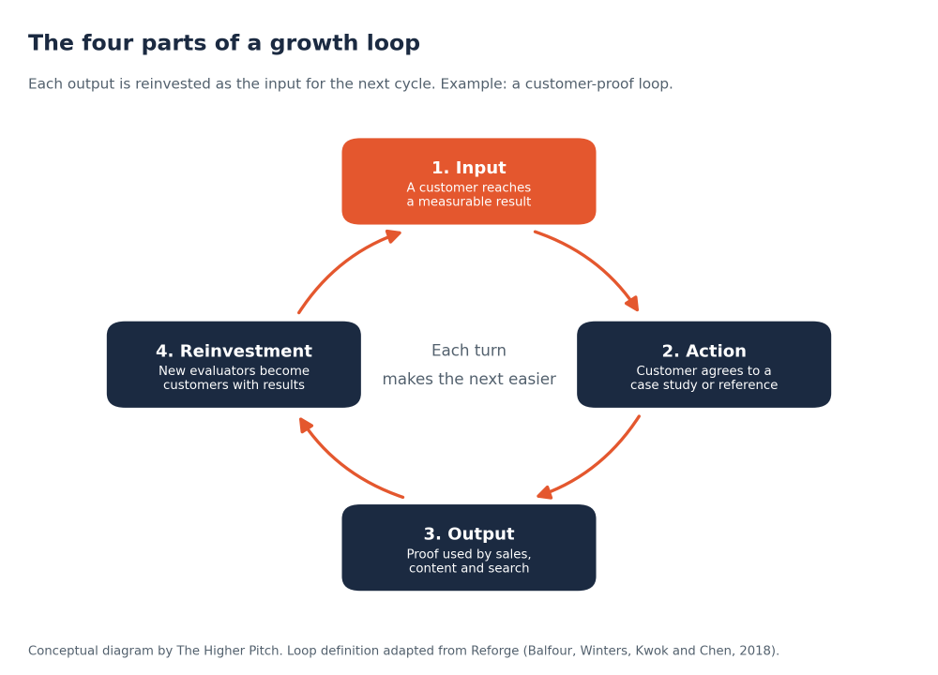
Figure 1: The four parts of a growth loop, shown with a customer-proof example. Conceptual diagram.
A simple test separates loops from everything else. If you cannot draw the arrow from output back to input, and name the person or system responsible for moving it, you have a campaign, not a loop.
Funnels Spend Effort Once; Loops Reinvest It
The traditional marketing funnel moves buyers in one direction: awareness, interest, consideration, purchase. It is still useful for diagnosing where prospects drop out and for forecasting. Its limitation is structural. The customer exits at the bottom and nothing flows back to the top, so growth stays roughly proportional to what goes in.
The Reforge authors made three criticisms of funnel thinking that still land in B2B boardrooms: funnels create strategic silos, create functional silos in which marketing, product and sales optimize at each other’s expense, and produce linear growth that needs ever more input.
| Dimension | Marketing funnel | Growth loop |
| Direction | One way, from awareness to purchase | Circular, with output returning as input |
| What a customer is | The end of the process | The start of the next cycle |
| Growth pattern | Roughly proportional to input | Can compound when output is reinvested |
| Core question | Where are we losing prospects? | What does each cycle produce that we can reuse? |
| Ownership | Each stage owned by a function | Each step owned, but the loop shared across functions |
Table 1: How funnels and loops differ. The full comparison is in Growth Loops vs Marketing Funnel.
There is a further irony. Even buyers do not move through a funnel. Gartner describes B2B purchases as six buying jobs (problem identification, solution exploration, requirements building, supplier selection, validation and consensus creation) that buyers loop through, revisiting each at least once. A model that assumes a straight line is describing neither the buyer nor the business.
Loops Matter More in B2B Than the Startup Playbooks Suggest
Growth loops were first articulated in the context of fast-growing product companies. B2B markets are different: fewer accounts, longer cycles, committees rather than individuals, and purchases that happen every few years rather than every week. Those differences change which loops work. They do not reduce the value of loops. If anything, they increase it, for three reasons.
Buyers arrive with history. 6sense’s 2025 B2B Buyer Experience Report, based on nearly 4,000 buyers, found that 97% had prior experience with at least one vendor on their shortlist, that buyers had been through an average of eight to nine purchase journeys in the category, and that buyers had direct experience with the vendor in 85% of successful purchases. The report’s advice follows directly: even a vendor unlikely to win the current deal should get on the list and make a good impression, because it shapes future decisions. In a loop model, every evaluation, including the ones you lose, is an input.
Most buyers are not in market right now. Research by the Ehrenberg-Bass Institute found that companies change providers of services such as banking, legal advice, software or telecoms around every five years. Loops that keep producing reusable assets, such as proof, content and relationships, maintain your presence between buying windows at a lower cost than buying attention again each time.
Buyers increasingly rely on sources you do not control. In G2’s April 2026 research, half of B2B software buyers (51%) said they now start software research with an AI chatbot more often than with Google, up from 29% in April 2025. Loops that generate third-party proof and consistent expert content feed the sources these tools draw on. Paid media does not.
We explore these shifts in more depth in The B2B Buyer Journey in 2026.
Seven Loop Types Fit B2B, and Each Compounds Differently
Not every loop suits every business. The table below summarizes seven that work in B2B markets. Each one is covered with scenarios in 7 B2B Growth Loop Examples.
| Loop | What starts it | What gets reinvested | Best fit |
| Content | Published expertise | Reader questions and sales conversations that shape the next piece | Firms selling expertise or complex solutions |
| SEO | Pages visible in search and AI answers | Query, conversion and sales data that decide new pages and internal links | Categories with active research demand |
| Product | Product usage | Colleagues or external parties exposed to the product through shared work | Software used across teams or companies |
| Referral | A customer who has seen value | Introductions to peers | Relationship-led, high-trust categories |
| Customer advocacy | A customer outcome | Case studies, references and reviews used in new deals | Almost every B2B company |
| Community | Members | Peer answers, events and content that attract new members | Categories with a shared professional identity |
| Data and personalization | Engagement data | Better targeting and relevance that raise engagement | Companies with enough volume and clean CRM data |
Table 2: Seven B2B growth loop types.
Compounding Comes From Reinvestment, Not From Volume
A loop compounds when its output adds to a stock that generates more input: a growing library of proof, a larger base of customers who refer, a deeper body of content that earns visibility. Volume alone does not compound. A campaign that doubles its budget doubles its reach, then stops when the budget does.
The less obvious consequence is that loops often look worse before they look better. Building the reinvestment step takes time and money that would otherwise go into direct acquisition. Figure 2 shows a simple illustrative model: a funnel that buys 100 inputs a month, compared with a loop that diverts 20% of that budget into building the loop and then reinvests 5% of its accumulated output each month.
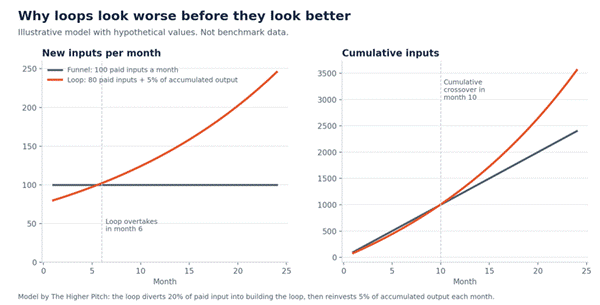
Figure 2: Illustrative model with hypothetical values, not benchmark data. In this model the loop trails for five months, overtakes on monthly input in month 6 and on cumulative input in month 10, and by month 24 produces 246 new inputs a month against the funnel’s 100.
The numbers are invented; the shape is the point. A leadership team that judges a loop on its first quarter will usually kill it. Three conditions decide whether the curve bends upward in practice: the output must be genuinely reusable, the reinvestment must happen quickly, and quality must hold as volume grows.
The Right Loop Starts From How You Already Win
The best first loop is rarely the most fashionable one. It is the one that reuses something your business already produces and currently wastes. Four questions narrow the choice:
- Where do your best customers actually come from? Look at original source data in your CRM, then ask recent customers directly. The answers often differ, and the difference is informative.
- What does your business produce as a by-product? Sales conversations, implementation results, support questions, evaluation feedback and usage data are all potential loop inputs.
- What do buyers in your category trust? If peers and experts carry more weight than vendor content, advocacy and community loops deserve priority over content volume.
- Can you own the reinvestment step? A loop that depends on a platform or partner you do not control is fragile.
Every Leader Judges a Loop Investment by a Different Test
Growth loops cross functional lines, so they need more than marketing’s enthusiasm. Each member of the leadership team will judge the investment with a different question, and the loop design should answer all of them before launch.
| Leader | The question they bring | Evidence that convinces them |
| CEO or founder | Does this make growth less dependent on spend and heroics? | A loop map tied to how the company already wins deals |
| CFO | When does it pay back, and what does it cost if it fails? | Cycle time, the cost of the reinvestment step, CAC by source, and an agreed stop rule |
| CMO | Can marketing run it without owning every step? | Named owners for each step and metrics shared with sales and customer success |
| CRO or sales leader | Will it produce accounts sales wants, or just volume? | Fit criteria built into the loop and win rates for loop-sourced opportunities |
| CIO or RevOps lead | Can our stack capture and route the data reliably? | A data model, integration points and an automation plan |
Table 3: The internal buying-committee lens for a growth loop investment.
Measure Loops by Cycle, Not by Channel
Channel reports credit the last touch, and funnel reports measure stage conversion. Neither is designed to see an output that comes back months later as a referral or a reused case study. Loops need their own measures:
- Loop input volume: how many triggers start the loop each period.
- Loop conversion rate: the share of inputs that produce a reusable output.
- Loop velocity: how long one full cycle takes, from trigger to reinvested output.
- Yield per cycle: how much new input each cycle generates.
- CAC and LTV by source: whether loop-sourced customers cost less to win and are worth as much or more.
Stage metrics (acquisition, activation, retention and referral) still matter, but they should be read as links in one chain rather than separate scorecards. The detail is in Growth Loop Metrics.
Five Mistakes That Stop Loops From Compounding
- Calling a campaign a loop. If nothing flows back to the start, it is a campaign with a circular diagram.
- Copying a consumer loop into a B2B market. Incentivized referral schemes and viral mechanics often fall flat with buyers whose recommendations put their professional reputation at stake.
- Leaving the reinvestment step unowned. The arrow back to the start is an operational task. Without an owner and a deadline, it does not happen.
- Judging the loop on its first quarter. As Figure 2 shows, a healthy loop can trail a funnel for months.
- Letting quality decay. Content produced for volume, referrals from poor-fit accounts and personalization built on unreliable CRM data all compound in the wrong direction.
Loops and Flywheels Describe the Same Idea at Different Altitudes
The flywheel is the older metaphor. In Good to Great, Jim Collins used a heavy flywheel to describe how transformations happen through consistent pushes that build momentum over time, rather than through one decisive action. HubSpot applied the idea to go-to-market in 2018: CEO Brian Halligan argued in Harvard Business Review for replacing the sales funnel with a flywheel, and HubSpot described its own flywheel as a cycle of attracting, engaging and delighting customers.
| Aspect | Flywheel | Growth loop |
| Level | Company-wide model of momentum | A specific, measurable mechanism |
| Focus | Customer experience, speed and friction across the business | One defined input, action, output and reinvestment step |
| Best use | Aligning the organization around a growth philosophy | Designing, owning and measuring how growth actually happens |
| Relationship | Often made up of several loops | One component of a flywheel |
Table 4: Flywheels and growth loops compared.
In practice, the distinction matters for accountability. A flywheel tells a company what it believes about growth. A loop tells a team what to build on Monday and how to know whether it worked.
AI and Automation Shorten Cycle Time, Which Is Where Compounding Lives
The most valuable thing AI and automation can do for a loop is not to produce more output. It is to shorten the time between an output appearing and it being reinvested. A loop that completes a cycle every six weeks compounds far faster than one that takes six months, even with identical yield.
Practical applications include:
- Capture: summarizing sales calls, support tickets and RFPs to extract the questions buyers are actually asking.
- Routing: triggering an advocacy or referral request in the CRM when an account reaches a defined outcome, instead of relying on memory.
- First drafts: turning captured questions into content briefs and outlines that experts then shape and approve.
- Personalization: adjusting content and outreach based on engagement signals, if the underlying data is trustworthy.
- Measurement: timestamping each loop step so velocity can be tracked rather than guessed.
The caveat is that automation amplifies whatever the loop already does, including its mistakes. For the tooling side, see our pieces on AI marketing automation, AI agents in the MarTech stack and moving from manual to automated marketing. THP’s AI-powered approach, SAID, is designed around the same principle of connecting AI to business outcomes rather than activity.
Build a Growth Loop Strategy in Seven Steps
- Agree the objective and the constraint. Name the one growth problem the loop should solve, such as rising acquisition cost or low win rates in a priority segment.
- Map how recent customers found and chose you. Use CRM data and customer conversations, not assumptions.
- Pick one loop to build first. Choose the loop that reuses an existing by-product and that you can fully own.
- Design the value exchange and the reinvestment step. Decide why each participant takes part, and who moves the output back to the start, by when.
- Instrument before you launch. Add the CRM fields, source tracking and timestamps you will need to measure velocity and yield.
- Automate the safe parts. Automate triggers, routing and data capture; keep the ask and the judgment human.
- Review on the loop’s cadence. Decide in advance what evidence will justify scaling the loop, adding a second one, or stopping.
The step-by-step method, with a worked example and a design canvas, is in How to Build a B2B Growth Loop From Scratch. For search-led companies, SEO Growth Loops shows how the same principles apply to organic visibility. Loops also depend on sales and marketing sharing ownership, which our RevOps playbook covers in detail.
THP Studio Perspective
Much of the growth loop literature was written for consumer apps and product-led software, where a feature can spread from user to user. B2B rarely works like that, and pretending it does leads teams to chase referral schemes and viral mechanics their buyers ignore. The loops that compound in B2B are less glamorous: a customer result that becomes the proof in the next deal, a sales question that becomes the next article, a won account that introduces a peer. They look like operations, not growth hacks. That is exactly why competitors rarely copy them.
Frequently Asked Questions
Key Takeaways
- Treat recurring pipeline dependence on spend as a design problem. A loop is how a company stops starting every quarter from zero.
- Start with the loop that reuses what you already produce and waste: customer outcomes, sales questions and evaluation feedback.
- Expect loops to trail direct acquisition early. Agree the leading indicators and review cadence before launch, not after the first disappointing quarter.
- Give the reinvestment step an owner and a deadline. Most loops that fail were never closed.
- Use AI and automation to shorten cycle time, and fix data quality first, because automation compounds errors as efficiently as it compounds results.
Work With THP’s Integrated Marketing & Demand Practice
THP’s Integrated Marketing & Demand team connects brand, content, campaigns and technology into full-funnel programs built around pipeline and revenue, which is the foundation any growth loop depends on. If your growth still resets every quarter, mapping your first loop is a practical place to start.
Author