After 15 years, HubSpot has retired INBOUND — the event that essentially defined an entire marketing movement — and replaced it with something called UNBOUND. The conference is being held in Boston, and it’s already sold out with over 200 sessions planned.
It’s easy to write this off as a marketing team getting bored with an old name. It isn’t. The rebrand is a signal about where HubSpot — and the broader GTM industry — thinks the next few years are headed. Here’s what’s actually behind it, and what it means if you run marketing, sales, or RevOps for a B2B company.
Why “Inbound” Stopped Fitting
Inbound marketing, as a concept, was built on a simple premise: publish useful content, rank on Google, let buyers find you. For over a decade, that premise held up well enough to build a company — and an entire industry — around it.
That premise is now under real pressure. Search behavior has shifted meaningfully toward AI-generated answers instead of traditional search results, and a large share of searches now end without a single click to any website. Buyers increasingly get their answers directly from tools like ChatGPT or Perplexity, never landing on the blog post that was written to capture them.
In other words: the traffic-driven playbook that “inbound” was built around doesn’t fully work anymore. HubSpot’s own words on the rebrand put it plainly — INBOUND laid the foundation, and UNBOUND reflects how growth actually works today.
What UNBOUND Is Actually About
Based on HubSpot’s own positioning, UNBOUND centers on three ideas:
Connected systems. Marketing, sales, service, and operations treated as one system instead of four disconnected departments each running their own tools and their own version of the truth.
AI-driven execution. Less “AI as a feature bolted onto existing software” and more AI actively doing parts of the work — drafting outreach, updating CRM records from call transcripts, mapping buying committees.
Unified customer experience. The buyer doesn’t experience your company as marketing-then-sales-then-service. They experience one relationship, and increasingly expect your systems to reflect that.
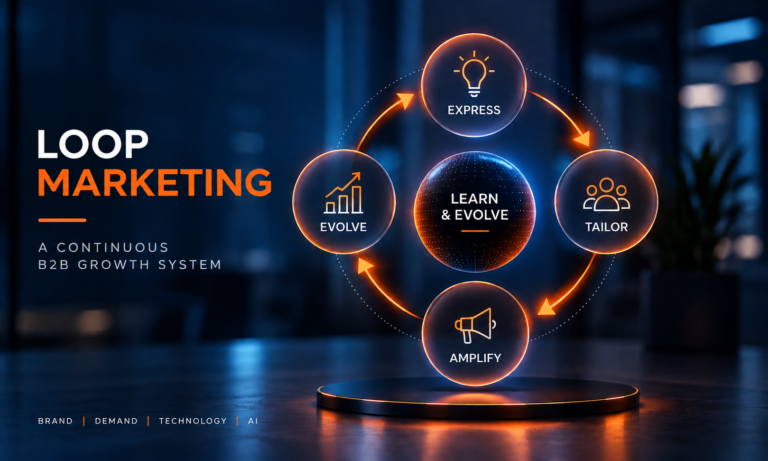
None of this is entirely new territory for HubSpot — components of it echo what the company has been calling “The Loop,” a framework it introduced as a successor to the traditional marketing funnel. But UNBOUND is where that direction gets formalized, product-ized, and put in front of the entire customer base at once.
The Skepticism Is Fair — and Worth Naming
Not everyone is convinced the name matches the reality. The rebrand lands at an awkward moment: HubSpot’s stock has fallen sharply this year, partly on investor concern that AI answer engines will erode the search-driven traffic model the company’s whole ecosystem was built around. Some longtime HubSpot partners have pointed out the irony directly — a platform known for tiered pricing and certain lock-in effects calling itself “unbound” is a claim worth some healthy scrutiny.
We’d rather name that tension than pretend it doesn’t exist. A new name doesn’t automatically solve a platform’s structural challenges. But it does tell you where the company is placing its bets — and those bets are worth paying attention to regardless of how the branding lands.
What This Actually Means for Your Team
Strip away the conference branding, and there’s a real, practical shift happening that’s worth acting on regardless of what HubSpot calls its event:
If your CRM still operates as three disconnected tools — one for marketing, one for sales, one for service — that gap is going to matter more, not less, over the next few years. Buyers already move across those functions without noticing (or caring about) the internal handoffs; systems that don’t reflect that will increasingly show.
If you’re relying entirely on organic search traffic, it’s worth starting to think about how your brand shows up in AI-generated answers, not just search engine results pages. That’s a genuinely different discipline than traditional SEO, and most companies haven’t started building for it yet.
If your automation is set-and-forget, this is a good moment to revisit it. A lot of the “AI-driven execution” HubSpot is describing only works well on top of clean data and workflows that were actually built for how your team operates today — not how it operated when the workflow was first set up.
Where We Come In
This is exactly the gap we spend most of our time closing for clients. Not chasing every new HubSpot feature the moment it ships, but making sure the fundamentals — clean data, connected workflows, systems that actually reflect how sales and marketing work together — are solid enough that new capabilities (AI-driven or otherwise) have something real to plug into.
If you’re not sure whether your current setup is ready for where HubSpot — and the industry — is heading, that’s a conversation worth having before the next platform shift, not after.
Curious where your HubSpot setup stands? Get in touch with The Higher Pitch — we’re a HubSpot Gold Solutions Partner and happy to talk through what’s actually worth prioritizing for your team.
Author