Quick takeaway
- These four terms describe different things, not different degrees of the same thing. MQL is a marketing judgement about a person. SAL is a sales acknowledgement that the judgement was reasonable. SQL is a sales judgement about a real deal. An opportunity is a record with money and a date attached. Most arguments between marketing and sales are caused by two teams using one of these words to mean something the other team means by a different word.
The four stages in one line each
Marketing qualified lead (MQL). A contact that marketing believes meets the agreed fit and intent thresholds and is ready for sales attention. Owned by marketing.
Sales accepted lead (SAL). An MQL that a seller has looked at and agreed is worth working. Owned by sales. This is an acknowledgement, not a qualification.
Sales qualified lead (SQL). A contact a seller has worked and confirmed has a real need, the authority or access to authority, and a plausible process and timeline. Owned by sales.
Opportunity. A deal record with a value, a close date and a stage. It represents a potential transaction rather than a person.
The sequence matters because each stage transfers something specific: MQL transfers attention, SAL transfers acceptance, SQL transfers confidence, and opportunity transfers the record from a person-shaped object to a deal-shaped one.
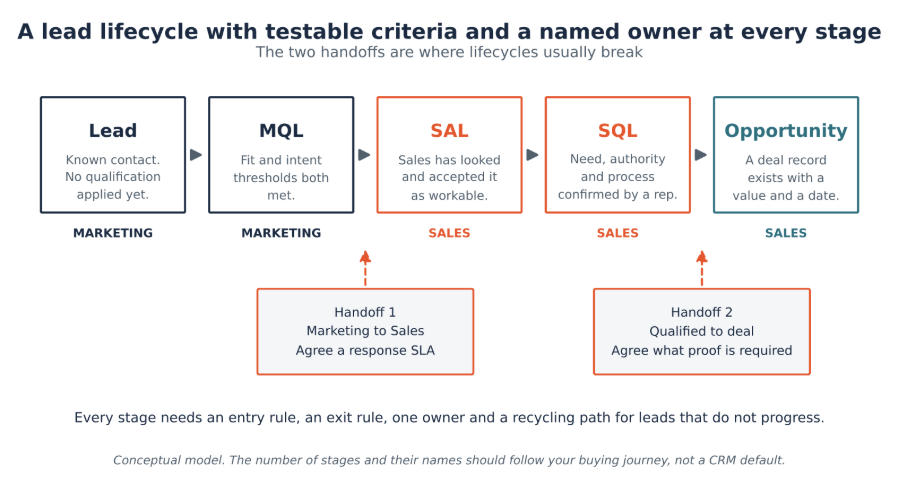
Figure 1. Each stage needs a testable rule and one owner. Conceptual model.
The comparison in full
| Stage | What it means | Owner | Entry criteria | Typical evidence |
| Lead | A known contact who has done something beyond a passive visit | Marketing | Identified through a form, event, list or enrichment | Contact record with a source |
| MQL | Marketing judges this person worth a seller’s time | Marketing | Fit threshold and intent threshold both met | Score, ICP match, demo or pricing activity |
| SAL | Sales agrees the lead is workable and takes ownership | Sales | Reviewed within the agreed SLA and not rejected | Accept or reject logged with a reason |
| SQL | Sales confirms a real, workable deal exists | Sales | Need, authority and process confirmed in a conversation | Call notes with a named decision process |
| Opportunity | A deal with a value and a close date | Sales | Buyer agreed to evaluate, deal record created | Deal record with amount, stage and date |
The column that teams skip is the last one. Criteria without evidence requirements become opinion. “Need confirmed” is only meaningful if somebody can say where that confirmation is recorded.
Where SAL fits, and what you lose by skipping it
Most teams do not use SAL. It is the stage that gets cut first, usually on the grounds that it adds admin without adding insight.
That reasoning gets it backwards. SAL is the only stage that measures agreement between marketing and sales. Without it, you can see how many MQLs marketing produced and how many SQLs sales created, but you cannot see how many MQLs a seller looked at and rejected, or why.
That rejection data is the most valuable diagnostic in the funnel. It tells you whether your quality problem is a targeting problem, a timing problem or a routing problem. Teams without SAL end up arguing about lead quality using anecdotes, because nobody instrumented the moment where the disagreement actually happens.
The cost is real but small: one field, one SLA and a required rejection reason. The alternative is a recurring argument with no data in it.
If you are adding SAL, make two rules non-negotiable. Rejection requires a reason from a fixed list, not free text. And a lead that is rejected goes somewhere specific, usually back to nurture with a re-entry rule, rather than disappearing.
Lead, contact, account, deal: the object confusion inside CRMs
A lot of cross-team confusion is not conceptual at all. It is about CRM objects, and it differs by platform.
Some systems, including Salesforce in its classic model, keep a separate Lead object that converts into a Contact, an Account and an Opportunity. Others, including HubSpot, do not use a separate lead object in the same way. HubSpot applies a lifecycle stage property to contacts and companies, with seven default stages running subscriber, lead, marketing qualified lead, sales qualified lead, opportunity, customer and evangelist.
That difference has a practical consequence worth knowing before you design anything. In HubSpot, “opportunity” is a lifecycle stage on a person or company, meaning the record is associated with a deal. The deal itself is a separate object with its own stages. So a contact can be at lifecycle stage “opportunity” while the deal sits at stage “discovery”. Both are correct. They are describing different objects.
Write down which object each of your terms applies to before you write the definitions. Teams that skip this step produce rules that cannot be implemented.
Pipeline, forecast and funnel are three different words
These get used interchangeably in meetings and they should not be.
Funnel is the conceptual model of how prospects narrow down as they progress. It is a way of thinking, and increasingly a contested one, since real buying journeys loop rather than descend.
Pipeline is the actual set of open deals right now, with values and stages. It describes the present.
Forecast is the subset of pipeline you are committing to close in a defined period, adjusted by judgement or by method. It is a prediction with accountability attached.
A business can have a growing pipeline and a falling forecast at the same time, and both numbers can be accurate. If your leadership team treats them as synonyms, every pipeline review turns into a negotiation about which number is real.
How definitions change in product-led motions
In a sales-led motion, qualification is something a human does in a conversation. In a product-led motion, the product generates the evidence.
The term that appears here is the product qualified lead, which the investor Tomasz Tunguz described as a user who has experienced meaningful value in the product rather than one who filled in a form. The practical difference is that a PQL’s qualifying evidence is behavioural and already recorded: the account invited four teammates, hit the usage ceiling, or used the feature that correlates with retention.
If you run both motions, resist the urge to force them through one set of thresholds. A PQL and an MQL are both “qualified”, but they are qualified on different evidence and they usually need different routing and different first conversations. Our product-led growth pillar covers the motion in full.
What to do when marketing and sales disagree
Disagreement about definitions is normal and healthy. Unresolved disagreement is what kills funnels.
The mechanism that works is a written agreement with four parts, reviewed on a set cadence:
- The definitions. What qualifies as an MQL, stated as testable criteria rather than adjectives.
- The volume commitment. How many marketing expects to deliver in a period, so sales can resource for it.
- The response commitment. How quickly sales will action a lead, and what action counts. A touch is not a review.
- The feedback loop. Mandatory rejection reasons and a monthly review of them, with a named owner who can change the definitions.
The fourth part is the one most agreements leave out, and it is the only part that makes the document self-correcting. Without it, the definitions calcify while buyer behaviour moves on.
THP Studio Perspective.
- We have stopped opening these projects by asking what each term means. We ask something narrower instead: show us the last ten records that became MQLs, and tell us why each one qualified. In most rooms the answers do not match the written definition, and sometimes three people give three different answers about the same record. That is more useful than any workshop debate, because it reveals whether the definition is actually running the system or just describing it. Fix what the system does before you polish what the document says.
Frequently asked questions
Key takeaways
- The four terms describe different objects and different decisions, not increasing degrees of quality.
- SAL is the stage most teams cut and the only one that measures whether sales agrees with marketing’s judgement.
- Check which CRM object each term applies to before writing definitions, because platforms model this differently.
- Pipeline describes the present, forecast predicts a period, and funnel is a conceptual model. They are not interchangeable.
- A definitions agreement without mandatory rejection reasons and a review cadence will drift out of date within two quarters.
Work With THP’s MarTech Studio
- Most lead quality arguments turn out to be definition arguments that nobody has written down. We help B2B teams agree testable stage criteria, instrument the handoffs and configure the CRM so the definitions are enforced rather than described. Start with MarTech Solutions or our HubSpot consulting practice, and read the full lifecycle, pipeline and forecasting model for how these stages connect to deals and forecasts.