

Open LinkedIn on any given Tuesday and you’ll find a dozen posts making the same three claims: AI is changing everything, the buyer journey isn’t linear anymore, and trust matters more than ever. None of that is wrong. It’s just identical. B2B thought leadership has a sameness problem, and it is getting worse at the exact moment distinctiveness matters most. As AI search engines decide which brands get cited and which get skipped, the content that reads like everyone else’s content simply disappears.
This isn’t a headline problem you fix with a punchier hook. It’s a strategy problem. Most B2B content starts with the same five trend reports and lands on the same five conclusions because most content teams work from the same inputs. The fix starts with understanding why sameness spreads so easily, then building an editorial process that produces an actual point of view, one your competitor genuinely could not have written.
None of this is an argument against research-backed content. Citing credible data is still one of the strongest signals of expertise a piece of writing can carry. The distinction that matters is whether a credible statistic supports an original argument, or whether the statistic is the entire argument, repackaged with a new headline and published under a different logo.
Quick Takeaway
- B2B thought leadership has never been more abundant, or more interchangeable. New research shows 61% of B2B tech CMOs are already rethinking their content for AI-era discovery, yet most still lack the coordinated playbook to make that content distinctive. The opportunity isn’t publishing more. It’s publishing fewer, sharper pieces built on a defensible point of view — one with enough specificity that an AI engine, and a skeptical buyer, can tell it apart from the next ten search results.
What Is Happening to B2B Thought Leadership Right Now
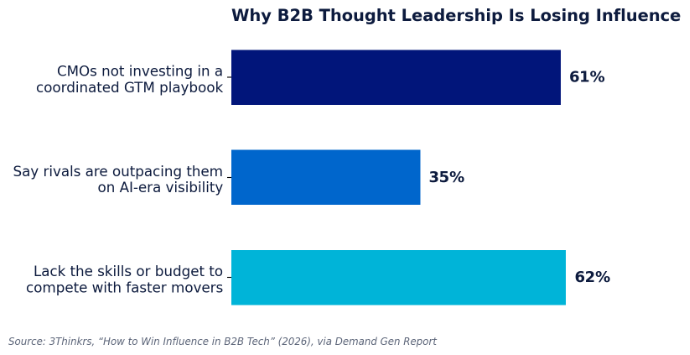
Tech brands are dealing with a strange paradox. Content output is up, budgets are up, and engagement is flat or falling. A 2026 report from communications firm 3Thinkrs, covering 200 CMOs at venture-backed start-ups and 200 at billion-dollar tech brands, found that 61% are already rethinking how they create content to optimize for AI engines as traditional search performance declines. That’s not a fringe behavior anymore — it’s the majority.
The same research found that 62% of CMOs say they lack the skills, budget, or internal resources to compete with faster-moving challengers on this shift, and 35% are specifically worried that competitors are outpacing them on AI-era visibility. Put those numbers together, and you get a market full of companies that know the old playbook is breaking, but haven’t yet built the new one.
Why Sameness Spreads So Easily in B2B Content
Sameness in B2B thought leadership isn’t an accident it’s a predictable output of how most content teams actually work. Two habits do most of the damage.
The Trend-Report Treadmill
Almost every B2B content calendar starts the same way: pull the latest Gartner, Forrester, or McKinsey report, extract the three headline statistics, and build a blog post around them. There’s nothing wrong with citing credible research this article does it too. The problem is when that’s the entire content strategy. If your competitor reads the same report and reaches the same conclusion in the same week, you haven’t built thought leadership. You’ve built a slightly reworded press release for someone else’s research.
The AI-Assisted Echo Chamber
Generative AI tools are trained on the internet’s existing content, which means the fastest way to get an AI-drafted blog post is also the fastest way to get a blog post that sounds like the thousand other AI-drafted posts already published on the same topic. Used as a first-draft accelerator with a strong human point of view layered on top, AI is a genuine asset. Used as the entire writing process, it quietly regresses every brand’s voice toward the same statistical average.
What a Defensible Point of View Actually Looks Like
A defensible point of view has three things generic content doesn’t: a specific claim, a reason to believe it, and a willingness to be wrong about something. “AI will transform marketing” is not a point of view it’s a weather report. “Most marketing teams are using AI to do the wrong jobs faster” is a point of view, because someone could disagree with it, and you’d have to defend it with evidence and experience.
The most useful test we use with clients: read the headline out loud. If a competitor’s CEO could publish the exact same headline over their own name without changing a word, the piece isn’t distinctive yet no matter how well it’s written.
This test works because it removes the temptation to judge a piece solely on craft. A well-written, well-edited article can still be completely interchangeable if the underlying argument is one any reasonably informed executive in the category would also make. Distinctiveness lives in the claim, not in the sentence-level polish around it.
A Practical Framework for Building Original Thought Leadership
Building a genuine point of view is a process, not a talent some writers have and others don’t. The table below outlines the four stages we work through with clients before a single sentence of a thought leadership piece is drafted
| Stage | What Happens | Output |
| 1. Position | Identify a claim your company is uniquely positioned to defend, based on real client work or data | One sentence the CEO would stand behind publicly |
| 2. Pressure-Test | Ask what a smart skeptic would say back, and address it directly in the piece | A stronger, more specific argument |
| 3. Evidence | Pair the claim with a proof point — client result, original data, or named experience | Credibility that a trend recap can’t fake |
| 4. Repeat | Carry the same point of view across formats — blog, LinkedIn, byline, sales deck | A recognizable voice instead of one-off posts |
Common Mistakes That Quietly Flatten Your Voice
Most brands don’t lose their distinctiveness in one bad decision. It happens through small, well-intentioned edits that smooth out everything specific. Watch for these patterns:
- Removing a strong claim during review because it feels “too opinionated” for a corporate blog
- Letting every department add a sentence, until the piece represents no one’s actual view
- Leading with industry context instead of your argument, burying the point of view at paragraph six
- Citing the same three analyst firms every competitor cites, with no original data of your own
- Optimizing a draft for keyword density before the argument is sharp, so the SEO pass smooths out the voice
THP Studio Perspective
- We tell clients the same thing before every thought leadership engagement: a point of view is only valuable if it’s specific enough to be wrong. The B2B brands earning real share of voice in 2026 aren’t the ones publishing the most content they’re the ones whose executives say things their competitors wouldn’t dare put in writing, backed by enough evidence that the claim holds up. That combination, repeated consistently across formats, is what separates thought leadership from content volume.
Frequently Asked Questions
Key Takeaways
- B2B thought leadership volume is rising while distinctiveness is falling — 61% of CMOs are rethinking content for AI-era search, but most still lack a coordinated playbook.
- Sameness spreads through two habits: rebuilding posts from the same trend reports and using AI for the entire writing process instead of as a first-draft accelerator.
- Sameness spreads through two habits: rebuilding posts from the same trend reports and using AI for the entire writing process instead of as a first-draft accelerator.
- Run claims through a four-stage process — position, pressure-test, evidence, repeat — before drafting begins.
- Audit for sameness by reading recent headlines aloud: if a competitor could publish them unchanged, the argument isn’t sharp enough yet.
Work With THP’s Content & Communications Studio
- THP’s Content & Communications Studio builds the editorial process behind a defensible point of view — from positioning workshops with your leadership team to the bylines, blog series, and sales enablement content that carry it consistently. If your last few posts could have come from any competitor, that’s exactly the conversation worth having.
Author