Quick takeaway
- A lifecycle that sales trusts has three properties: the stages match how your buyers actually move, the criteria can be checked by anyone, and every stage has one owner who is accountable for what happens next. Most lifecycles fail the second test. They are built from adjectives like “engaged” and “ready”, which means two people can look at the same record and disagree, and the first time that happens in a pipeline review the whole model loses authority.
Start from the buying journey, not from the CRM defaults
Every CRM ships with default stages, and adopting them is the most common way lifecycle design goes wrong. HubSpot’s defaults run subscriber, lead, marketing qualified lead, sales qualified lead, opportunity, customer and evangelist. They are a reasonable starting point and they are not a description of your business.
Before you touch a settings screen, map what your buyers actually do. Interview five recent closed-won accounts and five closed-lost ones. Ask what happened in what order, who got involved and when, and what triggered each step. You are looking for the real inflection points: the moment the problem became urgent, the moment a budget conversation started, the moment someone else joined the evaluation.
Those inflection points are your candidate stages. If a CRM default stage does not correspond to anything a buyer actually does, it is reporting furniture.
This is also where buying-committee reality enters the design. 6sense’s research found that the typical buying group evaluates around five vendors and that 75% of buying group members already know at least one seller when the process begins. A lifecycle built on the assumption that one contact discovers you, engages, and converts in sequence is modelling a journey that mostly does not happen.
Choose the smallest number of stages you can defend
More stages feel more precise. They are not. Each additional stage adds maintenance, reporting complexity and another place for records to get stuck.
The test for keeping a stage: can you state in one sentence what it is for, and does a different person take a different action when a record enters it? If the answer to either is no, merge it.
Five or six stages covers most B2B businesses. If you have more than seven, you are probably modelling your internal process rather than the buyer’s journey, which is a reliable sign the model will not survive contact with a busy sales team.
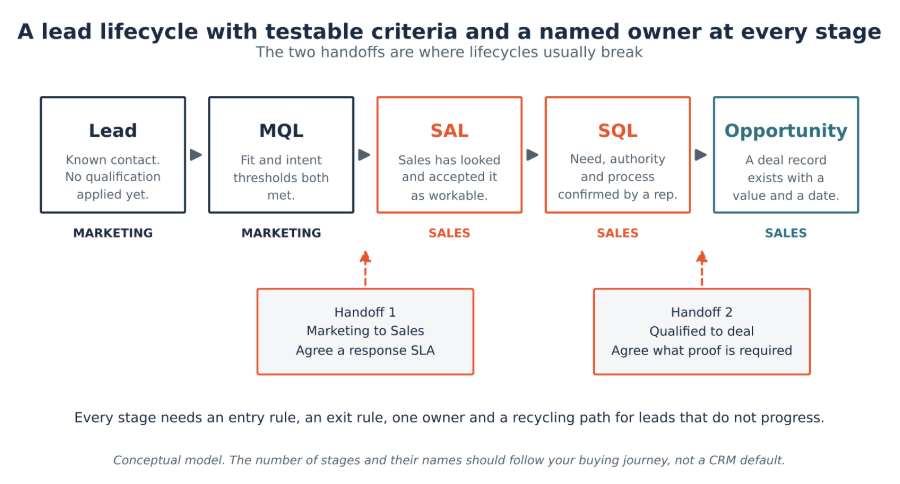
Figure 1. Stages are the easy part. The handoffs are where lifecycles break. Conceptual model.
Write entry and exit criteria as testable rules
This is the heart of the work, and it is mostly an exercise in removing adjectives.
A criterion is testable if two people independently applying it to the same record reach the same answer. “Highly engaged” fails. “Opened three emails” passes, though it may be a poor rule. “Title matches the buyer persona list, company matches ICP firmographics, and the contact has either booked a meeting or viewed pricing twice within 14 days” passes and is probably useful.
Write each stage with four elements:
| Element | What to write |
| Purpose | One sentence on what this stage is for and what decision it triggers |
| Entry criteria | The specific, checkable conditions that move a record in |
| Exit criteria | What must be true to move forward, and what sends a record backward or out |
| Owner and SLA | One named role, and how fast they must act once a record enters |
Two things to watch. First, exit criteria are not just the next stage’s entry criteria, because records can also exit sideways into recycling or disqualification. Second, if a criterion depends on data you do not reliably capture, it is aspirational. Either fix the data capture or write a rule you can actually run.
Design the handoffs, because that is where lifecycles die
The stages get the attention. The handoffs cause the failures.
At each handoff, agree four things and write them down:
- What transfers. Ownership, the record, the follow-up responsibility, or all three.
- How fast. A specific response time, measured from stage entry rather than from assignment.
- What counts as a response. A logged call attempt, not a record view. Teams that do not define this discover their SLA is being met by people opening records.
- What happens on rejection. Who can reject, what reason they must give, and where the record goes.
That last point is the one worth fighting for. A rejection path with a mandatory reason from a fixed list turns the eternal lead-quality argument into a dataset. Without it, you have two teams with competing anecdotes.
Build the recycling and disqualification paths deliberately
Most leads are not ready, and “not ready now” is a completely different state from “not a fit”. Collapsing them into one bucket destroys a lot of future pipeline.
Design at least three exit routes:
Recycle. Right account, wrong timing. Goes back to nurture with a defined re-entry trigger. The trigger matters: a date alone is weak, a date plus a new behavioural signal is much better.
Disqualify, reversible. Wrong fit on something that could change, such as company size or a missing integration. Suppressed from routing, retained for future qualification.
Disqualify, permanent. Competitor, student, out of serviceable geography. Suppressed from scoring and routing entirely so it stops consuming attention.
Here is an implementation detail that catches teams out. HubSpot’s documentation notes that automatic lifecycle stage updates only move a record forward. To set an earlier stage you must clear the property first and then set the new value, or change it manually. This is sensible behaviour, because it stops records bouncing between stages on every form fill. It also means recycling cannot be an afterthought. If your design assumes records will automatically fall back a stage when they go quiet, that is not what will happen.
Contact-level or account-level, and when you need both
A contact-level lifecycle tracks individuals. An account-level lifecycle tracks the company. Most B2B companies need both, and the mistake is usually running only the first.
Contact-level alone misleads in a predictable way. One enthusiastic contact at a 4,000-person enterprise produces the same MQL as one contact at a 30-person business, even though the first is a fragment of a buying group and the second might be the whole decision.
The practical pattern for account-based motions:
- Keep contact-level stages for routing and personalisation, because messaging is still sent to people.
- Add an account-level stage driven by aggregate signals: how many contacts are engaged, in how many functions, how recently, and whether any of them hold buying roles that matter.
- Route on the account stage, personalise on the contact stage.
That split keeps your nurture logic working while giving sales a view of the thing they actually sell to.
Where lead scoring fits, and where it does not
Scoring is an input to the lifecycle, not a replacement for it. A score is a continuous number. A stage is a discrete state that triggers an action. The score helps you set the threshold; the stage records that the threshold was crossed.
Two rules keep scoring useful. Separate fit from intent rather than blending them into one number, because a high score built entirely on fit means a perfect prospect who has done nothing, and a high score built entirely on intent means an enthusiastic contact who will never buy. And add decay, because engagement from four months ago is not evidence of current interest.
Our marketing automation strategy guide covers the scoring and trigger mechanics in more depth.
Implementing it in the CRM
Once the design is agreed, the platform work is about making the right path easy and the wrong path hard.
- Create the properties your criteria need. If a rule references ICP fit, there must be a field holding it. Rules that reference data you do not store cannot be automated.
- Automate stage entry from real signals, not from form submissions alone. A form fill is one signal among several.
- Set a default stage for new records and for records created by each connected integration, so nothing arrives unclassified.
- Prevent unintended backward movement. Use the forward-only default behaviour deliberately and handle recycling through an explicit clear-and-set workflow.
- Log stage change dates. Without timestamps you cannot measure stage duration, which means you cannot find where records stall.
- Report using the same definitions. If the dashboard filters differ from the stage criteria, you have two models and people will trust neither.
If your existing records are already inconsistent, sequence matters. Clean first, then implement. These seven signs that CRM data is blocking sales growth is a reasonable diagnostic, and our CRM data cleanup guide covers the mechanics.
THP Studio Perspective
- The best lifecycle review we run is not a workshop. We pull the twenty most recent records that crossed into MQL and ask the marketing and sales leads to mark each one accept or reject independently, without conferring. The disagreement rate tells you more than any amount of discussion about definitions. When it is high, the problem is the criteria. When it is low but sales still complains about quality, the problem is usually volume, timing or routing instead. Diagnosing that difference before you redesign anything saves weeks of work on the wrong thing.
Frequently asked questions
Key takeaways
- Build stages from the inflection points in your buyers’ actual journey, not from the CRM’s default list.
- A criterion is only usable if two people applying it independently reach the same answer.
- The handoffs cause more failures than the stages, so define what transfers, how fast, what counts as a response and what happens on rejection.
- Recycling and disqualification are different states and need different paths, especially given that stage automation generally moves forward only.
- Lead scoring is an input that sets the threshold; the stage is the discrete state that triggers the action.
Work With THP’s HubSpot Studio
- We run lifecycle design as a working session with marketing and sales in the same room, then implement the result in HubSpot so the criteria are enforced rather than documented. If your stages exist but nobody trusts them, talk to our HubSpot consulting team or see how our Automation and Technology practice handles the build. The full lifecycle, pipeline and forecasting model shows how this connects to deal stages and the forecast.