
For the last two years, AI in marketing mostly meant generative tools that helped a person draft something faster a blog outline, an image, a subject line. AI agents in martech are a different category entirely. An agent doesn’t just generate a suggestion for a person to review; it connects directly to tools like ad platforms, CRMs, and data sources through APIs, makes decisions based on rules a team defines in advance, and executes the resulting actions with minimal step-by-step oversight.
That distinction is the whole story of why martech vendors are racing to add agentic features in 2026. The earlier wave of AI saved time on individual tasks. This wave is starting to run entire workflows and that raises the stakes on governance just as fast as it raises the ceiling on output.
It’s a shift marketing operations teams should take seriously even if their current stack doesn’t yet include a labeled “agent” feature. Several existing automation and reporting tools are quietly adding agentic capability into routine updates, which means many teams will end up running agentic workflows whether or not that was a deliberate strategic decision.
Quick Takeaway
- AI agents are moving from generating suggestions to autonomously executing marketing workflows pulling account data, building campaign assets, and updating CRM records through direct API and tool connections. Nearly 94% of organizations are already exploring generative AI in some form, but 43% say integrating AI with their existing martech stack remains their biggest barrier. The opportunity is real. So is the need for a governance framework before agents start acting without a human checking every step.
What an AI Agent Actually Is in a Martech Context
An AI agent, in this context, is an autonomous system that connects to a company’s existing tools CRM, ad platforms, data sources through APIs, reads relevant data, applies decision logic defined by a human team, and takes action without requiring approval at every individual step. The human role shifts from doing the work to setting the strategy, defining the rules within which the agent operates, and reviewing outcomes rather than every action.
This is meaningfully different from a chatbot or a content-generation tool. A generative AI tool produces an output and waits for a person to use it. An agent can pull data, make a decision, and act on a connected system on its own, inside the boundaries it’s been given.
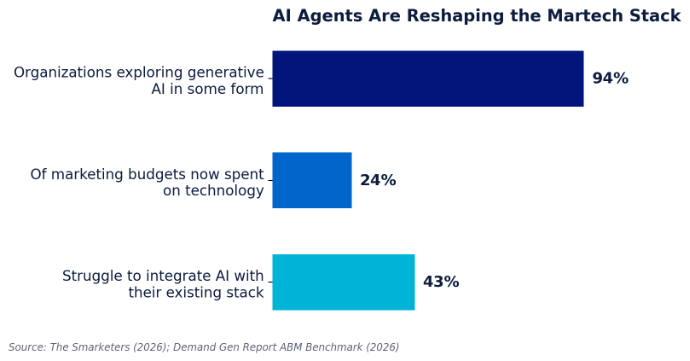
Figure 1: How fast AI and AI agents are spreading through the marketing technology stack
Why AI Agents Are Showing Up in the Stack Now
Marketing technology budgets have grown to the point that integration, not adoption, is now the bottleneck. Marketing technology accounts for close to a quarter of total marketing budgets at this point, and the typical enterprise stack has accumulated so many disconnected tools that manual work exporting from one system and importing into another has become a meaningful drag on speed. Agents are attractive specifically because they can sit across that fragmentation and execute a workflow that previously required a person to manually bridge several tools.
The protocol layer is part of why this is happening now rather than two years ago. Standards like the Model Context Protocol have made it more practical for an AI system to securely connect to a defined set of tools, rather than requiring a custom integration for every new capability.
Where AI Agents Are Already Doing Real Work
The use cases gaining traction first are the ones with clear rules and low ambiguity. Account research agents can query data sources for companies that match defined ICP criteria and surface a ranked list without requiring a human to manually cross-reference spreadsheets. Campaign execution agents can generate landing pages and ad copy variants tailored to specific accounts based on research the agent itself pulled together. Reporting agents can monitor live campaign data and flag anomalies in real time, instead of waiting for a weekly dashboard review to catch a problem that’s been running for days.
A useful way to think about current agent maturity: they’re strongest on tasks that previously required a person to gather information from multiple sources and apply a consistent, well-defined rule to it. They’re weakest on tasks requiring judgment calls a team hasn’t yet articulated clearly enough to turn into an explicit rule which is precisely the kind of ambiguity a skilled human marketer is still better equipped to navigate.
A Readiness Framework Before Deploying an Agent
Not every workflow is ready for agentic automation yet. The table below is a useful filter before handing a process to an agent.
| Readiness Factor | Question to Ask | Green Light Looks Like |
| Data quality | Is the underlying data clean enough to trust an automated decision? | Recent data hygiene audit, low duplicate/error rate |
| Rule clarity | Can the decision logic be defined without constant exceptions? | A documented rule set, not tribal knowledge |
| Reversibility | How hard is it to undo an action if the agent gets it wrong? | Low-risk, easily reversible actions first |
| Oversight | Who reviews outcomes, and how often? | A named owner reviewing a sample of agent decisions weekly |
Mistakes That Turn AI Agents Into a Governance Problem
Most early agent deployments don’t fail on capability they fail on oversight. Watch for these patterns:
Almost every governance failure we’ve seen traces back to one decision made too early: extending an agent’s autonomy faster than the team’s confidence in its accuracy actually warranted, usually under pressure to show results from a new investment quickly.
- Deploying an agent against messy or duplicate-heavy data and trusting its output anyway
- Skipping a documented governance framework because the agent “seems to be working fine” in early testing
- Giving an agent access to irreversible actions, like sending live customer communications, before testing on reversible ones
- Treating agent deployment as a one-time setup instead of an ongoing process with regular output review
- Letting integration complexity stall the project indefinitely instead of starting with one well-scoped, low-risk workflow
THP’s Take: Supervision Is the Job Now, Not Execution
THP Studio Perspective
- The marketing operations role doesn’t disappear as agents take on execution it shifts toward something closer to supervising a capable but literal-minded new hire. That means writing clearer rules than you’ve ever had to write before, because an agent will follow them exactly, including the parts you didn’t think to specify. Teams that invest in that clarity up front get real leverage from agents. Teams that skip it usually find out what they forgot to specify the hard way.
- We’d add that this is a genuinely different skill from traditional marketing operations work, and worth treating as one. Writing a rule set precise enough for an agent to follow without creating unintended consequences is closer to early-stage product thinking than it is to the campaign management work most ops teams have historically done.
Frequently Asked Questions
Key Takeaways
- AI agents differ from generative AI tools in that they connect directly to systems and execute actions, not just produce suggestions for review.
- 94% of organizations are exploring generative AI in some form, but integration with their existing stack remains the top barrier to adoption for 43%.
- Early agentic use cases cluster around clear-rule workflows: account research, campaign asset generation, and real-time reporting.
- Run a readiness check before deploying an agent: data quality, rule clarity, reversibility of actions, and a named human reviewer.
- The marketing ops role shifts toward supervision and rule-writing as agents take over execution, not toward fewer responsibilities.
Work With THP’s Technology & Martech Studio
THP’s Technology & Martech Studio scopes and deploys agentic workflows on a clean data foundation starting with low-risk, reversible processes and building governance in from day one. If your stack has the tools but not yet the integration to make agents safe to deploy, that’s exactly where we help.
Author