Two years ago, an AI avatar presenting a B2B product walkthrough would have looked like a novelty. In 2026, it’s standard production infrastructure. AI avatars in B2B video now show up in training modules, multilingual product announcements, and recurring explainer series at a volume that would have required a full production crew and a studio booking just three years ago. The technology stopped being the interesting part. The interesting part now is knowing exactly when to use it.
That distinction matters because AI avatars are not a universal replacement for filming a real person. They are a specific tool that solves certain production problems extremely well and others quite badly. Marketing teams getting the most value from them are not using AI avatars everywhere. They are using them deliberately.
The pace of adoption has also outrun most companies’ internal guidelines for when an avatar is appropriate. Many teams adopted the technology because a vendor demo looked impressive, then had to figure out the actual decision criteria after the fact, sometimes after publishing content that landed worse than expected with their audience.
Quick Takeaway
AI avatars have moved from gimmick to genuine production tool, with 58% of AI marketing videos now using AI voiceovers and 36% of brands using avatars to present scripts on camera. They excel at high-volume, low-stakes content like training modules and localized product updates. They fall short on brand-defining hero videos and any moment where a buyer needs to feel a real human stands behind the message. The skill is matching the tool to the stakes of the content.
What AI Avatars Actually Do in B2B Video
An AI avatar is a synthetic, lip-synced presenter generated from text or a recorded performance, capable of delivering a script on camera without scheduling a shoot, hiring on-camera talent, or re-recording every time the script changes. Modern platforms support well over a hundred languages with consistent lip-sync, which makes localized video previously one of the most expensive line items in B2B video production dramatically cheaper to produce at scale.
The shift isn’t just about cost. It’s about iteration speed. A script change that once meant rebooking a presenter and a studio now means regenerating a clip in minutes, which changes how teams think about producing video at all.
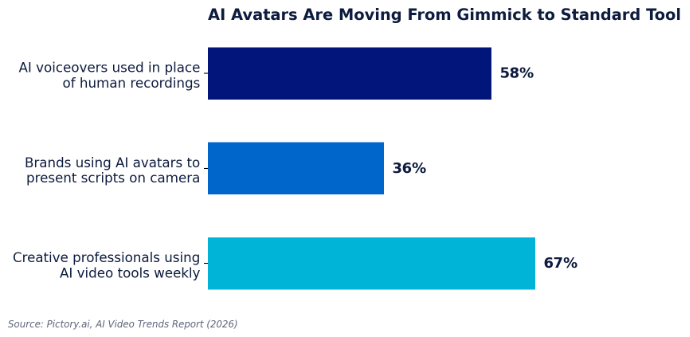
Figure 1: How quickly AI avatars and AI voiceovers have moved into B2B video production.
Why Adoption Jumped So Quickly in 2026
The economics made the decision easy for many marketing teams. Industry data shows AI-assisted video production costs have dropped from roughly $4,500 per finished minute with a traditional crew to around $400 per minute using AI tools, a reduction steep enough to change what gets greenlit at all, not just how it gets made. A 60-second video that once took up to two weeks from script to final cut can now move from script to finished asset in under half an hour.
That speed unlocked a category of content that rarely got made before: training videos, internal announcements, and recurring explainer series that didn’t justify a full production budget but clearly needed to exist.
It’s also reshaped who gets to greenlight video at all. When a finished asset costs a few hundred dollars and takes half an hour instead of thousands of dollars and two weeks, the approval threshold for trying a new video format drops accordingly, which is part of why overall AI video generation volume grew so sharply in such a short window.
Where AI Avatars Genuinely Work Well
AI avatars perform best in high-volume, instructional, or operational content where the message matters more than the messenger. Internal training and onboarding videos, product walkthroughs that need frequent updates as features ship, multilingual announcements rolling out to global teams, and recurring explainer series with a consistent format all fall into this category. In each case, viewers are evaluating the information, not forming a relationship with the presenter, which is exactly the situation where a synthetic presenter doesn’t cost you anything in credibility.
Where AI Avatars Quietly Fail With B2B Buyers
The failure mode is subtler than “it looks fake.” Most modern avatars look polished enough that the issue isn’t visual quality. It’s emotional weight. Brand-defining hero videos, founder-led storytelling, customer testimonials, and any moment meant to build trust ahead of a high-value purchase decision still depend on a viewer sensing that a real person stands behind the message. Swap in a synthetic presenter for those formats and the content can look perfectly professional while landing as strangely hollow, especially to an experienced enterprise buyer who has now seen enough AI video to recognize the pattern.
There’s a useful test for spotting this risk before publishing: would the message lose credibility if the audience later learned the presenter wasn’t real? If the answer is yes, that’s a strong signal the content belongs in human-presenter territory, regardless of how convincing the avatar looks in isolation.
A Decision Framework for Avatar vs. Human Presenter
Most teams don’t need a complicated decision process — they need a quick filter applied before every video brief gets written.
| Content Type | Recommended Presenter | Why |
| Internal training / onboarding | AI avatar | High volume, frequent updates, low emotional stakes |
| Product walkthrough / feature update | AI avatar | Needs fast iteration as the product changes |
| Multilingual announcements | AI avatar with voice cloning | Cost-prohibitive to reshoot per language with a human |
| Brand film / founder story | Human presenter | Buyer trust depends on sensing a real person |
| Customer testimonial | Human (the actual customer) | Authenticity is the entire value of the format |
THP’s Take: Use AI for Volume, Humans for High Stakes
THP Studio Perspective
Our rule of thumb with clients is simple: if the video’s job is to transfer information, an AI avatar is usually the right call and the faster one. If the video’s job is to earn trust ahead of a decision, put a real person on camera. Most B2B video calendars need both, in roughly the ratio their content mix demands — and most teams currently have that ratio backwards, reserving AI for the high-stakes hero video because it’s novel, instead of for the volume content where it actually pays off.
The teams getting the most value from this technology aren’t asking “should we use AI avatars.” They’re asking “which specific videos on our calendar this quarter are volume plays, and which are trust plays,” and routing each one to the right production approach accordingly.
Frequently Asked Questions
Key Takeaways
- AI avatars have moved from novelty to standard production tool, with 58% of AI marketing videos now using AI voiceovers.
- The cost shift is the real driver: roughly $400 per finished minute with AI versus $4,500 with traditional production.
- AI avatars perform best on high-volume, instructional content training, walkthroughs, and multilingual announcements.
- They consistently underperform on brand films, founder stories, and testimonials, where buyer trust depends on a real presenter.
- Apply a simple filter before every video brief: information-transfer content favors AI, trust-building content favors humans.
Work With THP’s Video Production & Motion Graphics Studio
THP’s Video Production & Motion Graphics Studio builds hybrid video workflows that use AI avatars where they make sense and real production craft where it matters most. If your video calendar is either all-AI or all-traditional, there’s likely a faster, more credible mix available.
Author