Account-based marketing used to be the strategy a handful of enterprise teams ran alongside their regular demand-generation program a specialized play for the biggest accounts, with its own budget line and a small team. That positioning has effectively collapsed. Nearly 80% of B2B organizations are now actively executing an account-based marketing strategy in some form, which means the conversation has shifted from whether to do ABM to how deeply its principles should run through everything else marketing does.
The shift isn’t really about a specific tactic spreading. It’s about a more fundamental change in how B2B teams think about who they’re actually marketing to a buying committee with multiple stakeholders, not a single lead filling out a form.
It’s a shift worth taking seriously even for teams that have never run a formal ABM program, because the underlying principle organize around the account, not the individual lead is increasingly embedded in the marketing technology itself, whether or not a team has explicitly adopted the ABM label.
Quick Takeaway
- Account-based marketing has moved from a specialized enterprise tactic to a default operating principle, with close to 80% of B2B organizations now running some form of ABM. The underlying driver is a shift away from targeting individual leads toward targeting entire buying committees, a structural change in B2B buying that AI-powered targeting and personalization tools have made far more practical to execute at scale than it used to be.
What “All Marketing Is Becoming Account-Based” Actually Means
The claim isn’t that every B2B company suddenly needs a dedicated enterprise ABM program. It’s that the core principle behind ABM, treating a specific company and its buying committee as the unit of marketing strategy, instead of an anonymous funnel of individual leads is becoming the default lens for B2B marketing generally, not a specialized add-on reserved for the largest accounts.
As one industry analyst put it in recent commentary on the shift, in complex, high-value B2B sales, all marketing arguably should already follow account-based principles because buying groups have always been part of how these deals are actually made. What’s changed is that the infrastructure now exists to act on that reality at a scale smaller teams can manage.
It’s a framing worth sitting with for a moment, because it reframes ABM not as a new invention but as a long-overdue correction. The buying committee was always there, on every meaningful B2B deal marketing technology simply lacked the tools to organize around it until fairly recently.
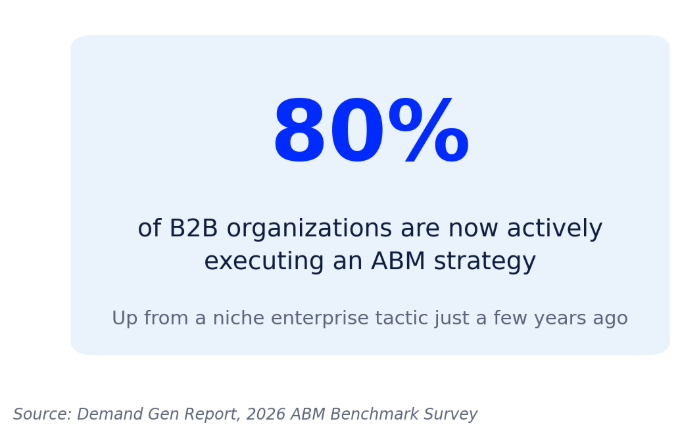
Figure 1: How widely account-based marketing has spread across B2B organizations.
Why Account-Based Marketing Crossed Into the Mainstream
Two forces converged to push ABM past its enterprise-niche origins. First, AI-powered tools made the personalization and targeting work that used to require a large dedicated team achievable with far less manual effort: account research, intent signals, and even first-draft landing page copy can now be generated and updated continuously rather than built once and left static. Second, the traditional lead-scoring funnel model (generate as many leads as possible, then hand the best-scoring ones to sales) has been losing credibility as B2B buying cycles have grown longer and more committee-driven, making a single lead score a poor proxy for real buying intent.
The tooling shift deserves particular attention because it changed the cost calculus, not just the capability. Account research that once required a dedicated analyst manually compiling firmographic and intent data can now be largely automated, which is the main reason ABM-style targeting has become viable for teams well below the size and budget of the enterprise programs that originally popularized it.
The Buying-Group Shift Behind the Trend
B2B purchases have always involved more than one decision-maker, but marketing technology spent years built around tracking individual leads anyway, because that was what the available tools could measure. As account and buying-group-level data has become easier to access and act on, marketing strategy has started catching up to how buying decisions were actually being made all along by a committee, evaluating a vendor together, not by a single name on a lead-gen form.
This is also why so many marketing and sales teams have felt a persistent, hard-to-name friction over the years: marketing was measured on individual lead volume while sales was managing relationships with an entire buying committee, and the two functions were effectively working from different units of analysis without anyone quite naming the mismatch.
A Framework for Applying ABM Principles at Any Scale
Teams without a large dedicated ABM function can still apply the core principles. The table below shows how the same idea scales down without losing its effectiveness.
| Scale | Approach | What Stays the Same |
| Enterprise (1:1) | Fully custom campaigns for a small number of named accounts | Deep, account-specific research and messaging |
| Mid-market (1:few) | Shared campaigns across a tightly defined account segment | Messaging built around a defined buying committee, not one lead |
| Broad (1:many) | Programmatic personalization at scale using AI-assisted tooling | Targeting and content still organized around accounts, not individual form fills |
Mistakes Teams Make When ABM Becomes the Default
As ABM principles spread beyond dedicated programs, a few predictable mistakes show up:
Many of these mistakes are really a single mistake wearing different disguises: adopting the language and tools of account-based marketing without actually changing how targeting, messaging, or measurement decisions get made day to day.
- Calling any account-level dashboard “ABM” without actually targeting buying committees differently from individual leads
- Adopting ABM language without adopting ABM measurement, so success still gets reported in lead volume instead of account engagement
- Assuming AI tools remove the need for sales and marketing alignment, when the model depends on that alignment more than ever
- Running 1:many ABM with messaging so generic it no longer reflects real account-level personalization
- Underinvesting in the account and intent data that makes any tier of ABM actually targeted, rather than account-based in name only
THP’s Take: Buying Groups, Not Account Lists, Are the Real Shift
THP Studio Perspective
- We’d push back gently on framing this trend purely as “ABM tools getting cheaper.” The more important change is conceptual: B2B marketing teams are finally building around the buying committee instead of the individual lead, because the data and tooling now make that possible at scales beyond a handful of enterprise accounts. Teams that adopt the language of ABM without adopting that committee-first mindset will see the label spread through their stack without the results following.
Our advice to clients making this transition: before buying any new ABM tooling, map out who actually sits on a typical buying committee for your product. That single exercise tends to reveal more about what your ABM program needs than a vendor comparison sheet ever will.
Frequently Asked Questions
Key Takeaways
- Nearly 80% of B2B organizations now run some form of account-based marketing, up sharply from its niche origins in enterprise.
- The underlying shift is conceptual: targeting buying committees instead of individual leads, not just a specific tactic spreading.
- AI-powered tooling and the limits of traditional lead scoring both pushed ABM principles into mainstream B2B marketing.
- ABM principles scale from fully custom 1:1 programs down to AI-assisted 1:many personalization without losing the account-first approach.
- Adopting ABM language without adopting buying-committee measurement and alignment is the most common way teams miss the real benefit.
Work With THP’s Campaigns & Demand Generation Studio
- THP’s Campaigns & Demand Generation Studio designs ABM programs at every tier — from fully custom enterprise plays to AI-assisted personalization at broader scale — always built around the buying committee, not just a list of target logos. If your funnel still treats every lead as a lone decision-maker, that’s worth revisiting.
Author