
B2B marketers have spent two decades optimizing for one dominant discovery channel: Google. That dominance is ending faster than most search strategies have adjusted for, and AI search SEO is the discipline most teams now need a working answer for. Gartner projects that by 2027, 95% of B2B buying journeys will start in a language model rather than a traditional search engine. Today, roughly 80% of buyer journeys still start with Google. That is not a gradual trend. It is a near-total channel reversal inside a couple of years.
The natural question for any marketing or SEO team watching that shift is simple: does SEO still matter? The honest answer is yes, but the job SEO is actually doing is changing underneath the same three letters.
It is worth noting how unusually fast this transition is compared to past search shifts. Mobile search took the better part of a decade to overtake desktop. The move toward AI-first discovery is on track to happen in a fraction of that time, leaving considerably less runway for marketing teams to adapt their existing SEO investment gradually.
Quick Takeaway
- AI search is on track to become the dominant starting point for B2B buying journeys, with Gartner projecting 95% of journeys beginning in a language model by 2027, up from roughly 80% starting on Google today. Traditional SEO does not disappear in that shift. It becomes the foundation AI search draws from, since AI tools still rely heavily on well-structured, technically sound, authoritative content to generate accurate answers. The job changes from ranking on a page to being a trusted, citable source.
What “AI Search Winning” Means for AI Search SEO
In practice, AI search winning does not mean Google disappears. It means an increasing share of research that used to start with a search query now starts with a question typed into a chat interface, which then synthesizes an answer from multiple sources instead of returning a ranked list of links for the buyer to click through themselves. The buyer gets a conclusion instead of a set of options to evaluate on their own.
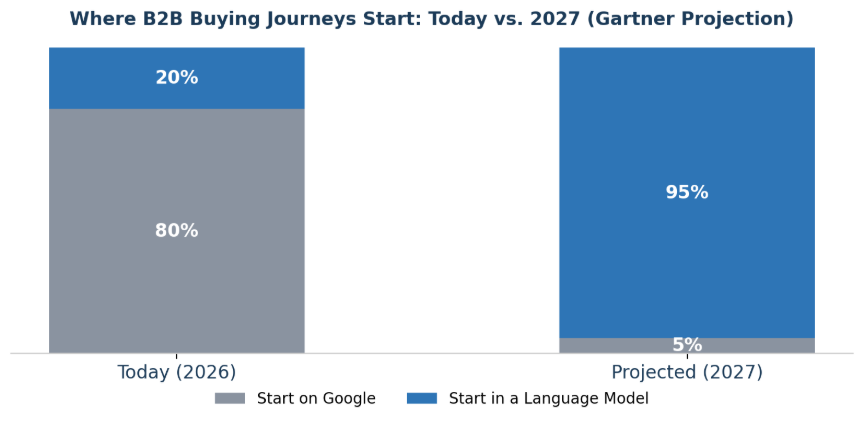
Figure 1: Where B2B buying journeys start today versus the 2027 projection.
Why Buyer Journeys Are Shifting So Quickly
Two forces are simultaneously accelerating the shift. Buyers have rapidly adopted AI chat tools for everyday research because they save time. A synthesized, conversational answer is faster to act on than scanning ten search results and forming a conclusion manually. At the same time, Google itself has been pushing AI-generated overviews directly into its own results pages, which means even searches that technically start on Google increasingly resolve into an AI-style synthesized answer before a buyer clicks through to any individual website.
A third, quieter force is simply familiarity. Once a buyer has a good experience getting a fast, synthesized answer from an AI tool for a personal question, it becomes the default habit for a professional research question as well. The behavior transfers across contexts faster than most B2B marketing teams expected.
Does Traditional SEO Become Irrelevant?
No, but its purpose shifts. AI search tools still need source material to generate an answer from, and that source material overwhelmingly comes from the same kind of well-structured, technically sound, authoritative content that good SEO has always rewarded. A page with clean technical fundamentals, clear topical authority, and credible citations is more likely to be the source an AI tool draws from and cites, even if fewer humans ever click through to read that page directly.
The practical shift is in what counts as success. Ranking number one on a results page matters less if the AI-generated answer above that results page already satisfied the buyer’s question using your content as a source, even when your brand name appears without a click-through. Visibility inside the answer becomes as important as ranking for the page underneath it.
This also changes how teams should think about content depth. Thin, surface-level pages built purely to rank for a keyword are particularly poorly suited to an AI-search world, because they offer an AI system little substantive material worth citing. Comprehensive, well-organized content that genuinely answers a question in depth tends to perform better on both fronts simultaneously.
A Framework for AI Search SEO in a Chatbot-First World
Adjusting an SEO strategy for this shift does not mean abandoning existing fundamentals. It means adding a layer on top of them.
| Focus Area | Traditional SEO Approach | AI-Search Era Addition |
| Content structure | Keyword-optimized headings and copy | Clear, structured answers to specific questions AI can extract cleanly |
| Authority signals | Backlinks from relevant sites | Consistent factual mentions across multiple credible sources |
| Technical foundation | Site speed, mobile responsiveness, crawlability | Same fundamentals, now equally important for AI crawlers |
| Success metric | Ranking position, organic traffic | Inclusion and accuracy inside AI-generated answers |
Mistakes Teams Make Reacting to the Shift
The urgency around AI search is real, but it is producing some predictable overreactions:
- Abandoning technical SEO fundamentals on the assumption they no longer matter, when AI tools depend on the same crawlable, well-structured content
- Chasing AI visibility with thin, repetitive content instead of the depth and accuracy AI tools actually reward when selecting sources
- Ignoring how a brand is discussed on third-party sites, when AI answers often synthesize from multiple sources, not just owned content
- Treating this as a one-time optimization project instead of an ongoing monitoring and adjustment process
- Underestimating how much traditional search traffic still matters today, even as the longer-term trend shifts toward AI search
THP’s Take: SEO Becomes the Foundation, Not the Finish Line
THP Studio Perspective
- We tell clients to stop thinking about SEO and AI search optimization as two competing disciplines fighting for budget. The content and technical work that earns a high search ranking is largely the same work that earns AI citation. The finish line just moved from a results page to an AI-generated answer. Teams that keep SEO fundamentals strong while adding AI-search monitoring on top are in a far better position than teams treating this as a reason to start over.
- The companies we would worry about most are the ones treating this shift as a reason to pause SEO investment while they figure out an AI strategy. The two are close enough to the same discipline that pausing one to plan the other mostly just loses ground on both.
Frequently Asked Questions
Key Takeaways
- Gartner projects 95% of B2B buying journeys will start in a language model by 2027, up from roughly 80% starting on Google today.
- Traditional SEO does not become irrelevant in an AI-search world. It becomes the foundation AI tools draw from to generate answers.
- The success metric shifts from ranking position to inclusion and accuracy inside AI-generated answers.
- Strengthen the same fundamentals: structure, authority, and technical health, while adding ongoing AI-search monitoring on top.
- Avoid abandoning SEO fundamentals prematurely. The content that earns search ranking is largely the same content that earns AI citation.
Work With THP’s Digital & XEO Studio
- THP’s Digital & XEO Studio builds search strategy for both destinations at once: strong technical and topical SEO fundamentals, paired with ongoing AI-search visibility monitoring. If your SEO roadmap has not yet accounted for the AI-search shift, that is the conversation to have before your next planning cycle.
Author