
For two decades, the visibility metric that mattered most to a CMO was some version of search ranking, where a brand showed up on a results page for the keywords that mattered. Share of AI voice is the metric quietly displacing that one. It measures how often and how favorably a brand is mentioned or cited in AI-generated answers from tools like ChatGPT and Perplexity, rather than how it ranks on a traditional results page that fewer buyers are actually clicking through anymore.
The shift isn’t theoretical. Recent research covering 400 B2B tech CMOs found that the share of AI voice is already the top visibility metric reported to CEOs, ahead of both traditional search share and media share of voice, a reordering that would have been unthinkable in a board deck two years ago.
It’s a metric that’s arriving faster than the tooling built to measure it reliably, which is part of what makes this moment interesting. CMOs are reporting on share of AI voice today using largely manual methods, well ahead of the mature, automated measurement platforms that eventually caught up with traditional SEO tracking over the better part of two decades.
Quick Takeaway
- Share of AI voice measures how often a brand appears, and how favorably, inside AI-generated answers rather than traditional search results. It’s now the top visibility metric reported to CEOs in recent CMO research, ahead of both traditional search share and media share of voice. The metric matters because buyers increasingly get their first vendor impression from an AI answer, not a search results page, making AI citation a new, measurable layer of brand visibility.
What Share of AI Voice Actually Measures
Share of AI voice tracks how frequently a brand, product, or executive gets mentioned inside the answers generated by AI search and chat tools, in response to relevant queries a real buyer might ask. A high share of AI voice means that when someone asks an AI tool a question your category should have an answer to, your brand is one of the names that comes back and ideally comes back with an accurate, favorable framing rather than an outdated or incorrect one.
It is a genuinely new measurement category, not a renamed version of an old one. Traditional SEO ranking tracks position on a results page a human scans. Share of AI voice tracks inclusion inside a synthesized answer a human reads as a conclusion, often without ever seeing the underlying sources.
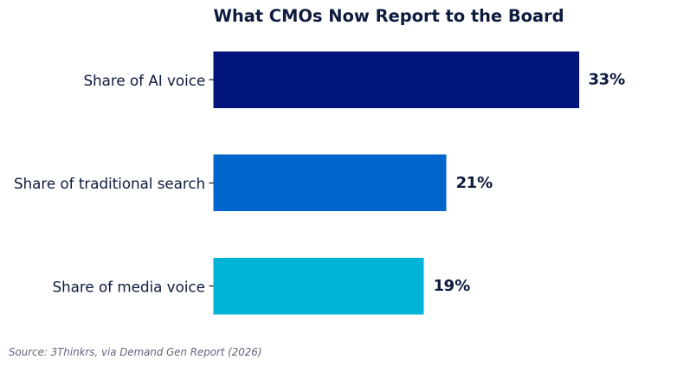
Figure 1: The visibility metrics CMOs are now reporting to their CEOs.
Why This Metric Is Showing Up in Board Reports Now
The board-level urgency tracks a broader shift in how buyers actually research vendors. AI tools are increasingly the first stop in a B2B buying journey, ahead of a direct visit to a company’s website, which means a brand that is effectively invisible in AI answers is invisible at the exact moment a buyer is forming their first impression of who belongs on a shortlist.
CMOs reporting share of AI voice to the board are making a specific argument: traditional search visibility, while still relevant, no longer captures the full picture of where buyer attention and trust actually form. A board that only sees search ranking data is missing an increasingly important part of the discovery journey entirely.
How Share of AI Voice Differs From Traditional Search Visibility
The mechanics behind the two metrics are genuinely different, which is why optimizing for one does not automatically improve the other. Traditional search rewards keyword relevance, backlink authority, and technical site performance. AI answer generation rewards content structure, factual consistency across sources, and how authoritatively a brand is discussed elsewhere on the internet. This means a brand can rank reasonably well in traditional search while still being underrepresented or misrepresented inside AI-generated answers, and vice versa.
This independence is exactly why CMOs are now tracking both metrics rather than assuming one implies the other. A brand with years of strong SEO investment may discover its AI voice share is surprisingly weak simply because its most authoritative content was never structured in a way that is easy for an AI system to extract and cite cleanly.
A Framework for Starting to Measure It
Most companies don’t yet have a mature measurement system for this metric, which means starting simple beats waiting for a perfect tool. The table below outlines a practical starting framework
| Step | What to Do | What You Learn |
| 1. Query mapping | List the questions a real buyer would ask an AI tool in your category | The actual queries worth tracking, not guesses |
| 2. Manual sampling | Run those queries across ChatGPT, Perplexity, and similar tools monthly | Whether your brand appears, and how accurately |
| 3. Accuracy audit | Check whether AI-generated mentions of your brand are factually correct | Where outdated or wrong information is spreading |
| 4. Source tracing | Identify which of your own pages or third-party mentions the AI cited | Which content is actually feeding AI answers |
Mistakes Teams Make When Adopting This Metric Too Fast
Share of AI voice is genuinely useful, but early adoption has a few predictable failure modes:
The common thread across all of these is borrowing the confidence of a mature metric for one that is still genuinely new, applying the same certainty to share of AI voice that decades of tooling investment eventually earned for traditional search ranking.
- Treating one good result from a single query as proof of strong overall AI visibility
- Reporting the metric to leadership without explaining the underlying measurement is still manually sampled, not a mature analytics platform
- Chasing AI visibility while ignoring the accuracy of what’s actually being said about the brand once it’s mentioned
- Abandoning traditional SEO investment prematurely, when both forms of visibility still matter and often reinforce each other
- Assuming a single tool’s results represent AI search behavior broadly, when answers vary meaningfully across platforms
THP’s Take: Treat It as a Leading Indicator, Not a Vanity Number
THP Studio Perspective
- We would caution against treating share of AI voice as a finished, board-ready metric the way search ranking became after years of tooling maturity. Right now, it is closer to a leading indicator worth tracking directionally. Is it improving, is the AI getting the facts right, are competitors showing up more often than you. Build the habit of tracking it now, while being honest about how early-stage the measurement infrastructure still is.
- The brands that benefit most over the next two years will likely be the ones that started tracking this directionally now, even imperfectly, rather than waiting for a polished dashboard to arrive before paying attention to it at all.
Frequently Asked Questions
Key Takeaways
- Share of AI voice measures brand visibility inside AI-generated answers, distinct from traditional search ranking.
- It’s now the top visibility metric reported to CEOs in recent CMO research, ahead of traditional search and media share of voice.
- The metric matters because AI tools are increasingly the buyer’s first stop for research, ahead of a direct website visit.
- Start measuring with manual query sampling across major AI tools before expecting mature automated tracking platforms.
- Treat it as an early-stage leading indicator right now, not yet a fully mature, board-ready metric the way SEO ranking became over time.
Work With THP’s Digital & XEO Studio
- THP’s Digital & XEO Studio tracks and improves share of AI voice alongside traditional SEO performance, mapping the queries that matter to your category and auditing what AI tools are actually saying about your brand. If your last board deck only covered search ranking, this is the gap worth closing next.
Author