
Technical SEO has always been the unsexy part of digital marketing: the crawlability fixes, the schema markup, the Core Web Vitals work that nobody outside the SEO team gets excited about. That reputation has not changed. What has changed is the stakes. AI search engines depend on technically sound, well-structured, clearly parseable content to generate accurate answers. A site with unresolved technical issues, inconsistent structured data, or poor content organization is not just less visible in traditional search. It is harder for AI systems to understand, extract from, and cite with confidence.
The technical SEO checklist that mattered in 2022, focused heavily on speed, crawlability, and backlinks, still matters. But it needs a significant extension for the AI search era. Several technical factors that used to be “nice to have” are now core to how AI engines decide whether to draw from your content at all.
This article is organized as a working checklist. Each item can be actioned by a technical SEO practitioner, a web developer, or, in many cases, a content team that understands what the technical signals are communicating. The goal is a site that performs equally well for the human buyer clicking through and the AI engine deciding whether to cite it.
Quick Takeaway
- AI search engines do not just reward high-quality content. They reward technically accessible, well-structured, schema-annotated content that is easy to parse, extract, and synthesize. This technical SEO checklist covers seven areas that matter most for AI visibility in 2026: structured data, content hierarchy, crawl accessibility, page experience, internal linking, entity signals, and freshness indicators. Many of these are also classic SEO best practices, which is good news. The improvements you make for AI visibility will typically improve traditional search performance as well.
Why AI Engines Have Different Priorities Than a Standard Technical SEO Checklist
Traditional search engines have decades of infrastructure built to crawl and rank web pages. They have sophisticated systems for interpreting pages even when those pages are technically imperfect. AI systems, particularly those that use live retrieval to generate answers, have less tolerance for ambiguity. They need to quickly determine what a page is about, what its key claims are, who published it, and whether it is authoritative enough to cite. Technical SEO factors that help with those determinations get rewarded in AI-era visibility.
The specific factors AI engines prioritize tend to be: content that is structured so its key points can be extracted without reading the entire page, schema markup that explicitly labels the content type and its key attributes, entity signals that connect the content to a known brand with established authority, and freshness signals that confirm the information is current.
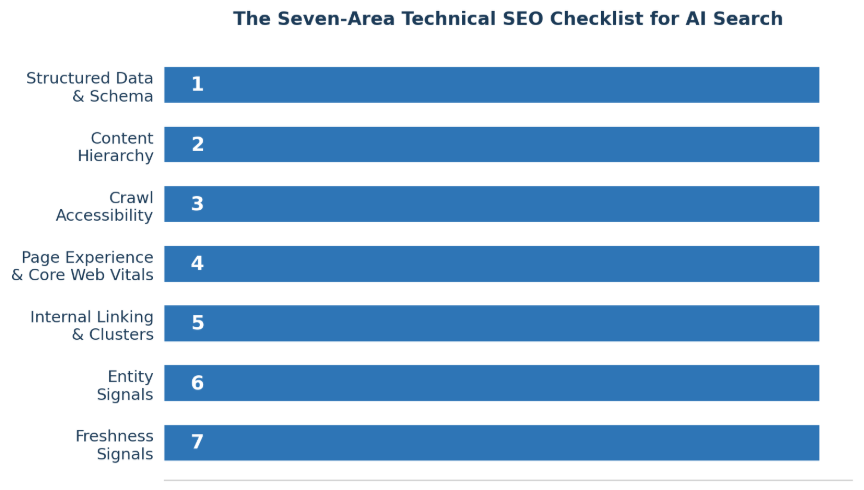
Figure 1: How technical SEO signals map to AI engine citation decisions.

The Seven-Area Technical SEO Checklist
Work through each area in order. Earlier items tend to have the most immediate impact on both traditional and AI search visibility.
Area 1: Structured Data and Schema Markup
| Checklist Item | Why It Matters for AI |
| Add Article or BlogPosting schema to every content page | Signals content type explicitly, helping AI engines categorize and extract |
| Add FAQPage schema to any page with Q&A content | FAQ schema makes Q&A content directly extractable by AI systems |
| Add Organization schema to homepage and About page | Establishes brand entity signals that AI engines use to identify your company |
| Add Author schema with linked author bios | E-E-A-T signal that AI citation selection weighs positively |
| Add HowTo schema to instructional content | Structured format AI engines prioritize for process-based queries |
Area 2: Content Hierarchy and Heading Structure
| Checklist Item | Why It Matters for AI |
| Every page has one H1 that clearly states the topic | AI engines use the H1 as the primary content signal for topic extraction |
| H2s are used as section headers that stand alone as descriptive phrases | AI systems often extract H2 content as answer snippets independently |
| H3s are used to break down H2 sections logically | Nested hierarchy signals content organization that aids AI parsing |
| No heading levels are skipped (no jumping from H1 to H4) | Irregular hierarchies confuse content parsers used by AI retrieval systems |
Area 3: Crawl Accessibility
| Checklist Item | Why It Matters for AI |
| Robots.txt does not block AI crawlers like GPTBot, PerplexityBot, or ClaudeBot | AI systems cannot cite content they cannot access |
| Key content pages are included in the XML sitemap | Ensures AI crawlers can discover content systematically |
| No important content is hidden behind login walls or JavaScript rendering | AI crawlers are typically less capable of rendering complex JavaScript than traditional search crawlers |
Area 4: Page Experience and Core Web Vitals
| Checklist Item | Why It Matters for AI |
| Largest Contentful Paint (LCP) under 2.5 seconds | Slow pages are crawled less frequently, reducing freshness for AI systems |
| Cumulative Layout Shift (CLS) under 0.1 | Layout instability is a signal of page quality that AI selection correlates with |
| Pages pass mobile responsiveness testing | AI systems that test pages for mobile compatibility factor it into quality signals |
Area 5: Internal Linking and Content Clusters
| Checklist Item | Why It Matters for AI |
| Related content pages link to each other with descriptive anchor text | Internal links signal topical relationships that AI systems use to assess depth |
| Pillar pages link out to and receive links from supporting cluster content | Cluster structure signals topical authority to both traditional and AI search |
Area 6: Entity Signals
| Checklist Item | Why It Matters for AI |
| Brand name used consistently across all pages (no abbreviations or informal variants) | Consistent entity naming is foundational for AI recognition |
| Author names consistent across all authored content | Allows AI systems to build accurate author entity records |
| Location, contact, and company details present and consistent across site | Entity corroboration signals that align with off-site references |
Area 7: Freshness and Update Signals
| Checklist Item | Why It Matters for AI |
| Published and last-modified dates included in page metadata | Freshness signals help AI engines prefer current information |
| Content updated with new data or examples at least annually | AI systems that perform live retrieval favor recently updated content |
| Outdated statistics or references replaced when updated data is available | Factual accuracy is weighted more heavily in AI citation than in traditional ranking |

THP’s Take: Technical SEO Is the Foundation AI Builds On
THP Studio Perspective
- The technical SEO audits we run for clients in 2026 look significantly different from the ones we ran three years ago. The checklist is longer, the schema requirements are more specific, and the crawlability considerations now include AI-specific bots that many sites have not yet addressed. But the underlying logic is the same: a technically sound site is one that any intelligent system, traditional search engine or AI retrieval model, can read, understand, and trust. Get the technical foundation right and every other visibility investment performs better on top of it.
- The most common gap we find is schema markup. Most B2B websites have none, or have the same generic Organization schema on every page regardless of content type. That is a fixable gap with measurable impact, and it is one of the first places we recommend clients invest technical SEO time in 2026.
Frequently Asked Questions
Key Takeaways
- AI search systems need technically accessible, well-structured, schema-annotated content to cite brands accurately.
- The seven technical areas that matter most for AI visibility are: structured data, content hierarchy, crawl accessibility, page experience, internal linking, entity signals, and freshness indicators.
- Schema markup is the most commonly neglected technical SEO area, and one of the highest-impact fixes available to most B2B websites.
- Blocking AI crawlers in robots.txt prevents AI systems from accessing content, which eliminates any possibility of AI citation.
- Technical SEO improvements for AI visibility also improve traditional search performance, making this a compound investment rather than a trade-off.
Work With THP’s Digital & XEO Studio
- THP’s Digital & XEO Studio runs comprehensive technical SEO audits built for both traditional and AI search engines, covering schema, crawlability, content structure, and entity signals. If your site has not been audited against AI-era technical requirements, that is where this engagement starts.
Author