Open most B2B marketing dashboards and you will find a funnel: visitors at the top, marketing-qualified leads in the middle, opportunities and closed deals at the bottom. The shape is familiar, the conversion rates are tidy, and the quarterly review follows a well-worn script. Where did we leak? How do we fill the top faster?
The funnel is not wrong. It is incomplete. It describes how a buyer moves toward a purchase, but it says nothing about what happens to the value created once they buy. Growth loops fill that gap. This article compares the two models, explains when each is the right tool, and shows how B2B teams can run them together without tearing up their reporting.
Quick Takeaway
- Funnels and loops are not rival philosophies. A funnel is a diagnostic for conversion; a loop is a design for reinvestment. B2B teams get into trouble when they use the funnel to plan growth, because the funnel assumes every quarter starts again at the top.
A Funnel Measures Conversion in One Direction
A marketing funnel is a model of the stages a buyer moves through on the way to a purchase, typically awareness, interest, consideration and decision, used to measure how many prospects progress from one stage to the next.
Funnels became the default growth model for good reasons. One widely used version, the AARRR framework (acquisition, activation, retention, referral and revenue), was created by Dave McClure, as Brian Balfour of Reforge notes. Funnels give each stage an owner and a conversion rate, make leaks visible and support forecasting. For a sales leader asking how many opportunities are needed to hit a number, a funnel is still the right tool.
A Growth Loop Feeds Its Own Output Back In
A growth loop is a closed system in which the output of one cycle, such as a customer result, a referral or a published answer, is reinvested as the input for the next cycle.
The concept was set out in Reforge’s “Growth Loops are the New Funnels”. The key difference is what happens at the end. In a funnel, a new customer is an outcome to be counted. In a loop, a new customer is also a source of the next input: a result that becomes proof, a sponsor who becomes a referrer, a set of questions that become content. Our pillar guide to B2B growth loops covers the model in full.
Six Differences That Change How You Plan
| Dimension | Marketing funnel | Growth loop |
| Direction | Linear, from top to bottom | Circular, with output returning as input |
| What a customer represents | The end of the process | The start of the next cycle |
| Growth pattern | Roughly proportional to input | Can compound when output is reinvested |
| Core planning question | Where are we losing prospects? | What does each cycle produce that we can reuse? |
| Team model | Stage owners: marketing, then sales, then customer success | Named owners for each step, with the loop shared across teams |
| Primary metrics | Stage conversion rates and volume | Cycle time, loop conversion rate and yield per cycle |
Table 1: Key differences between marketing funnels and growth loops.
The team model row deserves attention. The Reforge authors argued that funnels create functional silos in which marketing, product and sales optimize at each other’s expense. Anyone who has watched marketing hit a lead target while sales complains about lead quality has seen this in action. A loop makes the handoffs part of the design, because the loop only works if the output of one team becomes a usable input for another.
Linear Growth Needs More Fuel; Compounding Growth Needs Time
In a funnel, output is a function of input. Double the budget at the top and, if conversion rates hold, you roughly double the customers at the bottom. Stop spending and the flow slows. That is linear growth, and it is not a criticism. Linear growth is predictable and easy to plan around.
In a loop, some output is added to a stock that generates future input: a library of proof, a base of referring customers, a body of content that earns visibility. When that stock keeps growing, each cycle can produce more than the last. That is compounding. It comes with a cost: loops usually trail direct acquisition at first, because effort goes into building the reinvestment step.
| Month | Funnel: cumulative inputs | Loop: cumulative inputs | Loop: new inputs that month |
| 1 | 100 | 80 | 80 |
| 6 | 600 | 544 | 102 |
| 12 | 1,200 | 1,273 | 137 |
| 24 | 2,400 | 3,560 | 246 |
Table 2: Illustrative model with hypothetical values, not benchmark data. The funnel buys 100 inputs a month. The loop diverts 20% of that budget into building the loop and reinvests 5% of its accumulated output each month. The same model is charted in our pillar guide.
The practical lesson is about patience and proof. A loop judged on its first quarter will look like a worse funnel. Judged over two years, the same loop can change the economics of acquisition. That is why the metrics you agree before launch matter so much; we cover them in Growth Loop Metrics.
Buyers Never Moved Through Your Funnel in a Straight Line
The funnel is also a poor description of how B2B buyers actually behave. Gartner describes B2B purchases as six buying jobs that buyers loop through, revisiting each at least once: problem identification, solution exploration, requirements building, supplier selection, validation and consensus creation.
6sense’s 2025 B2B Buyer Experience Report, based on nearly 4,000 buyers, adds two findings that matter here. First, 94% of buyers ranked their shortlist by preference before engaging sellers. Second, buyers arrive with history: 97% had prior experience with at least one vendor on their shortlist. Buyers are not entering at the top of your funnel. They are re-entering, carrying impressions from previous evaluations, previous vendors and peers.
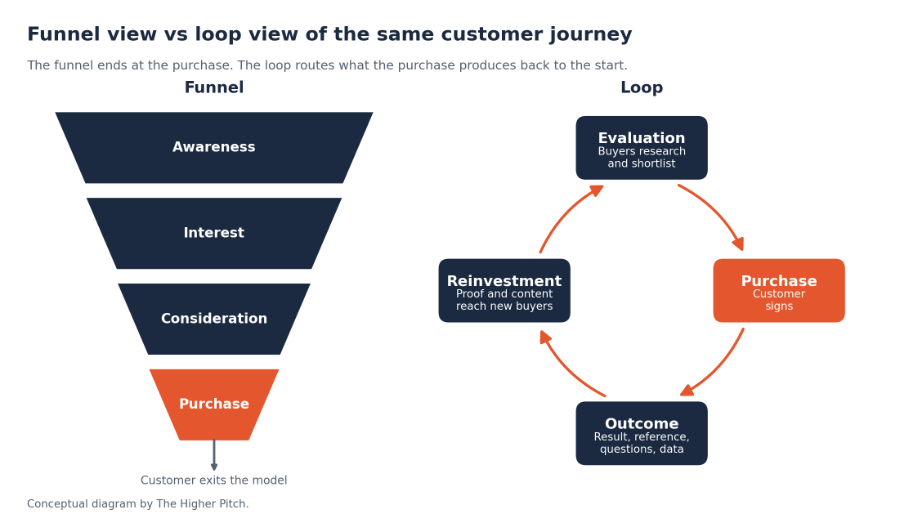
Figure 1: The same journey seen as a funnel and as a loop. Conceptual diagram.
The buying committee makes the difference sharper. A funnel tends to collapse a committee into a single lead or opportunity. A loop treats each member’s experience as a potential input.
| Committee role | How a funnel treats them | How a loop treats them |
| Champion | A contact on the opportunity | A future referrer and reference, whether or not you win |
| Ultimate decision maker | The signature at the bottom | A peer voice for future decision makers in the category |
| Financial ratifier | An approval step | A source of the cost and risk questions your next content must answer |
| Influencer or evaluator | A stakeholder to manage | A potential reviewer and a source of technical questions |
| Procurement | A late-stage hurdle | Feedback on how easy you are to compare and buy |
Table 3: The buying-committee lens on funnels and loops.
Use the Funnel to Diagnose and the Loop to Design
The choice is not either-or. The useful question is which model should lead in a given situation.
| Situation | Lead with | Why |
| New offer or new market with few customers | Funnel | There is little output yet to reinvest; you need to generate the first cycle |
| Short-term pipeline target this quarter | Funnel | Loops rarely move numbers within a single quarter |
| Diagnosing where deals stall | Funnel | Stage conversion rates show where the leaks are |
| Acquisition cost rising year after year | Loop | Reinvested output lowers dependence on bought input |
| Long cycles and infrequent purchases | Loop | Loops keep you present between buying windows |
| Strong customer base with unused proof and relationships | Loop | The inputs already exist and are being wasted |
Table 4: When to lead with a funnel and when to lead with a loop.
Funnels and Loops Work Best as One System
The most practical way to combine the two is to keep the funnel as the conversion spine and attach a loop to every exit from it. Every deal ends somewhere: won, lost, stalled or churned. Each of those exits produces something that can be reinvested.
| Funnel exit | What it produces | How to reinvest it |
| Closed won | A customer who will soon have results | Schedule an advocacy request at the first measurable outcome |
| Closed lost | A buyer who knows you and has reasons | Capture the reasons, answer them in content, and stay in the buyer’s orbit for the next cycle |
| No decision | Evidence of where consensus broke down | Build tools that help the next committee agree, such as business case templates |
| Churned | Candid feedback on fit and value | Tighten fit criteria and fix the gaps before they reach the next cohort |
Table 5: Attaching a loop to every funnel exit.
The closed-lost row is the one most teams ignore. 6sense’s research found that prior evaluations precede most B2B wins, and its 2025 report advises vendors to get on the shortlist and make a good impression even when the current deal looks unlikely. A lost deal is not the end of a funnel. It is an input to a future cycle, if someone owns it.
A B2B Example: Adding a Loop to a Services Firm’s Funnel
Consider a hypothetical cybersecurity services firm selling incident-readiness programs to mid-market financial services companies. This is an illustration, not a client.
The funnel view. Webinars and paid LinkedIn campaigns generate registrations. Marketing qualifies them, sales development books meetings, and a readiness assessment converts a share of meetings into programs. Each quarter the firm asks the same question: how do we get more registrations?
The loop added. Every readiness assessment produces anonymized findings. The firm aggregates them into a twice-yearly report on the gaps it sees most often, written for CISOs and risk leaders. The report attracts new evaluators, who request assessments, which produce more findings for the next report. A second loop runs alongside: each client that completes a program is invited to a small peer roundtable, and roundtable members introduce peers from other institutions.
What changes in measurement. The funnel metrics stay. The firm adds loop metrics: how many assessments feed each report, how many new evaluations the report generates, how long it takes from assessment to published insight, and how many introductions each roundtable produces. Within a few cycles, the leadership team can see whether the loop is producing more input per cycle, or simply producing reports.
To design a loop like this step by step, see How to Build a B2B Growth Loop From Scratch. For more loop types, see 7 B2B Growth Loop Examples.
THP Studio Perspective
- We would not tell a B2B team to throw away its funnel. Sales leaders need stage conversion rates, and boards need forecasts. The mistake is letting the funnel decide strategy. A funnel will always tell you to buy more at the top, because that is the only lever it can see. The question a funnel cannot ask is what your last hundred customers produced that you never used again: the results, the introductions, the questions. That unused output is usually the cheapest growth a company has.
Frequently Asked Questions
Key Takeaways
- Keep the funnel for diagnosis and forecasting, but stop using it as the growth strategy, because it only knows how to ask for more input.
- Attach a loop to every funnel exit, including lost deals, which most teams discard despite evidence that prior evaluations shape future wins.
- Expect a loop to trail direct acquisition early, and agree before launch which metrics will show it is working.
- Plan around the buying committee: each member’s experience with you, win or lose, is a potential input to a future cycle.
- Make handoffs part of the design, so that one team’s output is deliberately turned into another team’s input.
Work With THP’s Campaigns & Demand Generation Studio
- THP’s Campaigns & Demand Generation Studio designs B2B campaigns and funnel strategy around pipeline, not just lead volume. If your funnel is well measured but still resets every quarter, we can help you work out which exits to turn into loops first.