Most B2B companies do not have a lead problem, a pipeline problem and a forecasting problem. They have one problem that shows up in three places.
The lead lifecycle, the sales pipeline and the forecast are a single system. Each one is built from the layer below it. When marketing changes what counts as a qualified lead, the pipeline changes shape two months later and the forecast misses a quarter after that. The three are usually owned in three different places, reviewed in three different meetings, and defended with three different sets of numbers. That split is the reason so many revenue teams can produce a confident forecast and still be surprised at the end of the quarter.
This page sets out how the three layers fit together, what each one is for, who should own it, and where the model usually breaks. It is the parent page for a set of deeper guides on terminology, lifecycle design, opportunity stages, governance, qualification, deal management, forecasting methods and pipeline metrics.
The three layers, defined in plain terms
Start with the definitions, because almost every argument between marketing and sales about pipeline turns out to be an argument about words.
A lead lifecycle describes the state of a person or a company. It answers one question: is this account ready for a seller’s time? Typical stages run from lead through marketing qualified lead, sales accepted lead and sales qualified lead.
Opportunity stages describe the state of a deal. They answer a different question: how far has this specific deal actually progressed? Discovery, evaluation, proposal and negotiation are typical names.
Forecast categories describe the state of a commitment. They answer a third question: what are we telling the business we will land this period? Pipeline, best case, commit and closed are the common labels.
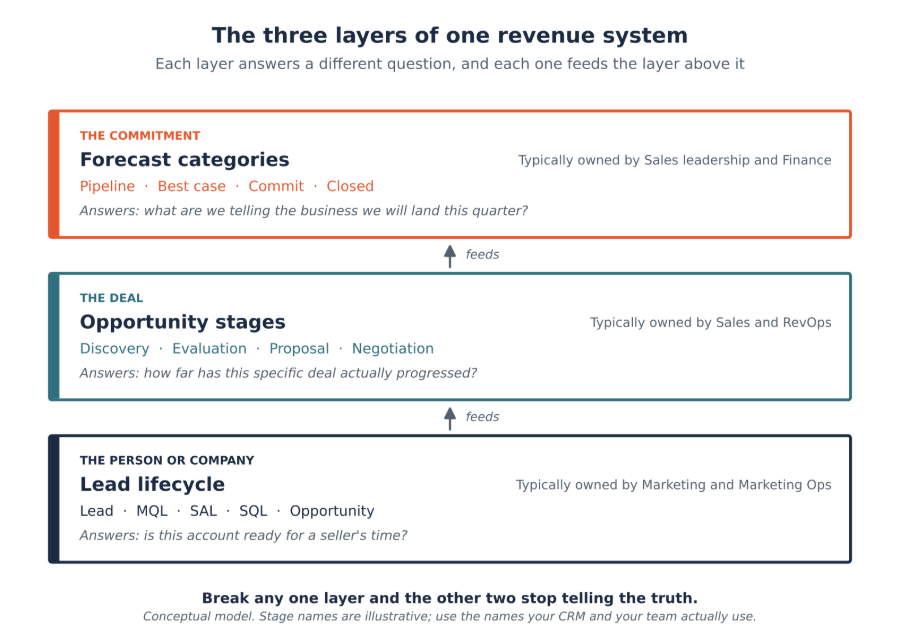
Figure 1. The three layers answer different questions and feed each other in sequence. Conceptual model.
The layers are sequential. Lifecycle feeds pipeline. Pipeline feeds forecast. That sequence is why a forecasting problem is so rarely a forecasting problem. If marketing is passing records that sellers do not accept, the pipeline fills with deals that were never real, and no forecasting method can correct for that. The arithmetic will be clean and the answer will still be wrong.
Our full comparison of MQL, SQL, SAL and opportunity covers the terminology in depth, including where each stage starts and ends and who owns it.
Why the split ownership causes most of the damage
In most B2B organisations, marketing owns the lifecycle, sales owns the pipeline, and finance and leadership own the forecast. Each team optimises its own layer. Each optimisation makes the next layer worse.
Marketing is measured on MQL volume, so the MQL threshold drifts downward. Sales is measured on pipeline coverage, so deals get created early and stages get skipped. Finance is measured on forecast accuracy, so it applies its own haircut to the number sales submits. By the time the board sees a figure, it has been adjusted three times by three groups who do not agree on what the underlying records mean.
The fix is not a new dashboard. It is a shared operating model with one set of definitions, one owner per stage, and written rules about what evidence is required to move a record forward. That is unglamorous work, and it is the single highest-return project most revenue teams can run.
This is the territory revenue operations is supposed to cover. Where RevOps exists and has authority over definitions, the three layers tend to agree. Where it does not, they drift.
Designing the lifecycle: fewer stages, testable criteria
A lifecycle should be built from your buying journey, not from your CRM’s defaults. HubSpot ships seven default lifecycle stages, from subscriber through to evangelist, and most teams adopt them without asking whether their buyers actually move that way.
Three design rules matter more than the stage names.
Use as few stages as you can defend. Every stage you add is a stage someone has to maintain, report on and argue about. If you cannot state what a stage is for in one sentence, delete it.
Write entry and exit criteria as testable rules. “Shows strong interest” is not a rule. “Has a job title in the target list, is at an account in the ICP, and has either requested a demo or visited pricing twice in 14 days” is a rule. Anyone can check it. Two people will reach the same answer.
Name one owner per stage, and agree a response time at each handoff. The handoffs are where lifecycles fail, not the stages.
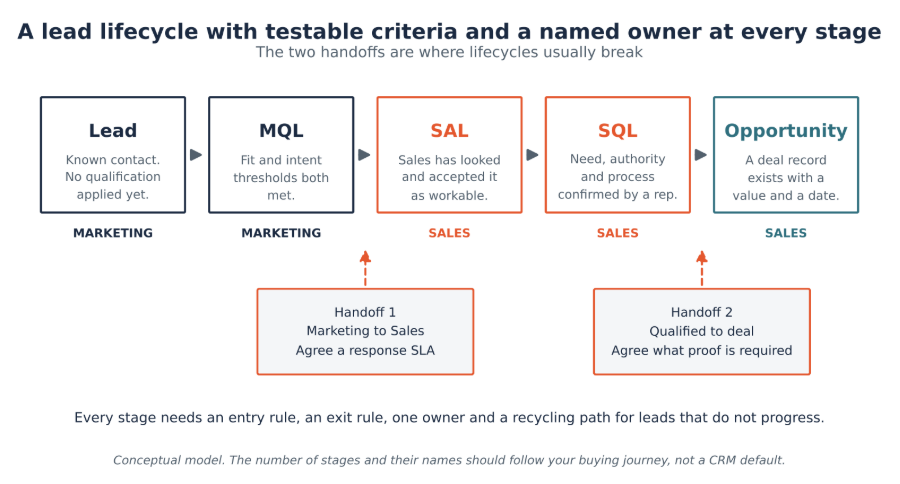
Figure 2. The two handoffs, marketing to sales and qualified to deal, are where most lifecycles break. Conceptual model.
One implementation detail trips up a lot of teams. HubSpot’s own documentation notes that automatic lifecycle stage updates only move a record forward; to move a stage backward you have to clear the value first and then set an earlier one, or change it manually. That is sensible default behaviour, because it stops records oscillating. It also means your recycling and disqualification paths need to be designed deliberately rather than assumed.
How to design a B2B lead lifecycle that sales actually trusts covers stage counts, SLAs, recycling paths, and contact-level versus account-level lifecycles for ABM motions.
Opportunity stages should describe what the buyer did
This is the single most useful change most sales organisations can make to their pipeline, and it costs nothing but a workshop and some rewriting.
Most stage models describe seller activity. Demo delivered. Proposal sent. Following up. The problem is that a seller can complete all of those without the buyer committing to anything. A deal can sit at “proposal sent” for a quarter and tell you nothing, because the stage records what your team did rather than what the customer decided.
Buyer-commitment stages describe something the buyer has done that can be verified. The buyer confirmed the problem and what it costs them. The buyer shared evaluation criteria in writing. The buyer introduced the economic buyer. The buyer agreed a mutual plan with dates in it.
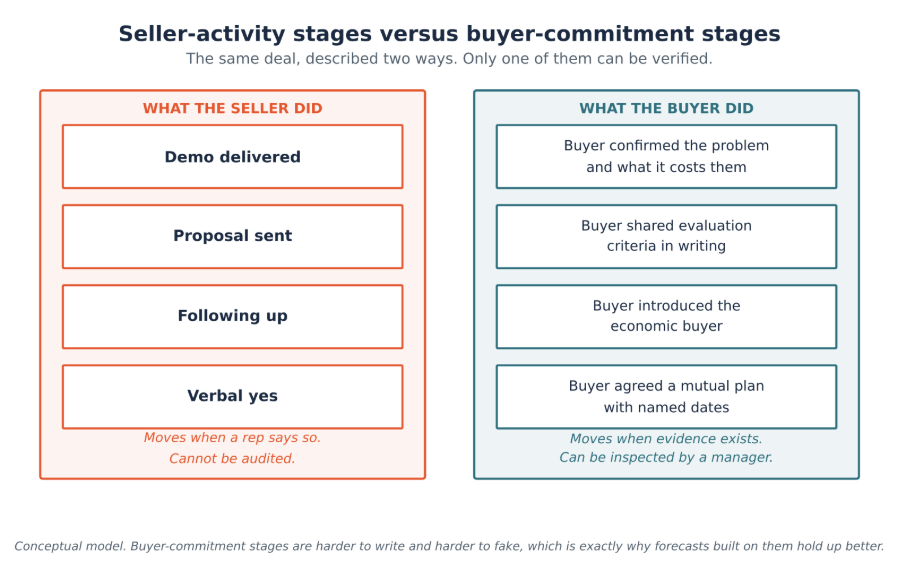
Figure 3. The same deal described two ways. Only the buyer-commitment version can be inspected. Conceptual model.
The practical difference shows up in pipeline review. With activity stages, a manager asks “where is this deal?” and gets an opinion. With commitment stages, the manager asks “what did the buyer do to get it here?” and either there is evidence or there is not. Forecasts built on the second kind of stage hold up better, because the stage itself is harder to fake.
Sales opportunity stages: how to define deal stages around buyer commitments works through a full stage model with exit criteria, and explains why default stage probabilities mislead.
Qualification is the gate between the two layers
Qualification is where the lifecycle hands over to the pipeline, which makes it the most consequential decision in the system. Let too much through and the pipeline inflates. Let too little through and you starve coverage and annoy marketing.
It helps to separate two different jobs that both get called qualification.
Marketing qualification asks whether this account and this person are worth a seller’s attention. It is mostly about fit and intent.
Sales qualification asks whether there is a real, funded, winnable deal here. It is about need, authority, process and timing.
The named frameworks each attack the second job from a different angle. BANT looks at budget, authority, need and timeframe, and IBM still publishes a formal BANT criteria template that partners must complete before an opportunity is accepted. MEDDIC, which originated in the sales organisation at PTC with Dick Dunkel, Jack Napoli and John McMahon, goes deeper on metrics, economic buyer, decision criteria, decision process, pain and champion. HubSpot built its own extension, GPCTBA/C&I, on the argument that BANT alone “isn’t good enough anymore” now that buyers diagnose their own problems before they speak to anyone.
The framework matters less than whether you turn it into CRM fields and stage exit criteria. A qualification framework that lives in a training deck changes nothing.
B2B sales qualification frameworks: BANT, MEDDICC, CHAMP and how to choose compares them properly and covers how to choose based on deal size, cycle length and committee size.
The buying-committee problem that lifecycles were not built for
Here is the structural flaw in the model almost everyone runs. Lifecycles track individual contacts. B2B purchases are made by groups.
The scale of the gap is well documented. 6sense’s research across just under 4,000 buyers found that the typical buying group evaluates around five vendors, and that 75% of buying group members enter the process already knowing at least one seller. Its 2025 Buyer Experience Report found buyers now make first contact with sellers around 61% of the way through their journey, earlier than the roughly 69% recorded in prior years, and that 94% of buyers had already ranked their shortlist by preference before engaging any seller. The vendor sitting at the top of that private ranking won 77% of the time.
Read that sequence again, because it reframes the whole model. By the time a single contact becomes an MQL, a group has usually been working for months, has a shortlist, and has a favourite. A lifecycle that scores one person against one set of thresholds is measuring a fragment of something much larger.
Forrester reached the same structural conclusion about its own model. The SiriusDecisions Demand Waterfall, first launched in 2006 and rearchitected in 2012, was built around individual leads. Its successors moved deliberately away from that: the Demand Unit Waterfall arrived in 2017, and in May 2021 Forrester released the B2B Revenue Waterfall, which expands the model to target buying groups and to include existing customers through renewal, cross-sell and upsell. Forrester’s Monica Behncke framed the shift simply: “The new role of marketing and sales is to help buyers progress through their buying journey.”
You do not need to rebuild your CRM to respond to this. Three practical moves get you most of the way:
- Roll scoring up to the account, not just the contact. A single engaged contact at a large account is weaker evidence than four contacts in different functions.
- Track buying roles on the deal, not just names. Who is the economic buyer, who is the champion, who runs the evaluation process.
- Treat a single-threaded deal as a risk flag in pipeline review, regardless of how confident the rep sounds.
Governance is what keeps the model honest
A well-designed pipeline decays. Reps skip stages under pressure. Close dates get pushed to the end of the next quarter and then the one after. Deals sit untouched and nobody closes them out, because closing them out makes the coverage number look worse.
Governance is the set of rules that slows that decay: required fields per stage, validation that blocks stage skips, aging thresholds that flag stale deals, and a review cadence that actually inspects rather than reports.
The hard part is the balance. Too few rules and the data is meaningless. Too many rules and reps enter whatever gets the form to submit, which produces data that is worse than none because it looks complete. The right test for any required field is whether a manager would change a decision based on it. If not, it should not be required.
Pipeline stage governance: rules, required fields and who gets to move a deal covers the operating rhythm in detail, including who owns change requests and how to document a one-page pipeline playbook. If the underlying records are already messy, these seven signs that CRM data is blocking sales growth are worth reading first.
Forecasting: pick the method that matches your data
There are three mainstream approaches, and the honest answer is that most teams should run two of them side by side.
Forecast categories place each deal in a named bucket by human judgement. HubSpot’s documented categories are not forecasted, pipeline, best case, commit and closed won, with “commit” defined as deals that have a high likelihood of closing and have been committed to the forecast. The method works when the categories have written definitions and people are held to their calls. It degrades quickly when “commit” quietly comes to mean “I hope so”.
Weighted pipeline multiplies each deal’s value by its stage probability. In HubSpot, stage probability drives the weighted amount shown in the deal board view. It is fast and reasonable at portfolio level with many similar deals. It is actively misleading when you have a small number of large deals, or when your stage probabilities are still the CRM defaults nobody ever revisited.
Historical conversion applies your own measured stage-to-stage rates to current pipeline. It is the hardest number to argue with, and it needs enough closed history and a stable motion to be trustworthy.
The useful discipline is to produce both a system number and a human number, then treat the gap between them as the agenda for the forecast call. When the rep call and the model disagree by a wide margin, that is information, not noise.
B2B sales forecasting methods compared goes through each method, how to reconcile rep call with manager call with system forecast, and what AI-assisted forecasting can and cannot realistically do.
The metrics that tell you where the system is leaking
Five numbers cover most of what leadership needs:
- Coverage. Open pipeline divided by target. Useful as a trend for your own business. Dangerous as a borrowed benchmark, because the right ratio is a function of your own win rate and cycle length, not an industry constant.
- Velocity. Opportunities times average deal value times win rate, divided by cycle length in days. The value of this formula is that it shows how much leverage sits in win rate and cycle time, neither of which requires more leads.
- Stage-to-stage conversion. The fastest way to find the actual leak. In most B2B funnels the largest single drop sits at the marketing-to-sales handoff, which is also the drop teams are least willing to look at.
- Win rate, measured by count and by value, split by source and segment. The blended number hides almost everything interesting.
- Cycle length and stage duration. Where deals sit, not just how long they take overall.
Pipeline metrics that matter works through each one with a labelled illustrative example, including the pipeline velocity calculation and how to decide what each metric should change.
Common failure patterns
Four show up again and again:
Inflated MQLs. The threshold drops to hit a volume target. Sales stops working the queue. Marketing concludes sales is lazy, sales concludes marketing sends junk, and both are responding rationally to the incentive they were given.
Happy ears. Deals advance on enthusiasm rather than evidence. A buyer who says “this looks great” has committed to nothing. Commitment stages are the structural fix.
Stages nobody uses. The model has eight stages and the pipeline sits in three. Usually it means the stages describe an internal process rather than the buyer’s.
Forecasts built on gut feel. Not because judgement is worthless, but because unexamined judgement cannot be improved. A call that is never compared against what actually happened never gets better.
How CRM and automation support the model
A CRM does not create a lifecycle. It enforces one you have already agreed.
Once the definitions exist, the platform work is mostly about making the right thing easy and the wrong thing hard: properties that match your stage criteria, automation that sets stages from real signals rather than form fills, validation that stops deals skipping stages, required fields kept deliberately lean, and reporting that uses the same definitions everyone argued about in the workshop.
HubSpot is a reasonable example because its lifecycle, deal stage and forecast objects are documented and connect cleanly. The platform matters less than the discipline. A well-governed pipeline in a modest CRM beats a badly governed one in an expensive stack every time. Our HubSpot implementation guide covers the setup sequence, and marketing automation strategy covers the triggers that drive stage changes.
THP Studio Perspective
- The uncomfortable part of this work is that it usually makes the numbers look worse before anything improves. Tighten the MQL definition and volume falls. Enforce stage criteria and coverage drops. Clean out stale deals and the pipeline shrinks. We have watched teams abandon the project at exactly that point, because the first reporting cycle after a clean-up reads like a decline rather than a correction. It is not. It is the first honest number you have had. Agree with leadership before you start that the first quarter is a baseline, not a result.
Where to start
If you are inheriting a system you do not trust, work bottom up. Fix definitions before stages, stages before governance, governance before forecasting methods. Changing forecasting technique on top of unreliable stage data just produces a more sophisticated wrong answer.
A reasonable first 90 days: agree written definitions for every lifecycle stage and deal stage, rewrite the deal stages around buyer commitments, set required fields and a stale-deal threshold your team actually chose, then measure stage-to-stage conversion for a full quarter before you change anything else.
Frequently asked questions
Key takeaways
- Lifecycle, pipeline and forecast are one system in three layers. A forecasting problem is almost always a definitions problem that has travelled upward.
- Opportunity stages built on verifiable buyer commitments hold up under inspection. Stages built on seller activity do not.
- Qualification is the gate between the lifecycle and the pipeline, and a framework only works once it becomes CRM fields and stage exit criteria.
- Lifecycles track individuals while B2B purchases are made by groups, so account-level rollups and buying-role tracking are corrections, not refinements.
- Expect the numbers to look worse after you fix the model. That first honest reading is the baseline the rest of the work is measured against.
Work With THP’s HubSpot and MarTech Studios
- We help B2B revenue teams rebuild the connection between lifecycle, pipeline and forecast so that one set of definitions runs through the whole system. That usually starts with a review of how your stages are defined and what your CRM is actually enforcing. If your forecast and your pipeline keep telling different stories, talk to our HubSpot consulting team or explore how our Automation and Technology and MarTech Solutions practices approach revenue system design.
Author