
Quick takeaway
- Most pipeline stages record what the seller did. Useful stages record what the buyer did. The difference sounds semantic until a manager asks why a deal is at proposal and the honest answer is “because we sent a proposal”, which tells you nothing about whether anyone is going to sign it. Stages built on verifiable buyer commitments can be inspected, challenged and forecast against. Stages built on seller activity can only be believed.
The two ways to describe the same deal
A sales opportunity stage is a label on a deal record describing how far the deal has progressed. There are only two honest ways to define what “progressed” means.
Seller-activity stages describe what your team has done. Demo delivered. Proposal sent. Following up. Verbal commitment.
Buyer-commitment stages describe something the buyer has done that leaves evidence. The buyer confirmed the problem and quantified what it costs. The buyer shared evaluation criteria in writing. The buyer introduced the economic buyer. The buyer agreed to a plan with named dates.
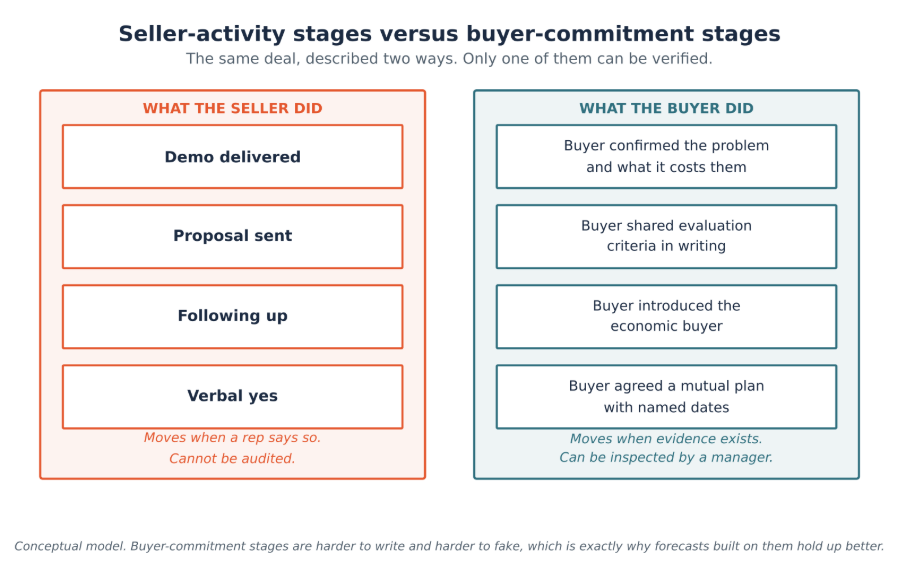
Figure 1. The same deal described two ways. Only one version can be verified by someone who was not on the call. Conceptual model.
The second list is harder to write and harder to satisfy. That is the point. A seller can deliver a demo to a buyer who is comparison shopping with no budget. A seller cannot get that buyer to introduce an economic buyer, so the stage will not move, and the pipeline will tell the truth about a deal that is not real yet.
This matters more than it used to. 6sense’s 2025 Buyer Experience Report, based on just under 4,000 buyers, found that 94% of buyers had already ranked their shortlist by preference before engaging any seller, and that the vendor at the top of that private ranking won 77% of the time. If buyers arrive with a preference already formed, seller activity is a particularly weak signal of progress. What the buyer does in response is the only read you have on where you sit in a ranking you cannot see.
A sample stage model with exit criteria
Names matter less than the exit criteria behind them. Here is a model that works for considered B2B purchases with multiple stakeholders. Adapt the labels; keep the structure.
| Stage | What the buyer has done | Exit criteria | Required evidence |
| Qualified | Confirmed a problem exists and is worth solving | Problem named, impact described, buyer agrees to a working session | Notes naming the problem and its cost |
| Discovery | Shared how they will evaluate and who is involved | Evaluation criteria and process captured, at least two stakeholders engaged | Written criteria, named contacts with roles |
| Validation | Tested the solution against their own criteria | Technical or commercial validation completed and signed off by their team | Validation outcome recorded |
| Proposal | Received a proposal built against agreed criteria | Proposal reviewed with the economic buyer, not just forwarded to them | Meeting held with economic buyer present |
| Commercial | Entered formal negotiation or procurement | Terms under discussion, approval path and dates confirmed | Mutual plan with dates |
| Closed won | Signed | Contract executed | Signed agreement |
| Closed lost | Chose otherwise or stopped | Loss reason selected from the fixed list | Reason code plus competitor if relevant |
Two design rules sit behind that table.
Each stage should be exited for one reason, not several. If a stage has four possible exit conditions, it is really two stages or none.
Evidence must be something a manager can look at. “Rep confident” is not evidence. A recorded meeting with the economic buyer is.
Stage probability, and why the defaults mislead
Every CRM attaches a probability to each stage. In HubSpot, each stage in the default pipeline carries a probability indicating the likelihood of closing, and that probability “is used to determine the weighted amount shown in board view, which is calculated by multiplying the total amount in each stage by the stage probability”. Custom values can be set.
The defaults are placeholders. They were not derived from your business, your segment or your current motion, and most teams never replace them. That produces a weighted pipeline number which looks analytical and is essentially decorative.
Three things to fix:
Derive probabilities from your own closed history. Take deals that reached each stage over a long enough window and calculate what share eventually closed won. That is your probability. It will usually be lower than the default at early stages and sometimes higher at late ones.
Segment them. New business and expansion deals do not convert at the same rates. Neither do enterprise and mid-market. One blended probability per stage averages away the thing you needed to know.
Recalculate on a schedule. Probabilities drift as pricing, competition and motion change. Once a year is a reasonable minimum, once a quarter is better if your volume supports it.
One caution worth stating plainly. Weighted pipeline is a portfolio tool. It works when you have many deals of similar size, because errors cancel out. With a small number of large deals it produces nonsense, because no individual deal closes for 40% of its value. Our forecasting comparison covers when to use it and when not to.
One pipeline or several
A single pipeline is simpler to manage and usually wrong once you sell more than one way.
Use separate pipelines when the stages themselves would differ. New business, expansion, renewal and partner-sourced deals genuinely move through different steps: a renewal has no discovery stage worth the name, and an expansion deal starts with an existing relationship and a known economic buyer.
Use one pipeline with a deal-type field when the stages are the same and only the reporting needs to differ. If you find yourself leaving half the stages unused on a whole category of deal, that category needs its own pipeline.
The cost of over-splitting is real: more pipelines mean more models to maintain, more training, and more chances for reporting to double count. Three or four is usually plenty.
Stages for long, complex, multi-stakeholder deals
Long cycles create a specific problem. A deal can sit in one stage for months while real progress happens, which makes stage alone a poor indicator of health.
Three additions help without multiplying stages:
- Track stakeholder coverage as a field, not a stage. How many of the known buying roles have you actually met. A deal in late stage with one contact is a different risk from the same deal with five.
- Track the next commitment, with a date and a name, separately from the stage. Progress inside a stage is still progress.
- Track stage entry date, so that time-in-stage becomes visible. Long cycles are fine. Long silences are not.
Resist the urge to add stages to represent partial progress. That produces the eleven-stage pipeline where everything sits in stage four.
Closed-lost reasons should be a designed field
This is the cheapest high-value change on the list, and almost everyone leaves it as free text.
Free text loss reasons are unanalysable. You end up with four hundred unique strings, half of which say “price”. Design the field instead:
- Use a fixed picklist of eight to twelve reasons, mutually exclusive, written in the buyer’s terms rather than yours.
- Separate “lost to competitor” from “no decision”, because they are completely different failures with completely different fixes. No-decision losses usually point at a qualification or urgency problem, not a competitive one.
- Capture the competitor as a separate field when relevant.
- Make it required to close a deal as lost, and audit it quarterly.
Then actually read it. A loss-reason report that nobody reviews is a data collection exercise. Reviewed quarterly against stage data, it tells you which stage your losses concentrate in, which is usually where your stage criteria are too loose.
Signs your stages need a redesign
Four symptoms, each with a likely cause:
Deals skip stages. Either the skipped stage represents something that does not happen in your real process, or the criteria are so onerous that reps route around them.
Everything piles up in one stage. Usually that stage covers too much. If 60% of your pipeline sits in “discovery”, discovery is doing the work of three stages.
Deals move backward often. Stages are advancing on optimism rather than evidence. The stage is being set by how the call felt.
Reps and managers disagree about what a stage means. The criteria are either undocumented or written in adjectives.
A useful diagnostic: pull twenty open deals, and ask the rep and the manager independently which stage each belongs in. The disagreement rate tells you whether you have a definition problem or an enforcement problem. Pipeline stage governance covers the enforcement half.
THP Studio Perspective.
- The rewrite we push hardest for is turning “proposal sent” into “proposal reviewed with the economic buyer”. It is one phrase and it changes the behaviour of a whole sales team, because sending a document is something a rep controls and getting a specific person into a specific meeting is not. Teams resist it, usually by saying their buyers do not work that way. Sometimes true. More often the deals where you cannot get that meeting are the deals that were never going to close, and the stage is doing its job by refusing to move.
Frequently asked questions
Key takeaways
- Stages describing verifiable buyer commitments can be inspected. Stages describing seller activity can only be believed.
- Every stage needs one exit reason and evidence a manager can actually look at.
- CRM default stage probabilities are placeholders, and weighted pipeline built on them is decorative rather than analytical.
- Split pipelines when the stages genuinely differ, and use a deal-type field when only the reporting needs to.
- A designed closed-lost picklist that separates competitive losses from no-decision losses is the cheapest diagnostic you can add.
Work With THP’s Automation and Technology Studio
- We help sales organisations rewrite deal stages around buyer commitments and then configure the CRM so the criteria hold under pressure. That usually includes deriving stage probabilities from actual closed history rather than inherited defaults. See how our Automation and Technology practice approaches it, or talk to our HubSpot consulting team. The full lifecycle, pipeline and forecasting model sets out how stages feed the forecast.
Author