
Many B2B content teams live on a treadmill. They publish a set number of articles each month from a keyword list, watch traffic rise a little, and start again with the next list. Each article is a separate bet. Very little of what the last article taught them makes the next one better.
An SEO growth loop changes the unit of work. Instead of publishing pages, you run a system in which every page produces signals (search queries, conversions, sales questions) that decide what gets written next and how existing pages connect. This article explains how that loop works, where AEO and GEO fit, why internal linking is its most neglected step, and how to measure whether it is compounding.
Quick Takeaway
- The compounding part of SEO is not the traffic. It is the learning. A B2B SEO loop compounds when each page feeds real buyer questions and performance data back into the next piece and into the links between pages, so the whole topic gets stronger rather than simply bigger.
An SEO Growth Loop Turns Every Page Into the Source of the Next One
An SEO growth loop is a system in which content earns visibility in search and AI answers, that visibility produces visits, leads and conversations, and the data from those interactions is used to create, update and connect the next content, so each cycle improves the site’s coverage and authority on its core topics.
The contrast with a conventional content plan is the direction of information. A content calendar flows one way: plan, publish, report. A loop flows back: what buyers searched, clicked, asked and bought decides the next plan. It is one of the seven loop types we cover in 7 B2B Growth Loop Examples, and the model behind all of them is set out in our guide to B2B growth loops.
Content → Traffic → Leads → Data → Content
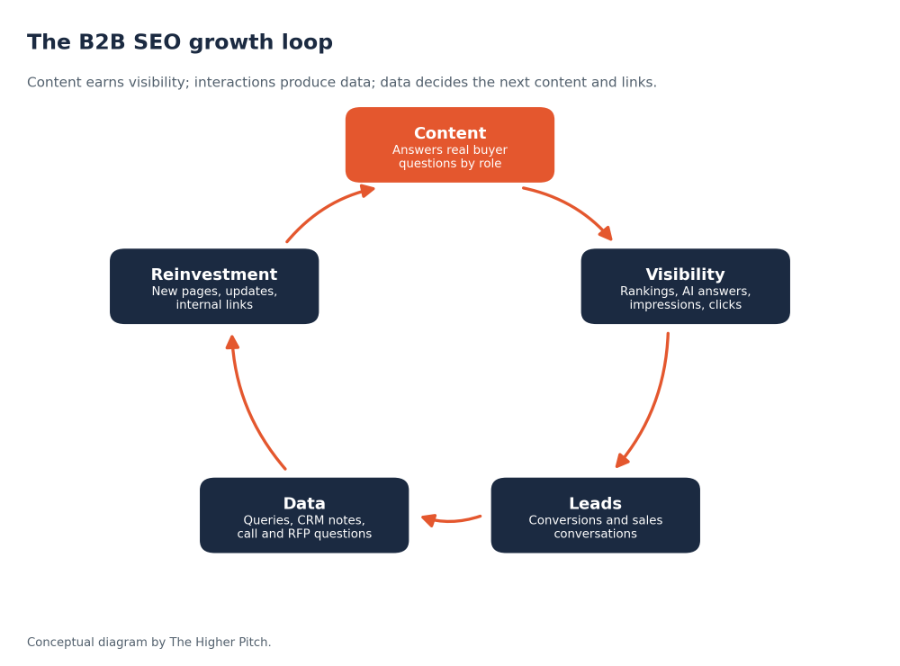
Figure 1: The B2B SEO growth loop. Conceptual diagram.
Content. Pages written for specific buying roles, answering questions buyers actually ask. In B2B, useful content is usually narrower than a keyword tool suggests, because it serves a committee member with a specific concern.
Traffic and visibility. Rankings, clicks and, increasingly, appearances in AI-generated answers. Not all visibility produces a visit; our piece on zero-click search explains why impressions and citations now matter alongside clicks.
Leads and conversations. Conversions such as demo requests and downloads, but also the less visible outcome: prospects who arrive at a sales call having read your content, and quote it back.
Data. Search Console queries, on-site search terms, CRM notes, sales call transcripts, RFP questions, support tickets and lost-deal reasons. This is the stage most teams underuse.
Reinvestment. New pages that answer uncovered questions, updates to pages that are close to ranking, consolidation of pages that compete with each other, and internal links that connect new work to old. Then the loop turns again.
Your Best Keyword Research Is Already in Your CRM and Sales Calls
Keyword tools tell you what large numbers of people search for. They are much weaker at telling you what the members of a B2B buying committee need answered before they will agree to buy. That information sits inside your own business:
- Sales calls and demos: the objections and “how does this work with…” questions that come up repeatedly.
- RFPs and security questionnaires: detailed requirements that buyers are also researching independently.
- Support and onboarding tickets: the problems customers hit after buying, which prospects worry about before buying.
- Lost-deal notes: the doubts you failed to resolve.
- Search Console queries: the phrases already bringing people to your site, often long and specific.
The process is straightforward: capture these questions continuously, group them by topic and buying role, prioritize them by commercial relevance, and turn them into briefs. The buying committee gives you a useful structure for that prioritization.
| Committee role | Typical questions they search | Content that answers them |
| Ultimate decision maker | Is this the right approach for a company like ours? | Strategic guides, comparisons of approaches, peer outcomes |
| Champion | How do I explain and justify this internally? | Business case frameworks, summaries they can forward |
| Financial ratifier | What will it cost, and what is the risk if it goes wrong? | Cost drivers, total cost explanations, risk and failure analysis |
| Influencer or technical evaluator | Will it work with our systems, and how is it secured? | Integration, architecture, security and implementation detail |
| Procurement | How do we compare vendors fairly? | Evaluation criteria, checklists and transparent scope definitions |
Table 1: The buying-committee lens for SEO topic selection.
AEO and GEO Extend the Loop Into AI Answers Without Changing Its Fundamentals
Buyers increasingly start research in AI assistants. In G2’s April 2026 research, half of B2B software buyers (51%) said they now begin software research with an AI chatbot more often than with Google, up from 29% in April 2025. That makes answer engine optimization (AEO) and generative engine optimization (GEO) part of the same loop rather than a separate program.
Google’s own guidance is helpful here. Its documentation on AI features and your website says there are no additional requirements to appear in AI Overviews or AI Mode, and no special optimizations needed beyond foundational SEO practices such as creating helpful, reliable, people-first content. It also explains that these features may use a “query fan-out” technique, issuing multiple related searches across subtopics to build a response.
The practical implication for the loop is our analysis, not Google’s claim: a site that covers a topic’s subtopics thoroughly, and connects them clearly, gives these systems more relevant material to draw on. No one can guarantee inclusion in an AI answer. What the loop can do is make sure the answers buyers are looking for exist on your site, are clearly written, and are consistent across pages. Track AI visibility as one of the loop’s outputs; our articles on generative engine optimization, entity SEO and share of AI voice cover the mechanics, and AI search and B2B buying journeys covers the buyer side.
Internal Linking Is the Reinvestment Step Most Teams Skip
Publishing is the visible part of SEO. Linking is where the loop closes, because it is how new content strengthens existing content and vice versa.
Google’s link best practices state that Google uses links as a signal when determining the relevance of pages and to find new pages to crawl. The same guidance recommends that every page you care about is linked from at least one other page on your site, that anchor text describes the destination, and that linking out to cite sources can help establish trustworthiness.
Turn that into a standing rule for every cycle of the loop:
- Link up: every new page links to its pillar page and to the relevant service page, with descriptive anchor text.
- Link across: every new page links to the two or three closest related articles in the same cluster.
- Link back: when a new page goes live, add links to it from older related pages. This reverse linking is the step most teams forget, and it is the one that turns a new page into a stronger cluster.
- Cite out: link claims to their primary sources, which serves readers and signals care.
Our technical SEO checklist for AI search covers crawlability and site structure in more detail.
Measure the Loop, Not Just the Rankings
Rankings and traffic are loop outputs, not loop health. Measure each stage, and pay particular attention to the reinvestment stage, because that is where most SEO programs quietly stall.
| Loop stage | What to measure | Where to find it | Warning sign |
| Content | Share of new pages briefed from real buyer questions | Content briefs, CRM and call notes | Briefs come only from keyword tools |
| Visibility | Impressions, clicks, rankings and AI answer appearances for the cluster | Search Console, rank and AI visibility tracking | Growth in pages without growth in cluster visibility |
| Leads | Content-assisted conversions and content referenced in sales conversations | CRM, analytics, sales feedback | Traffic rises while pipeline influence stays flat |
| Data | New buyer questions captured each month | Call summaries, support, RFPs, Search Console | Question capture depends on one person remembering |
| Reinvestment | Time from question to published answer; links added to older pages | Content calendar and CMS | New pages published without reverse links |
Table 2: SEO growth loop metrics by stage.
If organic traffic is falling while the loop is healthy, that is not necessarily a failure; our piece on why B2B website traffic is dropping explains how to read that situation. The broader metric model is in Growth Loop Metrics.
Example of a B2B SEO Growth Loop
Consider a hypothetical data integration software company selling to mid-market finance and operations teams. This is an illustration, not a client.
Cycle one. The company publishes a pillar guide on connecting ERP and CRM data, plus four supporting articles. Search Console shows impressions for queries the team had not targeted, including several about reconciling data between systems during month-end close. Sales call summaries show CFOs repeatedly asking about audit trails.
Reinvestment. The team writes two new articles: one on month-end reconciliation between systems, written for finance leaders, and one on audit trails in automated integrations, written for the financial ratifier. Both link up to the pillar and across to the related articles, and three older pages are updated to link to them.
Cycle two. The new articles bring in visitors from finance roles the company previously struggled to reach. One converts to a demo request, and the prospect’s questions on implementation timelines become the next brief. The cluster now covers the CFO’s concerns as well as the technical evaluator’s.
What compounded. Not the page count. The company’s coverage of the full buying committee, the internal links that connect it, and a process that turns every sales conversation into a candidate brief.
THP Studio Perspective
- A slightly contrarian view: most B2B sites do not need more content first. They need their existing content connected, consolidated and corrected. In our view, the fastest compounding in SEO usually comes from the reinvestment step rather than the publishing step: merging pages that compete for the same query, linking new work to old, pruning pages that no longer earn their place, and rewriting pages to answer the questions sales keeps hearing. Publishing is the visible part of SEO. Maintenance is where the loop actually closes.
Frequently Asked Questions
Key Takeaways
- Treat SEO as a system that learns, not a publishing schedule: the data stage decides what the next cycle produces.
- Mine your CRM, sales calls, RFPs and support tickets for topics, and organize them by buying-committee role.
- Keep AEO and GEO inside the same loop, since Google says foundational SEO practices apply to its AI features.
- Make internal linking, especially reverse linking from older pages, a mandatory step in every cycle.
- Measure reinvestment speed and committee coverage, not just rankings and traffic.
Work With THP’s Digital & XEO Studio
- THP’s Digital & XEO Studio works across SEO, AEO, GEO and AI search visibility for B2B brands. If your content program publishes steadily but does not seem to compound, we can help you build the data and linking steps that close the loop.
Author