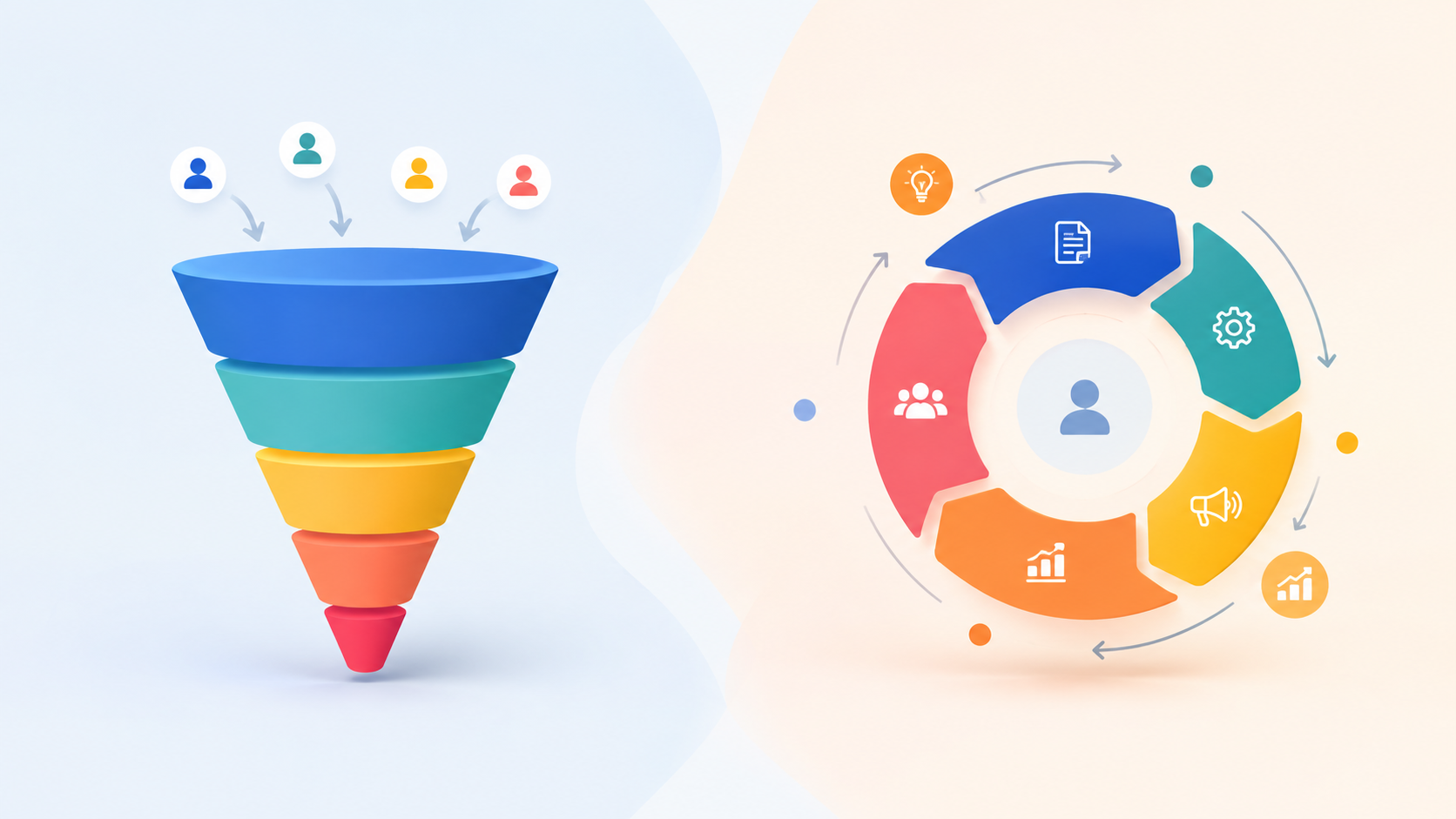
Every few years someone announces the death of the funnel, and every few years marketing teams keep using it, because forecasting and stage conversion rates are genuinely useful. HubSpot’s Loop Marketing is the latest of these announcements, and it deserves a more careful hearing than most, because the evidence behind it is checkable.
This article compares the two models on specifics: how each handles the buyer journey, segmentation, channels, experimentation and data. It also answers the question most articles skip, which is whether a B2B team should actually retire the funnel.
Quick Takeaway
- The funnel describes how a buyer progresses. The Loop describes how a marketing team works. They answer different questions, which is why the honest answer to “does Loop replace the funnel” is no, and why HubSpot’s own framing is narrower than the headlines suggest.
The Traditional Funnel Is a Model of Buyer Progression
A traditional marketing funnel is a model of the stages a buyer passes through on the way to a purchase, typically awareness, consideration and decision, used to measure how many prospects progress between stages.
Its strengths are practical. It assigns stage ownership, makes drop-off visible, and supports forecasting. In campaign form it also describes how most marketing work is organized: plan, produce, launch, report.
Loop Marketing Is a Model of How Marketing Work Runs
HubSpot Loop Marketing is a four-stage framework (Express, Tailor, Amplify, Evolve) in which marketing runs as a continuous cycle, with humans and AI working together and each cycle’s learning feeding the next.
HubSpot introduced it in September 2025 and describes it on its playbook page as a cycle that applies to any objective once three foundations are in place: a customer guide, a style guide and a data layer. Our pillar guide covers the framework in full.
Note the difference in what each model is about. The funnel is about the buyer. The Loop is about the team. That distinction explains most of the confusion in this debate.
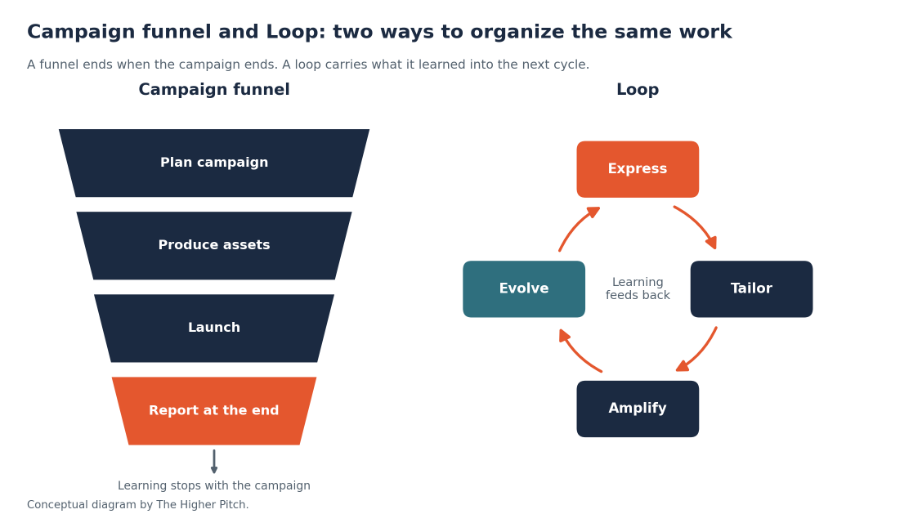
Figure 1: Campaign funnel and Loop compared. Conceptual diagram.
Six Differences That Change How Work Gets Planned
| Dimension | Campaign funnel | Loop Marketing |
| Shape | Linear, from awareness to decision | Cyclical, each pass informing the next |
| Unit of work | The campaign, with a start and end date | The loop, aimed at one objective |
| Segmentation | Defined in advance, applied consistently | Continuous, driven by unified data and intent signals |
| Channels | Owned channels plus paid media | Diversified, including answer engines and third-party sources |
| Optimization | Reviewed after the campaign ends | Continuous experiments during the cycle |
| Team model | Humans execute against a plan | Humans and AI working together, each on what they do best |
Table 1: The differences that matter in planning.
For the general argument about linear versus compounding growth models, which applies beyond HubSpot’s framework, see Growth Loops vs Marketing Funnel.
The Buyer Journey Changed, and the Click Data Is the Clearest Evidence
The strongest part of HubSpot’s case is not the framework, it is the diagnosis. Kipp Bodnar, HubSpot’s CMO, is quoted in the announcement saying the old funnel assumed customers would come to you, and that when a majority of searches never leave Google and AI answers questions before prospects click, the playbook is broken.
Checking the numbers is worthwhile, because they have moved. HubSpot’s launch post cites 60% of Google searches ending without a click, attributed to SparkToro’s 2024 study, which reported 58.5% in the US and 59.7% in the EU. SparkToro’s 2026 study, based on a Similarweb panel for January to April 2026, found 68.01% of US searches ended without a click.
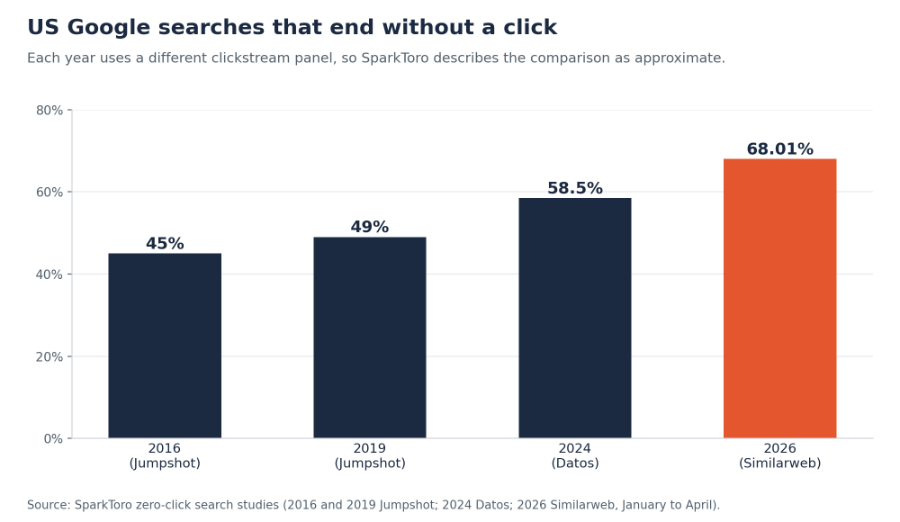
Figure 2: Source: SparkToro zero-click search studies. Rand Fishkin notes that the years use different clickstream panels, so the comparison is approximate.
Buyer research supports the same direction. Gartner describes B2B purchases as six buying jobs that buyers loop through rather than complete in order. 6sense’s 2025 B2B Buyer Experience Report, covering nearly 4,000 buyers, found that 94% ranked their shortlist by preference before engaging sellers. Buyers are not progressing through your funnel; they are researching in places you do not control and arriving with a view already formed. We cover this in the B2B buyer journey in 2026.
Segmentation and Channels: Where the Practical Differences Show
Traditional segmentation versus AI-powered personalization. In funnel-based planning, segments are agreed up front and campaigns are built for each. HubSpot’s Tailor stage instead uses unified data, including CRM records, call transcripts and website behaviour, to make messaging personal at the individual level. The prerequisite is data quality, which is why this stage exposes CRM problems rather than solving them. Start with the signs your CRM data is holding back growth.
Owned channels versus diversified discovery. Funnel-based marketing optimizes the path to your website. HubSpot’s Amplify stage assumes buyers are asking ChatGPT, watching YouTube, reading G2 and Reddit and trusting creators, and that being discoverable across those places matters as much as the site. For B2B teams, the implication is a budget shift toward third-party presence, which our piece on zero-click search also argues.
Campaign cycles versus continuous experimentation. The funnel reviews after launch. The Loop expects experiments during the cycle. This is the change most constrained by organizational reality rather than tooling: if approvals take two weeks, the cadence stays slow regardless of what AI can generate. Our campaign management maturity piece covers the readiness question.
Customer Data Is the Load-Bearing Part
In a funnel, data is mainly used for reporting after the fact. In a loop, data is an input to every stage: it defines segments, decides what gets personalized, tracks channel and AI visibility, and determines what the next cycle does differently.
That makes the data layer the honest dependency. HubSpot names it as one of the three foundations, alongside the customer guide and style guide, and its own guidance notes that the Tailor stage in particular needs reasonably clean CRM data. A practical middle path is to start with broad segments you can defend and tighten as data improves, rather than waiting for a perfect CRM.
| Committee role | What a funnel gives them | What a loop changes |
| CMO | A forecastable pipeline model | A weekly decision rhythm, and new data dependencies |
| CFO | Campaign budgets with clear start and end points | Continuous spend that needs different reporting |
| Sales leader | Stage conversion rates they recognize | Better-timed, better-informed conversations, if segments are right |
| RevOps or CIO | Reporting requirements after the fact | Data quality as an operating requirement |
| Brand lead | Controlled campaign messaging | Higher volume that must still sound like the brand |
Table 2: How each leader experiences the shift.
Does Loop Marketing Replace the Marketing Funnel?
No, and it is worth being precise about what HubSpot actually claims. On inbound marketing, the company’s stated position is that the core components remain essential but are no longer enough, and that Loop Marketing builds on the inbound foundation. That is a claim about extension, not replacement.
The same logic applies to the funnel. You still need to know how many opportunities produce a forecast, where deals stall and which stages leak. What changes is how the work that feeds those stages is organized: continuously rather than in campaign blocks, personalized from data rather than by pre-agreed segments, and distributed across channels you do not own.
Keep the funnel for forecasting and diagnosis. Use the Loop to organize how the team works.
How to Transition From Funnel to Loop Marketing
- Keep your funnel reporting. Removing it before the new cadence is proven costs you forecasting for no benefit.
- Audit the three foundations: customer guide, style guide and data layer. Fix what your first objective depends on.
- Pick one objective and run a single loop end to end, manually where the tooling is in beta.
- Add a weekly decision slot with named attendees and clear authority over what can change without approval.
- Start tracking discovery beyond your site, including answer engine visibility, so Amplify has something to read.
- Report both: stage metrics for the loop, and funnel metrics for pipeline, until you trust the connection between them.
- Only then widen, adding loops in parallel.
The detailed method is in how to build a HubSpot Loop Marketing strategy, and the stage-by-stage explanation is in the framework explained.
A B2B Example: Running Both at Once
Consider a hypothetical company selling compliance software to regional banks. This is an illustration, not a client.
Under the funnel. Two campaigns a quarter, each with a gated report, a nurture sequence and a paid programme. Results are reviewed after the campaign closes. By then the next campaign is already in production, so the findings rarely change anything.
With a loop added. The team keeps the funnel dashboard for forecasting, and changes how one objective is pursued: qualified conversations with risk and compliance leaders. It writes a point of view about why compliance programs fail at evidence collection rather than at policy, produces one core asset, varies the framing for risk officers and technology leaders, remixes it for LinkedIn, a webinar and an FAQ page, and starts tracking how AI assistants answer questions about compliance software selection.
What changes. Within a few weeks the team finds that the technology leader framing drives most engagement, and that AI answers in the category cite two industry publications the company has never appeared in. Both findings go into the next cycle. The funnel dashboard still reports pipeline, but the work feeding it is now decided by evidence rather than by a calendar.
THP Studio Perspective
- The framing we would push back on is “the funnel is broken”. The funnel was never a description of how buyers behave; it was an accounting model for pipeline, and it still works for that. What has broken is the campaign as a unit of work: a three-month cycle where results arrive after the next plan is approved. The Loop addresses that well. But a team that deletes its funnel reporting in favour of loop stages will find at the next board meeting that nobody can forecast.
Frequently Asked Questions
Key Takeaways
- Recognize that the funnel models the buyer and the Loop models the team, so the two are not direct substitutes.
- Keep funnel reporting for forecasting and diagnosis while changing how the work that feeds it is organized.
- Treat the click and shortlist evidence as the real argument for change, since it is checkable and still moving.
- Expect the shift to expose CRM data quality as the limiting factor for personalization.
- Fix the decision rhythm and approval authority, because organizational speed constrains the loop more than tooling does.
Work With THP’s Campaigns & Demand Generation Studio
- THP’s Campaigns & Demand Generation Studio designs B2B campaign and funnel strategy around pipeline rather than activity. If you are weighing a move from campaign cycles to a continuous cadence, we can help you work out what your team and data can realistically support.
Author