
Answer engine optimization has become the part of Loop Marketing that generates the most noise and the least clarity. Vendors promise visibility in AI answers, dashboards report scores nobody can quite explain, and no one can guarantee how a model will describe you tomorrow.
What can be done is more modest and more useful: find out how AI systems currently answer the questions your buyers ask, see which sources those answers draw on, and change what you publish and where you appear accordingly. That is a loop, which is exactly why AEO sits so naturally inside this framework. For the framework itself, see our guide to HubSpot Loop Marketing.
Quick Takeaway
- AEO is not a separate program bolted onto the Loop. It is the Amplify stage’s visibility work and the Evolve stage’s feedback in one: track how AI answers your buyers’ questions, see what it cites, and let that decide what you publish next.
Where AEO Sits in the Loop
Answer engine optimization is the practice of improving how your brand appears in AI-generated answers on platforms such as ChatGPT, Gemini and Perplexity. HubSpot’s own definition on its AEO product page adds a useful note: the discipline goes by many names, including AI search optimization, generative engine optimization, LLM optimization and AI visibility optimization.
In the Loop, AEO touches two stages. HubSpot’s Amplify stage is described as making sure you are discoverable across channels and recommended by the voices buyers trust, including optimizing for answer engines so you are part of the answer when buyers search. The Evolve stage then reads what happened and decides what changes.
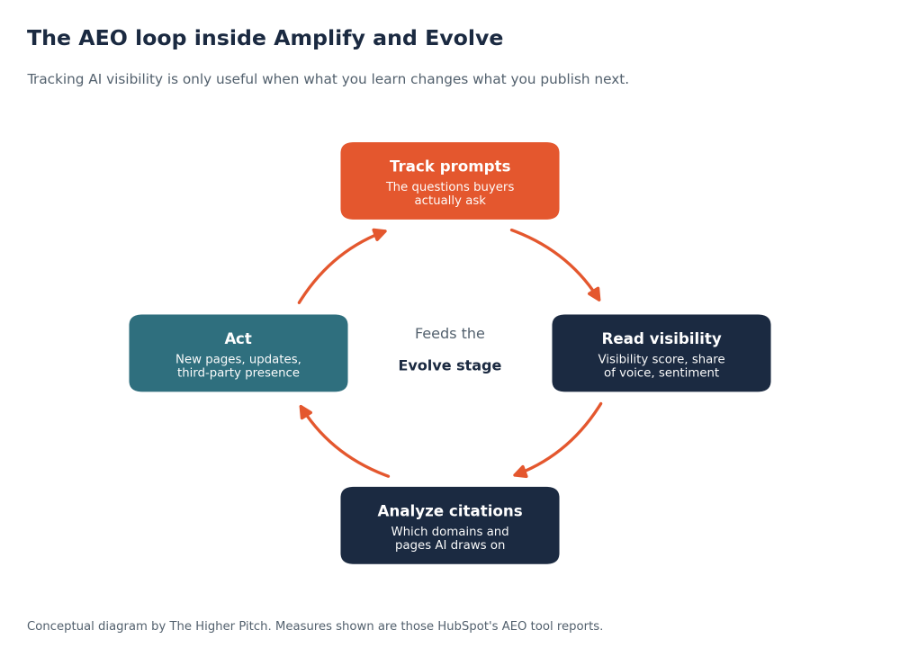
Figure 1: The AEO loop inside Amplify and Evolve. Conceptual diagram.
Why AI Discovery Matters Enough to Have Its Own Stage Work
Three sets of verified numbers explain the priority.
Clicks are leaving search. SparkToro’s 2026 study, using a Similarweb clickstream panel for January to April 2026, found 68.01% of US Google searches ended without a click, up from 58.5% in its 2024 study. Rand Fishkin notes these years use different panels, so the comparison is approximate, but the direction is consistent.
Buyers start in AI tools. In G2’s April 2026 research, half of B2B software buyers (51%) said they now begin software research with an AI chatbot more often than with Google, up from 29% in April 2025.
Decisions are largely made before you hear about them. 6sense’s 2025 B2B Buyer Experience Report found that 94% of buyers ranked their shortlist by preference before engaging sellers, and that the winning vendor was already on the Day One shortlist 95% of the time.
Put together: a growing share of the research that decides your shortlist position happens in systems you cannot log into, before anyone visits your site. We covered the buyer side of this in AI search and B2B buying journeys and the traffic side in why B2B website traffic is dropping.
SEO and AEO Are Not Separate Programs
The most common mistake is treating AEO as a new discipline requiring new infrastructure. Google’s own guidance states that there are no additional requirements to appear in AI Overviews or AI Mode, and no special optimizations necessary beyond foundational SEO best practices such as creating helpful, reliable, people-first content. It also explains that these features may use a query fan-out technique, issuing multiple related searches across subtopics.
| Aspect | Traditional SEO | AEO |
| Goal | Rank a page for a query | Be part of the answer, and be described accurately |
| Unit | The page | The claim, and the source that supports it |
| Success signal | Clicks and rankings | Mentions, citations, share of voice, sentiment |
| Competitive set | Pages ranking for your terms | Every brand the model names in the answer |
| What you control | Your site | Your site, plus your presence on sources AI draws on |
Table 1: How AEO differs from traditional SEO in practice.
The last row is the important one. In AEO, the sources you do not own often matter more than the ones you do, which is why third-party presence moves from a nice-to-have to a core activity. Our pieces on generative engine optimization, entity SEO and technical SEO for AI search cover the mechanics.
What HubSpot’s AEO Tool Actually Measures
If you are running the Loop inside HubSpot, the AEO product is the tool mapped to this work. According to its product page, HubSpot AEO is in beta, priced at $50 a month ($45 paid annually), with a free trial covering 25 prompts across ChatGPT, Perplexity and Gemini, and no other HubSpot subscription required.
| Measure | How HubSpot defines it | What to do with it |
| Brand visibility score | How often your brand appears in AI answers across your tracked prompts, as a percentage | Track the trend, not the absolute number |
| Share of voice | How often your brand is mentioned compared with competitors across the same prompts | Identify prompts where a competitor dominates |
| Sentiment | Whether AI describes your brand positively, negatively or neutrally, on a scale from -100 to +100 | Investigate negative sentiment at prompt level |
| Prompt tracking | Visibility at individual prompt level, with the exact response returned | Read the actual answers, not just the score |
| Citation analysis | Which domains, pages and content types are referenced in answers for you and competitors | Decide where to publish and who to approach |
| Recommendations | Prioritized actions such as creating a page, fixing a technical gap or approaching third-party sites | Treat as a starting list, not a plan |
Table 2: What HubSpot’s AEO tool reports, as described on its product page.
HubSpot also offers two free options: AEO Grader, a one-time diagnostic, and AI Search Sensor, which tracks industry-wide AI visibility trends rather than your own brand. HubSpot states that it acquired XFunnel in 2026 and built these tools after running AEO on its own brand.
One vendor claim, flagged as such: HubSpot’s AEO page states “We grew leads from AI by 1,850%”. That is HubSpot describing its own marketing results, with no published methodology, baseline or time period. It is not evidence of what the tool will do for you, and we would not use it in a business case.
How Buyers Discover Brands Through AI, and What That Implies
Three patterns worth designing around:
- Comparison is the dominant use. Buyers ask AI to compare vendors, not just to define terms. That makes comparison-shaped content, honest about trade-offs, more valuable than another definition page.
- The model summarizes sources, it does not invent you. If your position exists only in your own marketing copy, there is little for a model to draw on. Third-party coverage, reviews and community discussion are what give an answer something to say about you.
- Absence is invisible. Unlike search, there is no page two. A brand that is not named is simply not in the conversation, and nobody reports it.
Presence on the sources AI draws on, including LinkedIn, matters here, which is the subject of our LinkedIn SEO piece.
Optimizing Content for AI Answers Without Chasing Guarantees
Practical moves that follow from Google’s guidance and from what citation analysis usually reveals:
- Answer the question in the first sentence, then support it. Extractable answers are the format these systems work with.
- Cover a topic’s subtopics properly, since query fan-out means an answer may be assembled from several related searches.
- Make claims traceable. Link to primary sources. Content that cites is easier to cite.
- Be specific about entities: your company, your products, the categories you operate in, described consistently everywhere.
- Keep facts consistent across sources, including third-party profiles. Contradictory descriptions weaken what a model can say confidently.
- Earn presence on the sources that actually get cited in your category, which citation analysis will identify.
No one can guarantee inclusion in an AI answer, and any tool or agency that offers one is overselling. What you can do is make sure the answers exist, are consistent and appear in the places these systems read.
Tracking Mentions, Share of Voice and Citations
Three measures, three different jobs:
AI brand mentions tell you whether you appear at all. Track at prompt level rather than in aggregate, because a strong overall score can hide total absence on the prompts that matter commercially, which are usually selection-stage comparisons.
AI share of voice tells you how you stand against competitors on the same prompts. It is the more useful number for a leadership discussion, because visibility in a category where a competitor is named three times more often is not success. Our piece on share of AI voice as a marketing KPI covers this measure in depth.
Citations tell you what the answers are built from. This is the most actionable of the three, because it converts directly into work: if community forums and two industry publications dominate citations in your category and you appear in neither, that is a plan.
Choose prompts deliberately. Track the questions a buying committee actually asks at the selection stage, not the ones that flatter your visibility score.
Feeding AEO Insight Into the Evolve Stage
This is the step that turns a dashboard into a loop. A workable rhythm:
| Cadence | What you do | What it feeds |
| Weekly | Read the actual answers for a handful of priority prompts | Immediate content corrections and factual fixes |
| Monthly | Review visibility, share of voice and sentiment trends | The next loop’s Express and Amplify decisions |
| Quarterly | Review citation sources and third-party presence | Digital PR, community and analyst plans |
| Per loop | Compare visibility before and after the loop’s content | Whether the approach is working at all |
Table 3: An AEO cadence that connects to the Evolve stage.
The test of whether AEO is inside your loop is simple: can you point to a piece of content published because of something citation analysis showed? If not, you have monitoring rather than a loop. The search-specific version of this argument is in SEO growth loops, and the metric set is in Loop Marketing metrics.
THP Studio Perspective
- Our read on AEO tooling, HubSpot’s included: the visibility score is the least useful thing it produces and the most likely to be reported upward. It moves for reasons you do not control, including model updates nobody tells you about. Citation analysis is where the value sits, because it answers a question you can act on: what are these systems reading when they discuss our category? Usually a small set of third-party sources, and the work that follows is unglamorous digital PR.
Frequently Asked Questions
Key Takeaways
- Treat AEO as Amplify and Evolve work inside the loop, not as a separate program with its own strategy.
- Prioritize citation analysis over the visibility score, because it converts directly into decisions about what to publish and where to appear.
- Choose tracked prompts from real selection-stage questions, since aggregate scores hide absence where it matters most.
- Treat vendor performance claims, including HubSpot’s own, as marketing rather than as evidence for a business case.
- Judge the loop by whether AEO findings have changed what you published, not by whether you have a dashboard.
Work With THP’s Digital & XEO Studio
- THP’s Digital & XEO Studio works across SEO, AEO, GEO and AI search visibility for B2B brands. If you are tracking AI visibility but nothing downstream has changed as a result, that gap is usually where the value is sitting.
Author