
For most of the last decade, SEO meant one thing operationally: find the right keywords, optimize your pages for them, and build links. That model still works, but it is working less well than it used to, and for a reason most keyword-focused strategies are not set up to address. Google has been shifting its understanding of the web from a collection of keyword-matched documents to a map of interconnected entities: real-world things, people, organizations, concepts, and products, each with defined attributes, relationships, and degrees of authority.
Entity SEO, sometimes called entity-based SEO, is the practice of making your brand, your products, and your key executives clearly defined entities in that map, rather than just pages that rank for search terms. The distinction matters because an AI system that has a clear, consistent, well-corroborated entity record for your brand can cite you, recommend you, and surface you in responses with a degree of confidence that no amount of keyword optimization can produce on its own.
The practical implication is that brand authority, in the entity sense, is now a prerequisite for sustained SEO performance rather than a nice-to-have bolted on top of technical optimization. B2B companies that have been treating brand building and SEO as separate budget lines may find that gap is exactly where their search and AI visibility is leaking.
Quick Takeaway
- Entity-based SEO treats your brand as a defined entity in Google’s Knowledge Graph rather than just a collection of keyword-optimized pages. Brands with strong entity signals, consistent naming, authoritative third-party references, and structured data, show up more reliably in both traditional search results and AI-generated answers. Building entity authority is no longer a long-term brand exercise. It is a near-term search performance investment with measurable returns.
What an Entity Is: The Building Block of Entity SEO
In the context of SEO and Google’s Knowledge Graph, an entity is any uniquely identifiable thing with real-world relevance: a company, a person, a product, a location, a concept. Google’s systems link entities to attributes (what they are, what they do, who they are connected to) and assign each entity a degree of authority based on how consistently and credibly it is described across the web.
For a B2B brand, the relevant entities typically include the company itself, its key executives, its flagship products or services, and the market category it operates in. Each of these can have its own entity record, and the strength of those records directly influences how confidently search and AI systems will surface the brand in response to relevant queries.
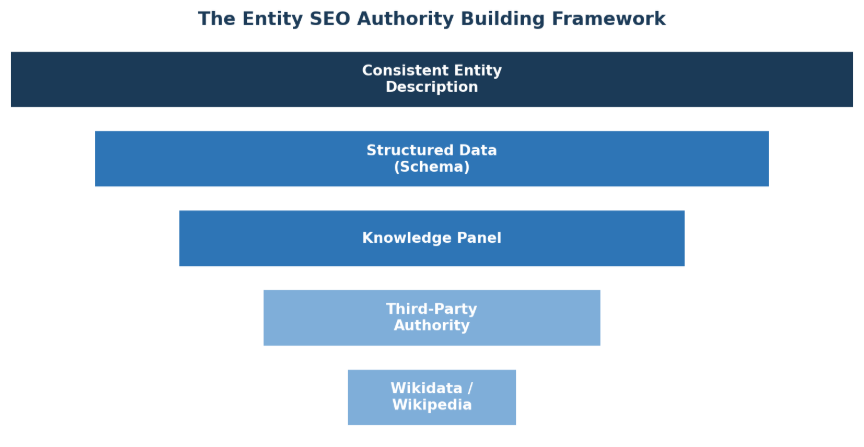
Figure 1: How entity authority connects brand signals to search and AI visibility.
Keywords work by matching the words in a query to the words in a document. That works well for informational searches where the user is looking for a specific phrase. It works poorly for intent-based queries where the user wants a specific type of company, product, or perspective, because the best answer to that query might not be the page with the highest keyword density for the search term.
Google has invested years in training its systems to understand intent and context beyond keyword matching. Its BERT and MUM language models, its E-E-A-T quality signals, and its Knowledge Graph entity systems all push in the same direction: toward understanding what the user actually wants, and surfacing the source best qualified to provide it. A brand that is a strong entity in Google’s understanding of its market will surface for intent-based queries even when a specific keyword is not present in the query, because the system understands the relationship between the query intent and the brand.
This is exactly the dynamic AI search systems amplify. When a user asks an AI tool for a recommendation, they are expressing intent, not entering a keyword. Entity strength is far more predictive of AI citation in that context than keyword optimization.
How Google’s Knowledge Graph Changes the Rules
Google’s Knowledge Graph is the database of entities and their relationships that underpins modern search. When you search for a company and see an information panel on the right side of the results page with the company’s description, founding date, executives, and related entities, that is the Knowledge Graph surfacing an entity record.
The presence or absence of a strong Knowledge Graph entity record for your brand has direct, measurable consequences. Brands with strong entity records are more likely to appear in AI-generated answers, more likely to be included in “best of” recommendation queries, more likely to be correctly described when mentioned in third-party content, and more resilient to search algorithm updates because their authority is built on entity relationships rather than keyword patterns alone.
The Entity SEO Authority Building Framework
Building entity authority is a specific set of activities, not a general brand awareness program. The table below outlines the five layers that matter most for B2B brands.
| Layer | What It Involves | Priority |
| 1. Consistent entity description | Aligned brand name, description, and category across all web properties | Highest: foundational for everything else |
| 2. Structured data | Organization, Person, and Product schema on owned pages | High: signals entity attributes directly to search systems |
| 3. Knowledge Panel | Claiming and verifying your Google Knowledge Panel | High: the most visible entity record in traditional search |
| 4. Third-party authority | Accurate, consistent brand mentions in trade press, analyst reports, and credible directories | High: corroborates your entity with external sources |
| 5. Wikidata and Wikipedia | Creating or improving Wikidata records and Wikipedia entries where eligible | Medium: powerful when eligible, not accessible to every company |
How Entity Strength Translates to AI Visibility
The connection between entity authority and AI citation is not theoretical. AI language models are trained on large bodies of web content, and the consistency and frequency with which a brand is accurately described across that content directly influences how confidently the model can cite that brand. A brand described differently across its own site, its LinkedIn page, analyst coverage, and press mentions creates a signal of ambiguity that pushes AI systems toward sources they can synthesize more cleanly.
This is one reason GEO work and entity SEO work overlap so directly. Many of the steps that build entity authority, consistent naming, structured data, authoritative third-party references, also improve AI citation rates because both outcomes depend on the same underlying signal: a brand that the web describes consistently and credibly.
THP’s Take: Entities Are the Infrastructure, Keywords Are the Decoration
THP Studio Perspective
- We have seen B2B brands spend significant budgets on keyword optimization for pages that rank acceptably in traditional search but get zero traction in AI-generated answers. In most cases, the gap traces to weak entity signals: inconsistent brand descriptions, missing schema markup, thin third-party presence. Fix the entity foundation and both problems tend to improve simultaneously, because the same signals that help AI systems recognize your brand also help traditional search systems understand your authority in a category.
- For teams with limited resources, entity cleanup is one of the highest-ROI activities available right now, precisely because so few B2B brands have treated it as a priority. The window where entity authority is a differentiator will not stay open indefinitely.
Frequently Asked Questions
Key Takeaways
- Entity-based SEO treats your brand as a defined entity in search knowledge systems, not just a collection of keyword-optimized pages.
- Brands with strong entity signals perform better in both traditional search and AI-generated answers, because both systems weight authority and consistency similarly.
- The five layers of entity authority are: consistent entity description, structured data, Knowledge Panel, third-party authority, and Wikidata or Wikipedia presence where eligible.
- Entity strength and GEO performance reinforce each other. Improving one typically improves both.
- Entity cleanup is one of the highest-ROI SEO activities available for B2B brands right now, largely because few have prioritized it.
Work With THP’s Digital & XEO Studio
- THP’s Digital & XEO Studio builds entity authority programs for B2B brands: from schema markup and Knowledge Panel optimization through to the third-party presence that makes your entity credible to both search engines and AI systems. If your brand is described inconsistently across the web, that is where this work starts.
Author