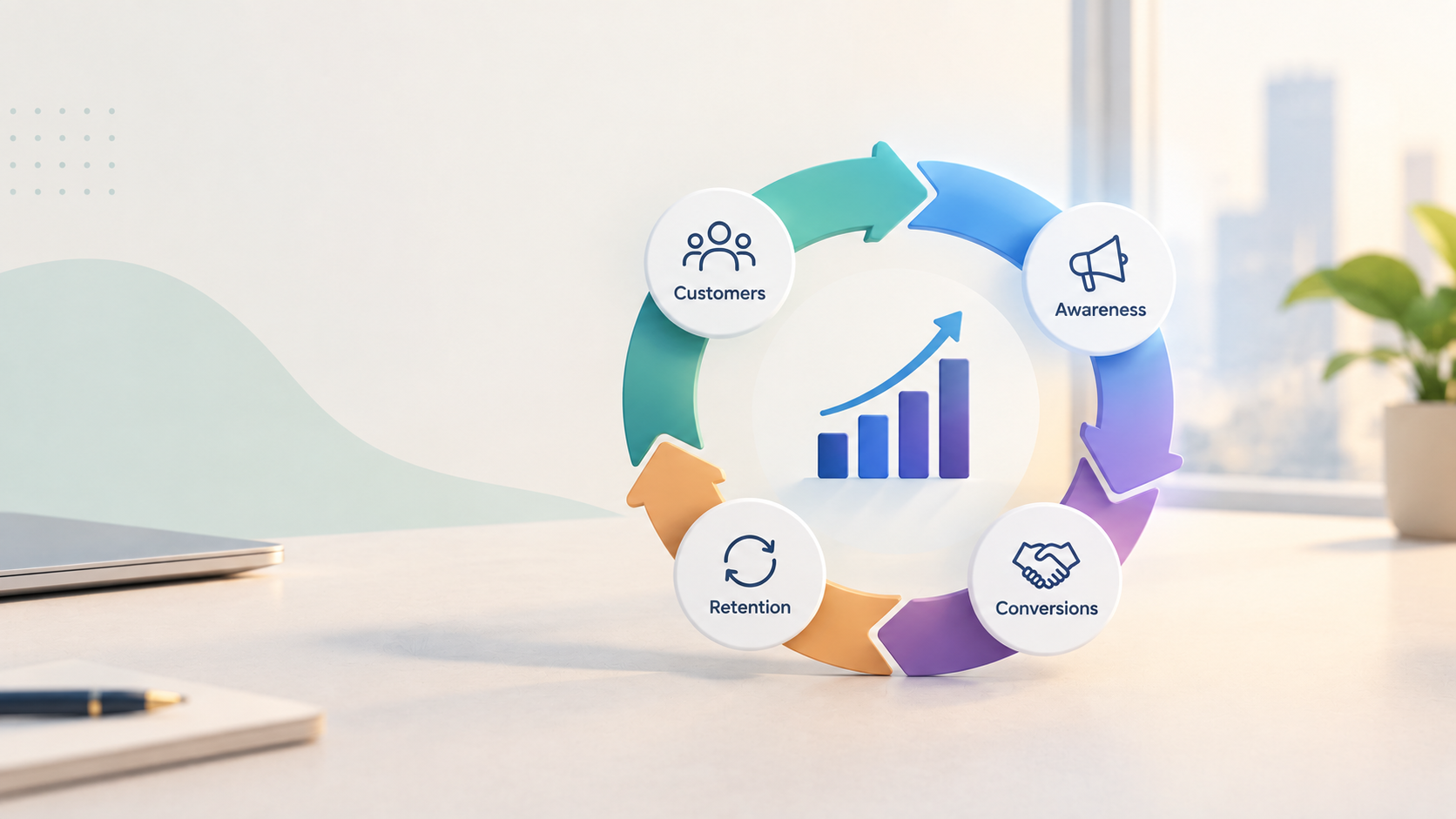
Most growth loops fail on the whiteboard, not in execution. A team draws a neat circle (content, traffic, leads, customers, back to content) and calls it a loop. Six months later nothing has compounded, because nobody could say who moved the output back to the start, when, or with what.
Building a loop is closer to process design than to campaign planning. A B2B growth loop is a repeatable system in which the output of one cycle, such as a customer result or a buyer’s question, is deliberately reinvested as the input for the next cycle. This guide walks through eight steps for building one from scratch, with a worked example that runs through every step and a design canvas your team can complete in a single working session.
Quick Takeaway
- A loop is only as strong as its weakest handoff. Before you design content, campaigns or automation, decide what triggers each cycle, why each participant takes part, and exactly who moves the output back to the start. Everything else is execution.
The worked example (hypothetical). Throughout this guide we follow an illustrative mid-sized consultancy that migrates manufacturing companies’ ERP and data platforms to the cloud. It is not a client. Its problem is familiar: paid campaigns produce leads, but acquisition costs keep rising and sales cycles are long.
Step 1: Identify Your Growth Objective, and the Constraint It Removes
A loop should solve one named growth problem. “Grow faster” is not an objective. “Generate more qualified evaluations from mid-market manufacturers without increasing paid spend” is.
Pair the objective with the constraint it removes. Typical B2B constraints include rising acquisition cost, low win rates in a priority segment, long cycles where buyers go quiet, and weak presence between buying windows. The constraint tells you which loop type to consider. If win rates are the problem, an advocacy loop that arms champions with proof is a better fit than an SEO loop that produces more traffic.
Worked example: the consultancy’s objective is more qualified evaluations from manufacturers. Its constraint is trust: buyers see cloud migration as high risk and want evidence from companies like theirs.
Step 2: Map Your Customer Journey as Buyers Actually Experienced It
Map the real journeys of your last ten to twenty won deals, using CRM history and short conversations with the customers themselves. The goal is to find where your business already creates reusable output, and where that output is lost.
Gartner describes B2B buying as six jobs that buyers loop through rather than complete in order: problem identification, solution exploration, requirements building, supplier selection, validation and consensus creation. Use those jobs as the rows of your map.
| Buying job | What the buyer needed | What we produced | Did we reuse it? |
| Problem identification | A way to explain the risk of staying on legacy systems | Discovery call notes | No |
| Solution exploration | Examples of similar migrations | One old case study | Rarely |
| Requirements building | Clarity on downtime and data security | Detailed answers by email | No |
| Supplier selection | Proof of experience with their ERP | Reference calls | Ad hoc |
| Validation | Confidence on cost and timeline | Project plans | No |
| Consensus creation | A business case the CFO would accept | Custom slides | No |
Table 1: A journey map for the worked example. The last column is where loops hide.
Worked example: the map shows the consultancy repeatedly producing high-value material, including answers on downtime and security, migration outcomes and business cases, and then discarding it after each deal.
Step 3: Identify the Loop Trigger
A loop trigger is the specific, observable event that starts each cycle. Good triggers share three traits: they happen often enough to sustain the loop, they are recorded in a system (not just in someone’s memory), and they coincide with value, so the participant is willing to act.
Examples of strong B2B triggers include a project go-live, an account reaching a defined outcome, a deal closing (won or lost), a support question being resolved and a new page earning its first conversions.
Worked example: the trigger is a project milestone already tracked in the consultancy’s project system: thirty days after go-live, when the client can see measurable results.
Step 4: Define the Value Exchange for Every Participant
Every loop asks someone to do something: a customer to share results, a sales rep to log a question, an expert to review a draft. If the exchange is not worth it to them, the loop stalls at that step.
This is where the buying committee matters. The person you ask to take part is usually a champion or sponsor, and their motivation is often personal as well as organizational. A 2013 study by CEB (now Gartner) and Google found that B2B buyers were almost 50% more likely to buy when they saw personal value, such as career advancement or confidence in their choice. The same logic applies to advocacy: give the champion something that helps their standing.
| Participant | What we ask | What they get |
| Client sponsor (champion) | Approve a short outcome story and join one peer event a year | Visibility for their team’s success and access to peers facing the same decisions |
| Client CFO (financial ratifier) | Validate the cost and risk figures in the story | A credible external record of a sound investment decision |
| Project lead (internal) | Capture three measurable changes at the milestone | Recognition, and a shorter path to the next similar project |
| Sales team (internal) | Use approved stories in live deals and log new questions | Proof that shortens validation and consensus stages |
Table 2: The value exchange in the worked example.
Step 5: Connect the Loop, and Make the Return Arrow Someone’s Job
This is the step most designs skip. Write down the reinvestment step as a process with an owner, a deadline and a destination.
Worked example: within two weeks of the milestone, the marketing lead turns the approved outcome into four assets: a one-page story for sales, a section on a manufacturing migration page, an answer to the most common downtime question, and a post from the consultancy’s practice head. Those assets reach new manufacturers, who request assessments, which lead to projects, which reach go-live. The loop is closed.
A useful test is to ask what would happen to the loop if its designer left the company. If the answer is that it would stop, the return arrow is not yet built into the process.
Step 6: Automate the Process Without Automating the Judgment
Automation shortens cycle time, and cycle time is where compounding comes from. But automation amplifies whatever the loop already does, including its weaknesses. Automate the repetitive, rule-based steps and keep the human parts human.
| Loop step | Automate | Keep human |
| Trigger | Create a CRM task when the milestone date is reached | Deciding whether the result is strong enough to share |
| Capture | Send a structured outcome form; transcribe and summarize the debrief call | The conversation with the sponsor |
| Approval | Route drafts for client sign-off and track status | Negotiating what can be named |
| Distribution | Tag the asset by industry and ERP so sales can find it | Choosing which deals it should support |
| Measurement | Timestamp each step; report cycle time and usage | Deciding what to fix |
Table 3: What to automate in the worked example.
Most of this is possible in a well-configured CRM and marketing automation platform. Our guides to HubSpot marketing automation, moving from manual to automated marketing and AI agents in the MarTech stack go deeper on the tooling. If the underlying CRM setup is the bottleneck, start with our HubSpot implementation guide.
Step 7: Measure Loop Performance From the First Cycle
Instrument the loop before launch, not after. At minimum, track:
- Trigger volume: how many cycles start each month.
- Participation rate: the share of triggers where the participant takes part.
- Output rate: the share of participations that produce a usable asset.
- Reinvestment time: how long it takes for an output to reach its destination.
- Loop velocity: the time for a full cycle, from trigger to new input.
- Yield: how many new inputs each cycle produces, such as evaluations influenced by the asset.
Worked example: the consultancy adds three CRM fields (milestone date, story approved date, first sales use date) and asks every new evaluator how they first heard of the firm. That is enough to calculate velocity and to see whether stories are reaching deals. The full metric set is in Growth Loop Metrics.
Step 8: Optimize the Slowest Step, Then Scale
Every loop has one step that limits the whole system. Find it and fix it before adding volume, because scaling a loop with a bottleneck just builds a queue.
Typical bottlenecks and fixes include low participation (improve the value exchange or the timing of the ask), slow approval (pre-agree approval rules in the contract), and low reuse by sales (put assets where sales already works, tagged by deal type).
Scale in one of three ways: add triggers (more milestones or segments), extend reach (new destinations for the same output) or add a second loop that reuses a different by-product. Agree the stop rule too. If the loop has not completed a set number of cycles, or its yield has not improved, by a date agreed at launch, redesign it or stop it.
Your Growth Loop Design Canvas
Use this canvas to design a loop in one working session with marketing, sales, customer success and RevOps in the room.
| Field | Question to answer | Worked example answer |
| Objective | Which single growth problem does this loop solve? | More qualified evaluations from manufacturers |
| Constraint | What is stopping growth today? | Buyers need trusted proof from peers |
| Trigger | Which recorded event starts each cycle? | Thirty days after go-live |
| Value exchange | Why will each participant take part? | Visibility and peer access for the sponsor |
| Output | What does each cycle produce? | An approved outcome story and four assets |
| Reinvestment | Who moves the output back to the start, by when? | Marketing lead, within two weeks |
| Automation | Which steps are rule-based? | Tasks, forms, routing, tagging, timestamps |
| Metrics | How will we know it is working? | Velocity, participation rate, sales usage, yield |
| Stop rule | What result by what date would end or redesign it? | Agreed at launch with the leadership team |
Table 4: Growth loop design canvas.
If you are still choosing which loop to build, 7 B2B Growth Loop Examples compares the options, and our pillar guide to growth loops explains the model. Loops also depend on marketing and sales sharing ownership, which our RevOps playbook covers.
THP Studio Perspective
- The unglamorous truth about loop design is that the arrow back to the start is almost always an operations problem. Someone has to own it, it has to happen within days rather than quarters, and it has to survive the person who designed it moving on. We would rather see a loop with one well-owned reinvestment step and a spreadsheet than an elaborate automated system nobody is accountable for. Automation makes a working loop faster. It cannot make a broken loop close.
Frequently Asked Questions
Key Takeaways
- Anchor the loop to one growth objective and the specific constraint it removes, because the constraint decides the loop type.
- Choose a trigger that is frequent, recorded in a system and aligned with the participant’s moment of value.
- Design the value exchange around the champion’s personal as well as organizational interests.
- Make the reinvestment step a named person’s job with a deadline, and test whether the loop would survive that person leaving.
- Instrument before launch, fix the slowest step before scaling, and agree a stop rule upfront.
Work With THP’s Technology & Martech Studio
- THP’s Technology & Martech Studio connects CRM, marketing automation and data so that the handoffs a loop depends on happen reliably. If your loop is designed but the systems behind it are not, we can help you wire the triggers, routing and measurement.
Author