
Most articles on this topic are a list of famous companies with a sentence each about why they are great. That is entertaining and not very useful, because the interesting part is never the logo. It is the specific mechanism: what a user can do alone, what that produces, and where the business captures value.
A product-led growth motion is a repeatable mechanism through which the product itself drives acquisition, conversion or expansion, without a sales conversation being required. Below are seven motions that work in B2B, what each needs to be true before it will work, and where each one breaks. For the underlying model, start with our guide to product-led growth.
Quick Takeaway
- Choose a motion by what your product does naturally, not by what worked for a famous company. A product people use alone needs a different motion from one people use together, and copying a collaboration-driven playbook into a single-player product is the most common way PLG efforts stall.
1. Self-Service Acquisition: Buying Without Talking to Anyone
The mechanism: a user finds the product, evaluates it, and purchases with a card, without a sales conversation.
This is the foundation the other motions sit on. Atlassian’s FY2024 annual report describes the model plainly: the website is its primary forum for sales and supports thousands of commercial transactions daily, a customer can evaluate and purchase a Jira subscription for 10 users or 50,000 users at a transparent list price without interacting with a salesperson, and the company does not solely rely on a traditional commissioned direct sales force to land new customers.
What must be true: the product is useful without configuration by your team, pricing is public, and the purchase clears without procurement approval.
Where it breaks: when the checkout exists but the product does not deliver value alone. A card form on top of a product that needs implementation just moves the friction later.
2. Freemium Growth: A Free Tier That Creates Future Buyers
The mechanism: a permanently free tier gives users real value, and the limits, usually seats, usage or features, create a natural reason to pay as needs grow.
Freemium is the motion most often adopted for the wrong reason: as a lead-generation tactic rather than a growth model. The economics only work if free users cost little to serve and a meaningful share eventually hit a limit that matters.
The honest base rate: Atlassian’s own risk factors state that, historically, a majority of users never convert to a paid version from free trials or limited free versions. The same filing notes the strategy also depends in part on persuading free users to convince others in their organization to purchase and deploy the products.
What must be true: low marginal cost per free user, a limit that correlates with value received, and a path from individual use to team use.
Where it breaks: when the free tier is generous enough to serve the main use case indefinitely, or when free users are expensive to support.
3. Free-Trial Conversion: A Clock Against Time to Value
The mechanism: full or near-full access for a fixed period, designed so the user reaches meaningful value well before the trial ends.
A trial is a bet that your time to value is shorter than your trial length. Bartlett’s point in his Sacra interview is that time to value in a self-service journey is really about reaching the user’s aha moment, ideally in the first or second session, not on day 13 of a 14-day trial.
What must be true: a defined first-value moment, onboarding built around reaching it quickly, and a product that works on the user’s real data.
Where it breaks: when setup consumes the trial, when the trial requires data the user cannot easily import, or when the product is only valuable once a whole team is using it.
Variant worth considering: the reverse trial, where users get premium features for a period and then drop to a free tier. It lets people experience the paid value before choosing, provided the transition is communicated honestly.
4. Product-Led Onboarding: Turning Sign-Ups Into Active Users
The mechanism: the onboarding experience itself does the work of teaching, configuring and demonstrating value, using in-product guidance rather than a human.
This is less a growth motion than the precondition for all the others. Every sign-up that never reaches value is acquisition spend converted into a negative impression.
What must be true: you know which action correlates with retention, and onboarding is designed backwards from it.
Where it breaks: when onboarding is a product tour rather than a route to a result. Showing someone the interface is not the same as getting them to an outcome. We cover the mechanics in Product-Led Onboarding and, from the UX side, in user onboarding for product success and reducing friction.
5. Collaboration and Viral Growth: Usage That Reaches New People
The mechanism: using the product exposes non-users to it, through shared documents, invitations, workflows that cross company boundaries, or outputs that carry the product with them.
Bartlett’s account of Calendly in the Sacra interview is a clear description of the mechanism: scheduling is an inherently shared problem, both people have it at the same time, and the recipient of a scheduling link can click through and get their own page. He describes it as a viral loop in which anyone using the product is also promoting it.
What must be true: the product’s core workflow naturally involves someone who is not yet a user.
Where it breaks: in single-player products where sharing is bolted on as an incentive. Most B2B software is not inherently viral, and building a referral prompt into a product nobody shares will not make it so. It also breaks in enterprise settings where spread does not equal purchase, because procurement and security still gate the transaction.
6. Usage-Based Expansion: Revenue That Grows With Value Delivered
The mechanism: pricing tied to consumption or seats, so that as the customer gets more value, revenue grows without a renegotiation.
This motion is why expansion is often the largest revenue line in mature product-led businesses. It also aligns incentives: the vendor earns more only when the customer uses more.
What must be true: a usage unit customers understand and can forecast, and billing infrastructure that handles it without disputes.
Where it breaks: when the usage metric is unpredictable. Finance leaders dislike bills they cannot forecast, and an unexpected invoice is a fast route to a procurement review. It also breaks when usage grows for reasons unrelated to value, such as inefficiency.
7. Product-Led Referral and Advocacy: Proof Generated by Use
The mechanism: users who get value recommend the product to peers, review it publicly, or bring it with them when they change jobs.
The evidence for why this matters in B2B is strong. 6sense’s 2025 report found that 97% of buyers had prior experience with at least one vendor on their shortlist, that in 85% of successful purchases buyers had direct experience with the vendor, and that buyers had been through an average of eight to nine purchase journeys in the category. A product that individuals adopt on their own creates exactly that prior experience, at scale, years before a purchase.
What must be true: users get value they would stake their reputation on, and there is a low-friction way for them to recommend it.
Where it breaks: when incentives replace genuine advocacy. In B2B a recommendation carries professional risk, so rewards rarely move it. This motion also pairs with a content and advocacy loop, which we cover in our growth loops cluster.
Choosing the Motion That Fits Your Product
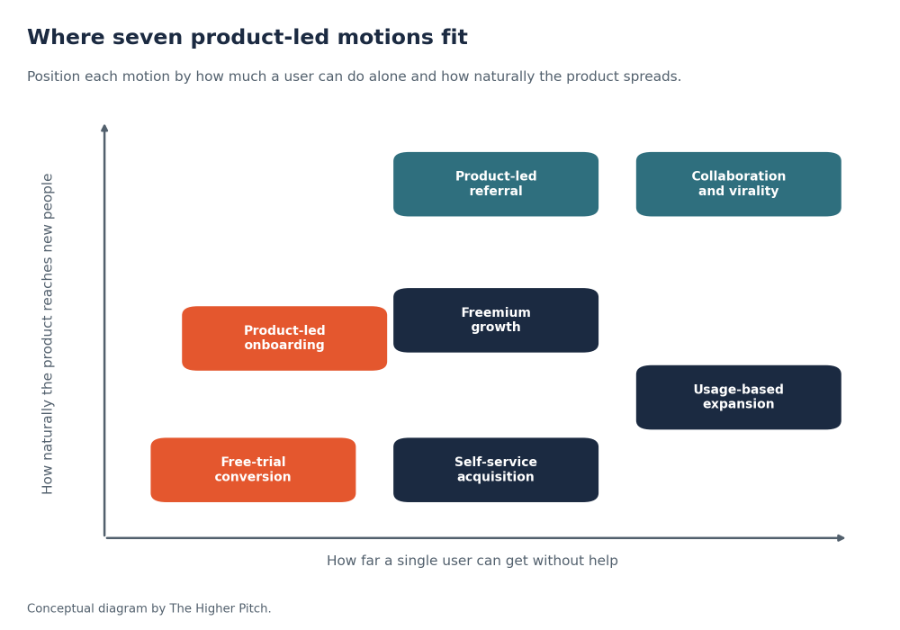
Figure 1: Where the seven motions fit. Conceptual diagram.
| Motion | What must be true | Where value is captured | Main risk |
| Self-service acquisition | Useful without setup; transparent pricing | At first purchase | Checkout without real self-service value |
| Freemium | Low cost to serve; limits that track value | When limits bite | Free tier serves the main use case |
| Free-trial conversion | Fast time to value | At trial end | Setup consumes the trial |
| Product-led onboarding | A known first-value action | Indirectly, through activation | A tour instead of a result |
| Collaboration and virality | Workflow involves non-users | As new users join | Forced sharing in single-player products |
| Usage-based expansion | A predictable usage unit | As usage grows | Unforecastable bills |
| Referral and advocacy | Value worth recommending | In future evaluations | Incentives replacing genuine proof |
Table 1: Comparing the seven motions.
The buying committee provides a second filter, because a motion that only reaches the end user will stall in a considered purchase.
| Committee role | Motions that reach them | What they still need |
| End user | Free trial, freemium, onboarding | A product that works on their real tasks |
| Champion | Collaboration, onboarding | Material to make the internal case |
| Financial ratifier | Usage-based expansion, self-service pricing | Predictable cost and clear terms |
| Technical evaluator | Free trial, self-service acquisition | Documentation, integrations, security detail |
| Procurement | Self-service purchase for small deals | Contracts, invoicing and vendor review at scale |
Table 2: The buying-committee lens on product-led motions.
Three questions usually settle the choice:
- Can a single user reach a result alone, on their real work, in one session?
- Does the core workflow naturally involve someone who does not yet use the product?
- Does value grow with usage in a way a customer can predict and a finance team can accept?
An honest no to the first question means the priority is product work, not a new motion. The build sequence is in How to Build a Product-Led Growth Strategy From Scratch.
THP Studio Perspective
- The motion we see copied most often, and mistakenly, is virality. Calendly is viral because scheduling is a shared problem: the recipient has the same need at the same moment. Almost nothing else in B2B works that way. When a company with a single-player product adds invite prompts and referral rewards, it is not building a loop, it is adding friction to an experience that was working. For most B2B products, the boring motions (fast activation, honest limits, usage-based expansion) produce more revenue than any attempt to engineer virality that the workflow does not support.
Frequently Asked Questions
Key Takeaways
- Pick motions from what your product does naturally; a single-player product cannot be made viral by adding prompts.
- Treat onboarding as the precondition for every other motion, not as one option among them.
- Set free-tier and trial limits against value received, and plan for the documented reality that most free users never convert.
- Use usage-based expansion only where the usage unit is predictable enough for a finance team to accept.
- Check that your chosen motions reach more than the end user, or the deal will stall at the committee.
Work With THP’s Design & UX Studio
- THP’s Design & UX Studio works on the digital experience layer that product-led motions depend on: first-run experiences, conversion-focused design and user journeys. If your sign-ups are healthy but activation is not, that is usually where the work is.
Author