Most coverage of AI in Loop Marketing reads like a feature list with stage names attached. That is not much use to a marketing leader deciding what to actually delegate, because the interesting question is not what the tools can do. It is which parts of marketing should stay human when the tools can do almost everything.
This article covers how AI works across the four stages, what HubSpot’s current AI products actually are, where each stage benefits and where it degrades, and how to design workflows that survive the volume AI makes possible. For the framework itself, start with our guide to HubSpot Loop Marketing.
Quick Takeaway
- AI’s real contribution to the Loop is not volume, it is cycle time: the gap between learning something and acting on it. A team that produces four times the content but still reviews results quarterly has bought speed in the wrong place.
HubSpot’s Position Is Hybrid Teams, Not Automation
HubSpot describes the Loop as relying on hybrid teams of humans and AI working together, each doing what they do best, with human creativity and AI efficiency. Its playbook page makes the same point differently: modern growth does not start with AI, it starts with you, because everyone has the same tools and the difference is what you feed them.
That framing is right, and it is also where the practical difficulty sits. “Humans do creativity, AI does execution” is easy to say and hard to operationalize when an AI tool can draft a positioning statement in seconds. The useful version of the split is not by task type but by consequence: who is accountable if the output is wrong, off-brand or unsupported by evidence.
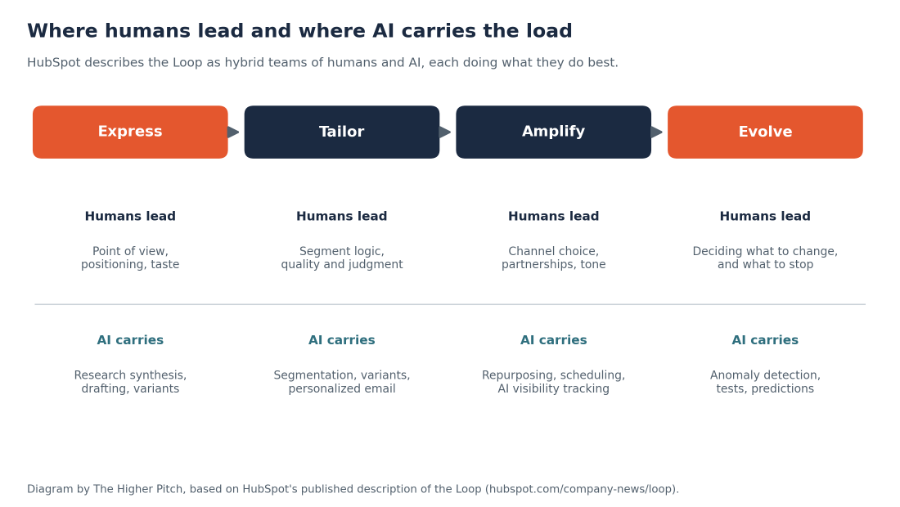
Figure 1: Where humans lead and where AI carries the load. Diagram based on HubSpot’s description of hybrid teams.
What HubSpot’s AI Products Currently Are
This is the part of every Loop Marketing article that dates fastest, so check current naming in your own portal before planning.
At the time of writing, Agent Hub is HubSpot’s home for AI agents across marketing, sales and service, described as letting teams see what agents are doing, activate them and build custom ones. Breeze Assistant is the assistant layer, and HubSpot says custom agents can be built by describing what you need to Breeze Assistant in plain language.
| Product | What HubSpot says it does | Loop stage it serves |
| Breeze Assistant | Assistant across the platform; also used to build custom agents | All stages |
| Campaign Agent | Turns a single goal into a planned multi-channel campaign | Express |
| Content Agent | Creates blog posts, social content and landing pages in your brand voice | Express and Amplify |
| Nurture Agent | Sends personalized email based on where a lead actually is | Tailor |
| Data Agent | Answers questions about contacts and companies from CRM data, calls and documents | Tailor and Evolve |
| HubSpot AEO (beta) | Tracks AI visibility, prompts, citations and competitor share of voice | Amplify |
| Agent Builder | Builds custom agents on one canvas using your data | Any stage |
Table 1: HubSpot’s AI products and the stages they map to, as described on its product pages.
Two commercial points worth confirming before planning: HubSpot states that Agent Hub is included for Starter, Professional and Enterprise customers, and that custom agents built in Agent Builder consume HubSpot Credits, which can be bought up front or used pay-as-you-go. Several Loop-mapped features, including Brand Identity, Marketing Studio, Personalization, AI-Powered Email and AEO, were marked beta at the time of writing.
On governance, HubSpot states that third-party AI providers are contractually prohibited from training their models on your data, that you can control what they access, and that it publishes model cards through its AI Trust Center. Those are the claims your security team will want to review directly rather than take from an article.
Using AI in the Express Stage, Without Outsourcing the Point of View
What AI does well here: synthesizing customer research from call transcripts and support tickets, stress-testing a message by arguing against it, generating campaign structures from an approved brief, and producing first drafts once a style guide exists.
What must stay human: the position itself. HubSpot’s own framing is that your brand identity and deep customer understanding are what separate great content from generic content. A model trained on the public web will reliably produce the most common framing in your category, which is the opposite of a differentiated point of view.
A practical test: ask your AI tool to write your positioning statement, then ask it to write your three closest competitors’. If the outputs are interchangeable, the model is describing the category, and the Express stage has not done its job. We wrote about this problem in B2B thought leadership’s sameness problem.
AI-Powered Segmentation and Personalization in Tailor
What AI does well here: identifying behavioural patterns that suggest intent, grouping accounts by characteristics a human would take weeks to notice, generating message variants per segment from one approved argument, and drafting individual emails informed by CRM context.
What must stay human: deciding which segments are commercially meaningful, and reviewing before send. HubSpot builds human quality checks into its own description of the stage, saying they ensure AI maintains accuracy while your taste, creative judgment and strategic thinking are applied.
Where it degrades: unreliable data. AI segmentation applied to duplicated contacts, overwritten sources and inconsistent lifecycle stages produces confident, specific, wrong targeting, at volume. Start with the signs your CRM data is holding back growth.
AI Content Creation and Repurposing in Amplify
Repurposing is the least controversial and most immediately valuable AI use in the whole framework. Turning one core asset into a webinar outline, a short video script, a LinkedIn carousel, an FAQ page and a sales briefing is exactly the kind of work that is high effort, low judgment and easy to check.
Two cautions:
- Repurposing is not rewriting. The same argument in five formats is amplification. Five thin variations of the same page is duplication that serves nobody.
- Volume raises the review burden. If your review capacity does not scale with production, quality control becomes a rubber stamp. Decide in advance what gets full review, what gets a spot check, and what is never published without a named human approving it.
On the AEO side, HubSpot AEO tracks brand visibility, prompt-level performance, citation analysis and competitor share of voice across ChatGPT, Gemini and Perplexity. Our Loop Marketing and AEO guide covers how to use that inside the loop.
AI in Evolve: Analysis, Prediction and Experimentation
HubSpot describes this stage as predicting which customers and campaigns are likely to convert before publishing, monitoring signals as they happen with AI highlighting anomalies, running rapid experiments, and applying learning to creative, targeting and spend.
This is where AI’s contribution is most underrated, because it is unglamorous. Surfacing an anomaly on Tuesday instead of at the end of the quarter is worth more than a faster draft, and it is the part that makes the loop compound.
Two limits worth stating plainly:
- Prediction inherits your history. A model that learns from your past campaigns will favour what worked before, which is a reasonable default and a poor guide when you are trying something new.
- Small samples mislead. Faster experimentation raises the risk of acting on noise. Set an evidence bar before the loop starts.
Building Human and AI Workflows That Hold Up
The practical design question is where accountability sits. This table is our recommendation rather than HubSpot’s, and it is the version we would defend in a review.
| Work | AI drafts | Human decides | Never delegate |
| Positioning and POV | Alternatives to react to | The position | The final wording |
| Research synthesis | Summaries of calls and tickets | Which patterns matter | Judging whether a claim is true |
| Segmentation | Candidate segments | Which segments are commercial | Approving targeting of named accounts |
| Content drafting | Full drafts from an approved brief | Whether it says anything new | Publishing unreviewed claims |
| Repurposing | Every derivative format | Which channels deserve the effort | Brand-critical assets |
| Performance analysis | Anomalies and hypotheses | What to change | Deciding to stop or scale spend |
Table 2: A workable split of human and AI responsibility across the loop.
Three rules make this operational:
- Every published asset has a named human owner. Not a reviewer in principle, a name in the record.
- Evidence rules are written down. What counts as a source, and what may never be asserted without one. This is the control that matters most as volume rises.
- AI outputs are logged as drafts, not decisions. A recommendation from an agent is an input to a judgment, not the judgment.
For the wider automation picture, see our pieces on AI marketing automation, AI agents in the MarTech stack and moving from manual to automated marketing. THP’s own AI approach, SAID, is built around connecting AI to business outcomes rather than to output volume.
THP Studio Perspective
- The risk to flag to any leadership team is not that AI writes badly. It writes competently, which is the problem. Competent, on-brand, unobjectionable content at four times the previous rate is a fast route to invisibility, because none of it gives a buyer a reason to remember you. In our view the teams that benefit most will get stricter about what is worth publishing, not looser. AI should raise your standard for what earns a place, because cost no longer filters anything out.
Frequently Asked Questions
Key Takeaways
- Judge the AI layer by cycle time, not content volume, because acting faster on findings is what makes the loop compound.
- Keep the position and the final wording human; AI reliably produces the category’s most common framing.
- Expect AI segmentation to amplify CRM data problems rather than work around them.
- Assign a named human owner and written evidence rules to every published asset before increasing volume.
- Treat predictions and agent recommendations as inputs to a judgment, and verify product naming and beta status directly.
Work With THP’s Automation & Technology Practice
- THP’s Automation & Technology team works on marketing automation, CRM and AI-powered workflows for B2B businesses. If you are deciding what to delegate to agents and what your team should keep, we can help you design the split and the controls around it.
Author