There is a question that separates companies doing product-led growth from companies talking about it: can a stranger sign up, reach a result that matters to them, and start paying, without anyone from your company being involved?
Most B2B software companies cannot yet answer yes. They have a free trial that funnels into a demo request, a product tour that is really a lead-capture form, and a sales team that still does the explaining. That is sales-led growth with a self-service veneer, and it usually produces the costs of PLG without the compounding.
This guide covers what product-led growth actually is, how the model works, where it fits and where it does not, the metrics that show whether it is working, and how to build a PLG strategy for a B2B business.
Quick Takeaway
- Product-led growth is not a free trial or a freemium tier. It is a decision to let the product carry acquisition, conversion and expansion, with humans assisting rather than leading. If a user still needs your sales team to understand the value, adding a sign-up button will not change the economics.
Product-Led Growth Puts the Product, Not the Sales Team, at the Centre of Go-to-Market
Product-led growth is a go-to-market strategy in which the product itself is the primary driver of customer acquisition, conversion and expansion, rather than the people on the sales and marketing teams.
That definition comes from Blake Bartlett, who coined the term at OpenView in 2016. In a 2023 interview with Sacra, he described PLG as bringing a consumer-like user journey into the enterprise, so that adopting business software feels like signing up for an app in your personal life. He is also clear about a point many teams get wrong: PLG is not anti-sales. It means that talking to a sales rep and signing a contract is not required to adopt the product. Sales still exists, but it is optional rather than foundationally necessary.
That last distinction is the one worth holding on to. A company can have a large sales team and still be product-led, provided the product can carry a customer from first use to first payment without help.
How Product-Led Growth Works: the Product Does the Selling, Then Humans Assist
In a sales-led model, humans carry the buyer from awareness to contract, and the product arrives after the decision. In a product-led model, the sequence reverses: the user experiences the product first, and the commercial conversation follows the value.
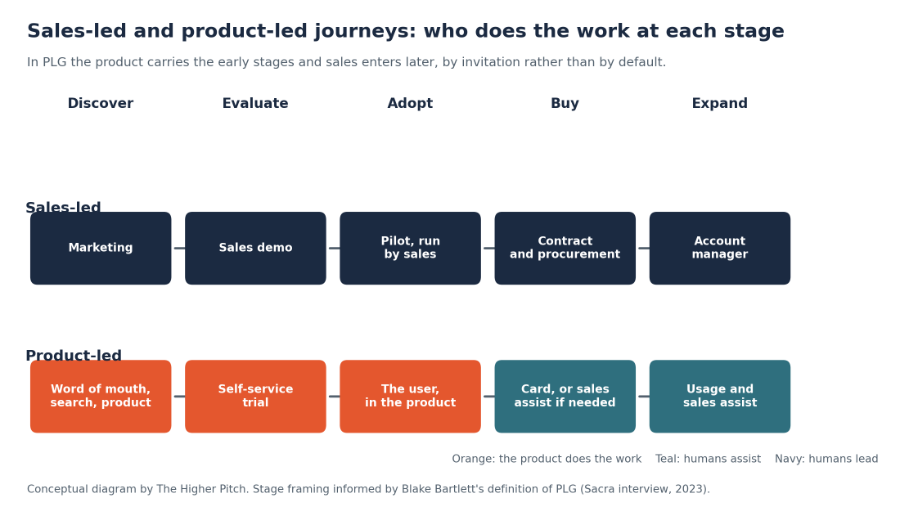
Figure 1: Who does the work at each stage. Conceptual diagram.
Bartlett describes the second half of this well in the same interview. Every user and team reaches what he calls a self-service ceiling: the point beyond which they cannot progress alone, whether because of team rollout, security review, procurement or complexity. The job of sales in PLG is to spot that moment and step in to help the customer continue, rather than to intercept every sign-up as a lead.
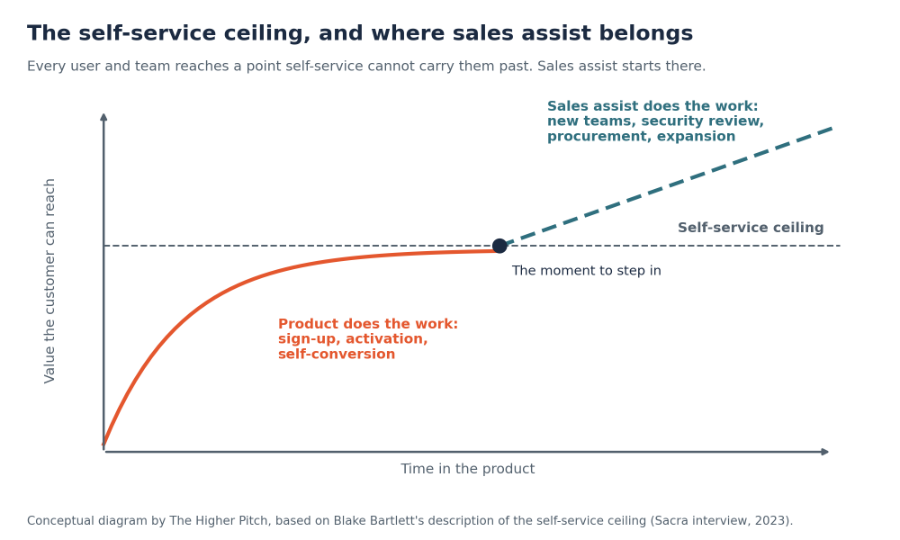
Figure 2: The self-service ceiling, and where sales assist belongs. Conceptual diagram based on Bartlett’s description.
This is why PLG fails so often as a bolt-on. If the product cannot deliver value alone, there is no ceiling to reach, only a trial that ends in a sales call.
Product-Led and Sales-Led Growth Differ in Who Bears the Cost of Explaining
| Dimension | Sales-led growth | Product-led growth |
| Who proves value | A sales rep, in a demo or pilot | The user, inside the product |
| First conversation | Before the product is used | After the user has seen value |
| What scales cost | Headcount | Infrastructure and product investment |
| Qualification signal | Firmographics and engagement with marketing | Behaviour inside the product |
| Where investment goes | Sales and marketing capacity | Product, onboarding and growth engineering |
| Natural deal size | Larger, negotiated | Smaller to start, growing with usage |
Table 1: How the two models differ. The full comparison, including when to use each, is in Product-Led Growth vs Sales-Led Growth.
Atlassian’s SEC filings describe the investment shift plainly. In its FY2024 annual report, the company states that it invests significantly more in research and development than in traditional sales activities relative to other enterprise software companies, and reports research and development expenses of 50% of revenue in FY2024 and 53% in FY2023. Its filing also describes a sales team focused primarily on expanding relationships with existing customers rather than landing new ones, and says the company does not solely rely on a traditional commissioned direct sales force to land customers because its model focuses on self-service, data-driven targeting and automation.
Read that as a cost structure, not a slogan. Product-led companies still spend heavily. They spend it on the product that does the selling.
PLG Fits the Way B2B Buyers Now Prefer to Evaluate, With One Important Caveat
Three shifts make PLG more relevant to B2B than it was a decade ago.
Buyers want to evaluate without being sold to. Gartner reports that 75% of B2B buyers prefer a rep-free sales experience. Its research also describes B2B buying as six jobs that buyers loop through, including validation, where trying the product is often the most direct route to confidence.
Decisions are made before the first conversation. 6sense’s 2025 B2B Buyer Experience Report, based on nearly 4,000 buyers, found that 94% of buyers ranked their shortlist by preference before engaging sellers, and that the winning vendor was already on the Day One shortlist 95% of the time. A product a buyer can try is a way onto that list without waiting for a sales cycle.
Research now starts in AI tools. In G2’s April 2026 research, half of B2B software buyers (51%) said they now begin software research with an AI chatbot more often than with Google. A product with a public, self-service entry point is easier for a buyer to verify quickly once they arrive.
Now the caveat, which comes from the same Gartner research and is rarely quoted alongside the 75% figure: self-service digital purchases are far more likely to result in purchase regret, and Gartner reports that B2B buyers are 1.8 times more likely to complete a high-quality deal when they use supplier-provided digital tools in partnership with a sales rep rather than independently.
That is the strongest available argument against pure self-service in considered B2B purchases. The goal is not to remove humans. It is to make them optional, well-timed and genuinely useful. Our piece on the B2B buyer journey in 2026 covers the buying-side shifts in more depth.
Five Principles Separate Real PLG Strategies From Free Trials
- The product must deliver value before payment. If the valuable part only exists after implementation or configuration by your team, PLG will stall.
- Time to value is the constraint. Bartlett argues that time to value is about reaching the user’s “aha moment”, ideally in the first or second session, and that AI has raised expectations because some products now deliver something impressive within seconds.
- The user is not always the buyer. In B2B, the person who adopts is often not the person who signs. The product must help the user make the internal case.
- Telemetry is infrastructure, not reporting. Bartlett describes great product telemetry as a must-have, warning that without it you are flying blind and that traditional B2B tools cannot simply be force-fitted into PLG.
- Sales assist is part of the product experience. Introduce humans where the ceiling is, and equip them with usage context so the conversation continues the journey rather than restarting it.
Free Trial, Freemium and Self-Service Solve Different Problems
| Model | How it works | Best when | Main risk |
| Free trial | Full or near-full product for a fixed period | Value is obvious quickly and the product is easy to set up | The clock runs out before the user reaches value |
| Freemium | A permanently free tier with limits on usage, seats or features | Usage grows naturally and the free tier creates exposure to new users | The free tier is generous enough that few users ever need to pay |
| Reverse trial | Full features for a period, then a drop to a free tier | You want users to experience premium value before choosing | Users feel downgraded if the change is not communicated well |
| Self-service purchase | Transparent pricing and checkout without a sales conversation | Deal sizes clear procurement thresholds without approval | Larger buyers still need invoicing, security review and contracts |
Table 2: Product-led models compared. Worked examples of each are in 7 Product-Led Growth Examples.
It is worth being honest about the base rates here. Atlassian’s own risk factors state that, historically, a majority of users never convert to a paid version from free trials or limited free versions. That is disclosed by one of the most successful product-led companies in the market. Any PLG business case built on the assumption that most free users will eventually pay is built on the wrong premise. The model works because the cost of serving those users is low and the small converting share compounds, not because conversion rates are high.
Product Experience Is the Go-to-Market Channel
In a sales-led company, a confusing interface costs the sales team extra explaining. In a product-led company, it costs the customer. Every unclear empty state, every unnecessary setup step and every feature that requires a manual becomes a leak in acquisition.
Practically, that puts a few things on the critical path: the first-run experience, the moment of first value, in-product guidance that appears when it is needed, and interfaces that make sense to the specific role using them. THP’s Design & UX Studio works on exactly this territory, and our articles on reducing friction in the user experience, role-based design for B2B dashboards and predictive interfaces go deeper.
Acquisition, Activation, Retention and Expansion Behave Differently in PLG
Acquisition shifts from generating leads to generating sign-ups, and the sources change. Atlassian’s filing describes relying primarily on word of mouth and low-touch demand generation to drive trial, adoption and initial expansion, with the website as the primary forum for sales.
Activation becomes the pivotal stage, because a user who never reaches value cannot be recovered by nurture emails. This is where most PLG programs actually fail, which is why we treat it separately in Product-Led Onboarding.
Retention is measured in usage before it shows up in renewals. A user who stops opening the product has already churned, whatever the contract says.
Expansion is where most product-led revenue eventually comes from: more seats, more usage, more products. Bartlett’s point about big public PLG businesses is relevant here: a user can still sign up and start the journey themselves even though most revenue comes from large enterprise deals.
Companies running loops elsewhere in their business will recognize the structure. A product-led motion is one type of growth loop, and our guide to B2B growth loops covers how to design and measure loops generally.
Every Executive Judges a PLG Investment Differently
PLG is a company-wide decision, not a marketing initiative, so it needs answers for the whole leadership team before it starts.
| Leader | The question they bring | What answers it |
| CEO or founder | Does this change our growth model or just add a sign-up button? | A clear view of which segments will be self-served and which stay sales-led |
| CFO | What does it cost before it pays, and how will we see payback? | Product and infrastructure investment, CAC by motion, payback period, and honest free-to-paid assumptions |
| CRO or sales leader | What happens to my team and my quota? | A defined sales-assist model, PQL criteria and compensation that rewards assisting rather than intercepting |
| Chief product officer | Who owns growth work against the roadmap? | A growth team remit distinct from core product, with its own goals |
| CIO or RevOps lead | Can we capture product usage and act on it? | A telemetry plan, CRM integration and data ownership |
| Security and legal | Can we expose a product publicly without new risk? | Tiering, data handling rules and controls for self-service accounts |
Table 3: The internal buying-committee lens on a PLG investment.
Measure PLG by Activation, Conversion and Expansion, Not Sign-Ups
Sign-up volume is the easiest PLG number to grow and the least informative. The measures that matter are:
- Activation rate: the share of new users who reach a defined first value.
- Time to value: how long that takes.
- Free-to-paid conversion rate: measured by cohort, not in aggregate.
- Product-qualified leads: users whose behaviour indicates readiness to buy. The term was popularized by Tomasz Tunguz in 2013, who defined PQLs as potential customers who have used a product and reached pre-defined triggers signalling a strong likelihood of becoming paying customers.
- Net revenue retention: whether existing customers grow.
- CAC payback period: how long a customer takes to pay back the cost of acquiring them.
The full set, with definitions and cautions about borrowed benchmarks, is in Product-Led Growth Metrics.
Six Mistakes That Stop PLG Working in B2B
- Adding a trial without changing the product. If the product needs configuration by your team to be useful, a trial only exposes that.
- Treating sign-ups as leads. Bartlett identifies this as the biggest failure mode when sales is layered on: viewing self-service as a lead source and abusing it, which creates both a reputational and a user-experience problem. He argues the right model is one continuous journey, not two funnels.
- Optimizing acquisition before activation. More sign-ups into a leaky onboarding flow just increases the number of people who form a negative opinion.
- Building for the buyer instead of the user. In PLG the user adopts first, so the product must serve them before it serves the purchaser.
- Ignoring the enterprise requirements that arrive with success. Security review, SSO, audit logs, invoicing and admin controls are what let a successful team expand into a company-wide account.
- Running PLG without product telemetry. Without usage data, nobody can tell which users are activated, which are stuck and which are ready for a conversation.
AI Changes the Expectation of Time to Value, and the Cost of Assisting
AI affects PLG in two directions.
It raises the bar for the product. Bartlett’s argument is that when a user can sign up and have something that seemed impossible delivered within seconds, “magic” becomes the new standard for time to value, and a product that takes three sessions to reach an aha moment will start to see an activation problem.
It lowers the cost of assisting. Onboarding guidance, in-product answers, usage summaries for sales and routing of PQLs can all be automated. Bartlett expects the sales-assist motion to become increasingly automated, while noting that quality was still a limitation at the time of the interview.
The practical caution is the same as with any automation: it amplifies whatever the product already does. An AI assistant on top of a confusing product produces confident answers about a confusing product. THP’s AI approach, SAID, is built around connecting AI to business outcomes rather than to activity, and our piece on AI agents in the MarTech stack covers the tooling side.
Build a B2B Product-Led Growth Strategy in Eight Steps
- Decide which segment PLG is for. Most B2B companies run a hybrid. Name the segment that will be self-served and the segment that stays sales-led.
- Define the core value a user can reach alone. If there is no such value, fix that before building a sign-up flow.
- Choose the model. Free trial, freemium, reverse trial or self-service purchase, chosen from how your product creates value rather than from what competitors offer.
- Define the activation moment. One observable event that correlates with retention and conversion.
- Rebuild onboarding around that moment. Remove every step that does not serve it.
- Instrument the product. Capture the events you need for activation, PQLs and expansion signals, and route them into the CRM.
- Design the sales-assist model. Define the self-service ceiling, the PQL criteria, what reps see when they pick up an account, and how they are compensated.
- Agree the metrics and the review cadence before launch, including what result would cause you to stop.
The detailed method is in How to Build a Product-Led Growth Strategy From Scratch. Because PLG splits ownership across product, marketing, sales and customer success, our RevOps playbook is a useful companion.
THP Studio Perspective
- Here is the part that rarely appears in PLG content: for a large share of B2B companies, full PLG is the wrong model. If your product needs integration work, if the buyer is a committee that will never touch the software, or if your deals clear six figures, a self-service motion will produce sign-ups and very little revenue. What usually works better is narrower: a self-service entry point for one segment or one product, with sales assist behind it. Less exciting than a PLG transformation, and far more likely to survive the second budget cycle.
Frequently Asked Questions
Key Takeaways
- Treat PLG as a decision about who proves value, not as a free trial or a pricing page change.
- Design for the self-service ceiling: define where the product stops carrying the customer and make sales assist start exactly there.
- Build the business case on realistic conversion, since even Atlassian discloses that most free users never convert.
- Use the hybrid evidence honestly: buyers want rep-free evaluation, but combining digital tools with a rep is associated with higher-quality deals.
- Instrument the product before scaling acquisition, because without usage data nobody can tell an activated user from a stuck one.
Work With THP’s Integrated Marketing & Demand Practice
- THP’s Integrated Marketing & Demand team connects brand, content, campaigns and technology into programs measured by pipeline and revenue, which is the layer a product-led motion needs around it. If you are weighing a self-service motion against your current sales model, that is a useful conversation to have early.
Author